For project managers balancing performance and budget, Q235 steel plate is often the practical choice for structural and fabrication applications. With reliable weldability, stable mechanical properties, and competitive pricing, it helps control material costs without sacrificing basic project requirements. Understanding when Q235 steel plate fits your specification can improve sourcing efficiency and support smoother project delivery.
When does Q235 steel plate make the most sense for a project?
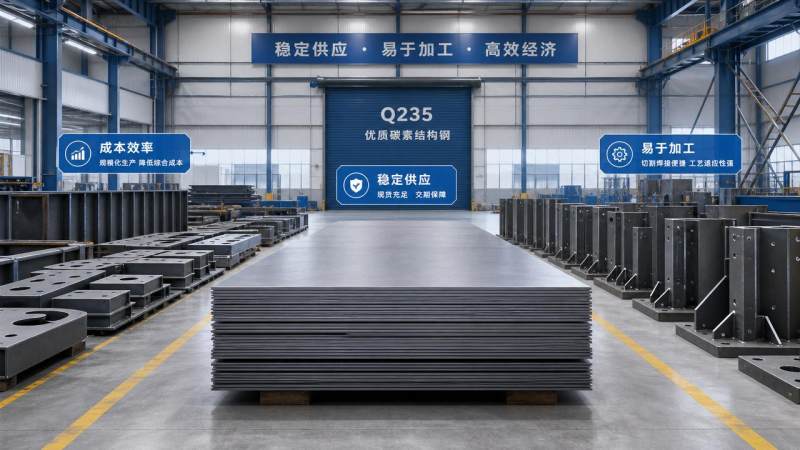
The core search intent behind Q235 steel plate is usually practical, not academic. Project managers want to know whether it is good enough for the job while keeping procurement costs under control.
In most cases, Q235 steel plate is the right cost choice when the project needs dependable structural performance, easy fabrication, and wide availability, but does not require high strength or extreme low-temperature toughness.
That makes it a strong candidate for general steel structures, equipment frames, base plates, supports, covers, brackets, and many welded fabrication parts used in construction and manufacturing.
It is less suitable when your design depends on reduced section weight, elevated yield strength, heavy abrasion resistance, or demanding service conditions such as offshore exposure or severe cold environments.
What project managers care about most when selecting steel plate
For engineering and project leadership teams, steel selection is rarely only about unit price. The real concern is total project value across procurement, fabrication, inspection, schedule, and installation.
That is why the best material decision often comes down to a simple question: will this grade meet design needs without creating hidden cost or execution risk later?
With Q235 steel plate, the main advantages are usually lower upfront material cost, stable supply from many mills, straightforward welding, and less difficulty in routine processing operations.
These factors matter because a cheaper plate that causes fabrication delays, quality issues, or repeated purchasing corrections is not actually the cheaper option from a project perspective.
Project managers also worry about specification mismatch. If a design truly needs a higher-grade material, choosing Q235 only for price can increase structural risk, rework exposure, and approval problems.
Why Q235 steel plate is often the economical baseline grade
Q235 is widely recognized in the Chinese steel system as a general carbon structural steel grade used in many standard fabrication and building applications.
Its value comes from balance. It offers acceptable mechanical performance for many everyday load-bearing and non-complex structural tasks without the premium attached to higher strength steels.
For projects where thickness can be adjusted and member size is not highly constrained, that balance often delivers the lowest practical cost per completed component.
It also supports efficient workshop execution. Cutting, bending, drilling, and welding processes are familiar to most fabricators, which reduces training needs and lowers production uncertainty.
Because Q235 steel plate is commonly available, buyers can often shorten sourcing lead times and reduce dependence on a narrow list of specialty suppliers.
That supply flexibility is especially useful for export projects or multi-phase jobs where replenishment speed can influence installation continuity and contractor coordination.
How to judge whether Q235 matches your actual specification
The best way to evaluate Q235 steel plate is to start with service conditions, not catalog descriptions. Ask what the plate must actually do in the finished project.
Begin with load requirements. If the design does not depend on high yield strength to reduce weight or section size, Q235 may remain a suitable cost-focused option.
Next, review fabrication demands. If the component will be heavily welded, routinely cut, or formed in standard workshop conditions, Q235 is typically a convenient and predictable material.
Then examine the operating environment. For indoor structures or normal atmospheric exposure with proper coating systems, Q235 usually performs well as a substrate.
Also check approval requirements. If the owner, consultant, or local code references equivalent international grades, confirm mechanical properties, chemistry, and certification before purchase.
Finally, compare the cost of using thicker Q235 sections against the cost of specifying a stronger grade. In many projects, slightly larger sections still cost less overall.
Typical use cases where Q235 steel plate is the right cost choice
Q235 steel plate is often the right choice for workshop-fabricated structural parts where moderate strength is enough and the project team wants dependable processing performance.
Examples include base plates for ordinary supports, connection plates, machine housings, frames, welded brackets, equipment skids, staircase components, and enclosure structures.
It is also practical for secondary steelwork in industrial buildings, agricultural facilities, warehouse systems, and general-purpose fabricated assemblies that are not highly weight sensitive.
For many OEM buyers, Q235 works well when the final product needs consistency, reasonable cost, and easy fabrication rather than advanced material performance.
In these situations, the cost benefit is not only the steel price itself. It also comes from reduced manufacturing complexity, easier sourcing substitutions, and fewer production disruptions.
When choosing Q235 can become a false economy
Although Q235 steel plate is economical, there are clear cases where it should not be selected just because it is cheaper at quotation stage.
If your design must minimize dead load, span longer distances, or control section dimensions tightly, a higher-strength plate may reduce total steel tonnage and offset its higher unit price.
The same applies to applications with stricter toughness requirements, dynamic loading, severe wear, or highly corrosive service where additional material properties are essential.
Q235 can also be a poor choice if the project specification is locked to ASTM, EN, or JIS grades with approval pathways that do not accept simple substitution.
Another hidden risk is overdesign through thickness compensation. If you must add too much material to make Q235 work, transport, handling, welding volume, and installation effort all increase.
In that case, the apparent savings on steel price may disappear when fabrication labor and project logistics are fully considered.
Cost should be measured beyond price per ton
Experienced project managers know that the cheapest steel plate is not always the lowest-cost delivered solution. Material decisions should be measured across the full project chain.
Start with direct purchase price, but continue into yield loss during cutting, welding consumables, processing speed, inspection rates, coating performance, and schedule reliability.
Q235 often performs well in this broader comparison because it is familiar to fabricators and usually available in common thickness ranges from multiple supply channels.
Its processing predictability can help stabilize production planning, which matters when late material changes would disrupt workshop sequencing or shipment commitments.
If the project uses coated or formed accessories alongside plate components, sourcing strategy also matters. For corrosion-sensitive applications, materials such as Gi Coil may complement plate-based assemblies.
That product category, typically offered in grades such as DX51D+Z or SGCC with zinc coatings, is useful where moderate corrosion protection and longer service life are needed for lighter formed parts.
How Q235 supports fabrication efficiency and schedule control
Schedule pressure is one of the strongest reasons buyers stay with Q235 steel plate when performance requirements allow it. Familiar materials reduce avoidable execution friction.
Most fabricators understand how to process Q235 efficiently. That means fewer shop-floor adjustments, smoother welding procedures, and less uncertainty in routine dimensional control.
Because the grade is common, replacement material is also easier to source if design revisions or quantity increases happen after production has already started.
This flexibility can be valuable on phased construction projects where unforeseen field changes often create urgent replenishment needs.
From a management viewpoint, a stable and widely used plate grade helps reduce procurement bottlenecks and supports more confident lead-time planning across suppliers.
What to confirm with suppliers before placing an order
Even when Q235 steel plate is the right commercial choice, supplier control remains critical. Buyers should verify more than just size, tonnage, and quoted price.
Request clear information on chemical composition, mechanical properties, heat number traceability, dimensional tolerances, surface condition, and available inspection documentation.
If the material will be exported or used in a project governed by foreign standards, discuss equivalency carefully instead of assuming automatic substitution acceptance.
You should also confirm thickness availability, rolling source, lead time, packaging method, and whether the supplier can support custom cutting or fabricated components if required.
For project managers handling multiple steel categories, it is useful to work with manufacturers that can coordinate structural items, formed sections, and coated products under one planning window.
This approach can reduce communication gaps and improve schedule reliability, especially for overseas procurement where shipment timing affects site execution directly.
A simple decision framework for project teams
If you are deciding whether Q235 steel plate is the right cost choice, use a practical filter rather than relying on habit or the lowest quote.
Choose Q235 when strength demands are moderate, fabrication is conventional, environmental exposure is manageable with proper protection, and supply reliability matters as much as price.
Be more cautious when structural optimization, low-temperature service, strict code alignment, or aggressive operating conditions are central to project success.
Then compare not only cost per ton, but total cost per approved, fabricated, delivered, and installed component. That is where the real savings become visible.
When this evaluation is done honestly, Q235 often proves to be the sensible middle ground between engineering adequacy and commercial efficiency.
Conclusion: use Q235 where it creates value, not just where it looks cheap
Q235 steel plate is the right cost choice when the application calls for reliable general-purpose structural performance, easy fabrication, and efficient sourcing without premium-grade requirements.
For project managers, its real value lies in combining acceptable performance with controllable procurement cost, predictable workshop handling, and broad market availability.
But the key is fit. If the project needs higher strength, tighter weight control, or special service properties, a low initial price should not drive the final decision.
The most effective procurement strategy is to match steel grade to actual project demand, then evaluate cost across the whole delivery process rather than by quotation alone.
When used in the right scenario, Q235 steel plate can help reduce risk, support smoother production, and keep budgets aligned with real construction and manufacturing priorities.
Please give us a message


Please enter what you want to find