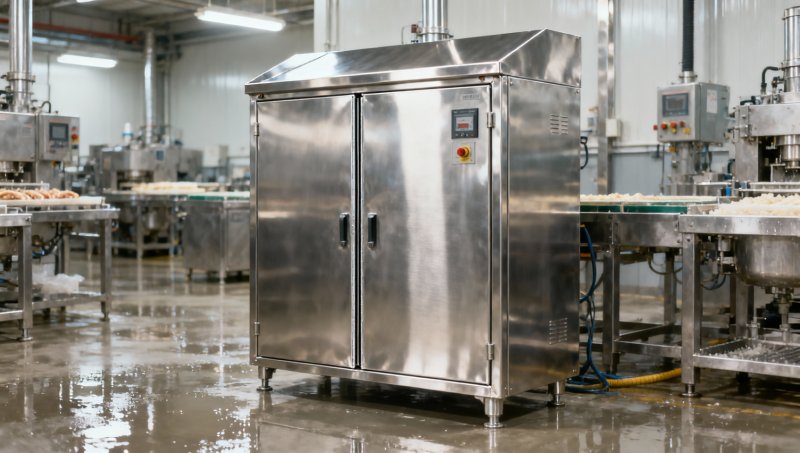
304 stainless steel sheet is the right choice for a fabricated enclosure when the enclosure must resist ordinary atmospheric corrosion, frequent washdown, humidity, food-processing residues, or indoor industrial contaminants without depending on a paint system for protection. It is especially well suited to cabinets, machine guards, control housings, instrument boxes, access panels, and architectural equipment covers where a durable metallic finish, cleanability, and long service life justify a higher initial material cost.
The decision becomes less straightforward when chlorides, coastal salt spray, aggressive cleaning chemicals, high temperatures, or severe crevice conditions are involved. In those cases, specifying 304 simply because it is “stainless” can shift corrosion risk downstream into fabrication, installation, and maintenance. The practical question is not whether 304 stainless steel sheet resists corrosion in general; it is whether the completed enclosure, including welds, seams, fasteners, drainage details, and surface finish, will remain suitable in its actual service environment.
Where 304 performs well in fabricated enclosures
Grade 304 is an austenitic stainless steel commonly selected for its balanced combination of corrosion resistance, formability, weldability, and availability. Its chromium content forms a passive oxide layer that protects the surface in many normal service conditions. Nickel supports its austenitic structure and helps make the material suitable for bending, drawing, and other common sheet-metal operations.
For enclosure projects, this translates into a dependable option in environments such as:
- Indoor manufacturing areas with moisture, dust, and occasional non-chloride cleaning;
- Commercial kitchens, food handling spaces, and equipment rooms where surfaces need regular cleaning;
- Laboratories, pharmaceutical support areas, and utility rooms with controlled chemical exposure;
- Electrical or automation enclosures located in sheltered industrial settings;
- Architectural panels, service cabinets, and exterior equipment covers away from heavy marine exposure;
- Machine housings where appearance must remain stable despite handling, abrasion, and repeated maintenance access.
In these settings, 304 often provides a more robust lifecycle solution than painted carbon steel. A scratch through a paint coating exposes the underlying steel and creates a localized maintenance concern. A properly finished stainless surface does not depend on a separate organic coating to retain its basic corrosion resistance. That distinction matters where the enclosure will be opened frequently, bumped by tools, cleaned repeatedly, or installed in locations where repainting would interrupt operations.
304 is also appropriate when appearance is part of the functional requirement. Brushed, satin, polished, or patterned finishes can reduce the visual impact of fingerprints, light scratches, and routine handling. However, finish selection should not be treated as purely decorative. A smoother, more cleanable surface can reduce residue retention and lower the chance that contaminants remain trapped on the enclosure for extended periods.
The environment matters more than the word “stainless”
The main selection error is treating all wet or outdoor locations as equivalent. An enclosure installed inside a humidity-controlled facility faces a very different corrosion mechanism from one mounted beside a seawater intake, a swimming pool plant room, a road exposed to de-icing salts, or a chemical dosing area.
304 does not contain molybdenum, the alloying element that gives 316 stainless steel stronger resistance to chloride-related pitting and crevice corrosion. Chlorides can come from sea air, salt-laden dust, cleaning products, process water, bleach solutions, and some water-treatment chemicals. They become more problematic when deposits remain wet, oxygen is limited, and the enclosure includes lap joints, gasket channels, unsealed seams, or poorly drained horizontal surfaces.
A sheltered coastal installation is not automatically unsuitable for 304, but it requires a more careful exposure assessment than an inland installation. Distance from the shoreline alone is not enough. Wind direction, salt deposition, rain washing, enclosure orientation, temperature, and cleaning access all influence actual performance. If salt deposits can accumulate but rain cannot rinse them away, a nominally sheltered position may be more demanding than an exposed surface that is regularly washed clean.
The same principle applies to industrial locations. Sulfur-bearing atmospheres, acidic vapors, or chemical splashes may require a material review based on the specific process chemicals and concentrations. Material selection should be coordinated with the project’s chemical compatibility information rather than inferred from the general label “industrial environment.”
When 304 is a better choice than coated steel—and when it is not
Painted galvanized steel, including pre-painted galvanized sheet, remains a rational enclosure material where the environment is moderate, color is important, and the project benefits from lower initial cost. For appliance housings, building-service cabinets, indoor utility panels, and non-aggressive architectural applications, a properly specified coating system can provide an effective protective barrier.
For projects where the enclosure is not expected to face repeated abrasion, harsh washdown, or exposed cut edges, coated products such as PPGI Steel Sheet may be evaluated as a lower-cost alternative. Its suitability depends on the substrate, paint type, coating thickness, formed-edge treatment, and the likelihood of damage during transport, fabrication, and service. The key limitation is that coating performance is system-dependent: bending, punching, welding, and field modifications can create areas that need separate protection.
304 becomes more compelling when coating damage would be difficult to inspect or repair, when hygiene requires frequent cleaning, or when the enclosure must retain a metallic surface without recurring repainting. It can also simplify decisions around color fading and coating compatibility with cleaning products. That does not mean 304 always has the lowest project cost. It means its higher material cost can be justified where reduced maintenance exposure, improved cleanability, and longer visual durability are genuine project requirements.
Aluminum may be another alternative where low weight is critical, but it has different stiffness, joining, galvanic compatibility, and dent-resistance characteristics. Carbon steel with a high-performance coating may be preferable for large external enclosures where structural stiffness and controlled coating systems offer the desired balance. The enclosure should therefore be selected as a complete fabricated assembly, not as a sheet-price comparison.
Choose 316 instead when chloride risk is real
Where chlorides are persistent or consequences of corrosion are high, 316 stainless steel is usually the more conservative specification. Typical triggers for reviewing 316 include direct coastal exposure, saltwater-related infrastructure, chloride-based washdown, wastewater treatment zones, pool environments, and locations where chloride-bearing deposits can remain trapped in joints.
The price difference between 304 and 316 should be assessed against the cost of replacement, access, shutdown, recertification, and reputational risk if a visible enclosure develops staining or pitting earlier than expected. For a small removable panel, 304 may remain an acceptable managed risk. For an integrated electrical cabinet on a difficult-to-access rooftop or process line, a higher alloy grade may be economically preferable even if its initial sheet cost is higher.
There is no universal rule that all outdoor enclosures need 316. Rain exposure can be beneficial where it removes deposits, while a warm, salt-laden, unwashed recess can be highly corrosive. The specification should identify the exposure condition rather than relying on broad labels such as “outdoor” or “corrosion resistant.”
Fabrication details can determine whether the material succeeds
An enclosure made from 304 stainless steel sheet can fail prematurely through poor fabrication even when the base material grade is appropriate. The most important risks arise at welds, cut edges, crevices, contaminated surfaces, and interfaces with dissimilar metals.
Welding and post-weld cleaning: Heat tint produced during welding has lower corrosion resistance than properly restored stainless surfaces. For demanding environments, weld discoloration should be removed through an appropriate controlled cleaning and passivation process. The exact method should be selected with due regard to safety, environmental controls, surface finish, and project requirements. Welding consumables should be compatible with the joint design and corrosion conditions. Where low-carbon material is required to reduce sensitization concerns in welded construction, 304L may be specified instead of standard 304.
Crevice control: A flat sheet can perform well while a fabricated enclosure develops corrosion at gasket overlaps, folded hems, unsealed seams, nameplate interfaces, or fastener pockets. Avoiding stagnant water is often more valuable than increasing sheet thickness. Sloped tops, drainage paths, sealed joints where appropriate, and accessible cleaning surfaces all reduce the risk of moisture and contaminants remaining in contact with the steel.
Surface contamination: Carbon steel particles transferred from grinding tools, work tables, lifting equipment, or shared fabrication areas can rust on a stainless surface. This is often mistaken for failure of the stainless itself. Segregated tooling, clean handling, and suitable protective film management are basic quality controls for visible or corrosion-sensitive enclosures.
Dissimilar-metal contact: Stainless steel connected to carbon steel, aluminum, galvanized steel, or copper-containing components can create galvanic corrosion concerns when an electrolyte is present. The risk depends on the metals involved, contact geometry, exposed area ratio, and whether moisture bridges the materials. Isolation washers, compatible fasteners, non-conductive barriers, and controlled drainage should be considered during the enclosure design rather than added after installation.
Thickness should follow stiffness and fabrication needs, not corrosion assumptions
Increasing sheet thickness does not materially transform 304’s resistance to a chloride environment. Thickness is primarily a structural and fabrication decision. It affects panel deflection, hinge support, door alignment, vibration response, resistance to denting, thread engagement, weld distortion, and the ability to maintain dimensional tolerances.
Large doors and removable covers may require return flanges, ribs, hat sections, internal frames, or formed stiffeners rather than simply heavier sheet. This can reduce weight while delivering better rigidity. For electrical enclosures, the design should also account for mounting loads, cable-entry locations, gland plates, internal equipment weight, and any grounding or bonding requirements established by the applicable project specification.
Thin 304 sheet has excellent forming potential, but it also work-hardens. Tight bends, repeated rework, and complex drawn features should be reviewed against the selected temper, bend radius, tooling condition, and finish requirements. A low-cost sheet selection can lose its advantage if cracking, springback, distorted doors, or excessive finishing work occurs during fabrication.
Do not confuse material grade with enclosure compliance
Specifying 304 is not equivalent to specifying an enclosure’s ingress-protection performance, electrical safety, fire performance, hygienic design, or structural adequacy. Ratings such as IP or NEMA, where applicable to the project, depend on the completed assembly: door geometry, gaskets, latches, penetrations, hinges, cable entries, weld continuity, mounting orientation, and verification method.
Material documents should identify the relevant product standard, grade, dimensions, surface finish, and traceability expectations. For sheet and plate used in many international supply chains, ASTM A240/A240M is frequently referenced for chromium and chromium-nickel stainless steel plate, sheet, and strip for pressure vessels and general applications, but project documents may instead require EN, JIS, GB, or other standards. The designation alone is not sufficient when mechanical properties, finish, flatness, or certification format are important to fabrication.
For visible installations, acceptance criteria should also address finish direction, protective-film removal, allowable scratches, weld appearance, and variation between panels. These details are often omitted from material descriptions and then become disputed late in the project.
A practical decision point before release
304 is a sound specification when the enclosure requires durable corrosion resistance in normal atmospheric, humid, cleanable, or moderately industrial conditions; when long-term appearance matters; and when fabrication can control weld treatment, contamination, drainage, and joint design. It is particularly valuable where painted surfaces would be vulnerable to recurring damage or difficult maintenance.
It is not the default answer for salt exposure, chlorine-containing cleaning regimes, continuously wet crevices, or chemically aggressive process areas. In those conditions, 316, a different alloy family, a coated system designed for the environment, or a revised enclosure design may provide a more reliable outcome.
The most defensible specification states the service environment, expected cleaning regime, surface finish, fabrication requirements, and acceptance conditions alongside the grade. That approach prevents a common project problem: selecting the correct alloy on paper but delivering an enclosure whose joints, welds, finish, and installation details cannot achieve the intended service life.
Please give us a message


Please enter what you want to find