For business decision-makers evaluating long-term material performance, duplex steel pipe can justify its higher upfront cost through greater strength, corrosion resistance, and reduced maintenance over time. In demanding industrial and structural applications, choosing the right steel solution is not only about purchase price, but also about lifecycle value, operational reliability, and project risk control.
That question becomes especially important when projects involve corrosive media, variable temperatures, offshore exposure, chlorides, or high mechanical loads. In these cases, a lower initial material price can quickly be offset by shutdowns, weld repairs, coating failures, and early replacement cycles.
For procurement leaders, engineering managers, and project owners, the decision is rarely about steel price alone. It is about whether a pipe system can deliver 10, 15, or 25 years of predictable service while controlling inspection frequency, maintenance budgets, and supply chain risk.
Where Duplex Steel Pipe Creates Real Economic Value
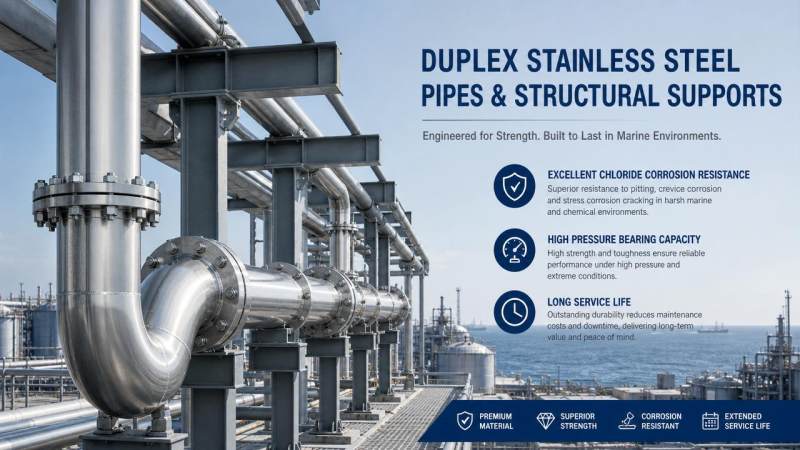
A duplex steel pipe combines austenitic and ferritic microstructures, giving it a useful balance of strength and corrosion resistance. In many industrial environments, this combination allows thinner wall design, longer service life, and lower total ownership cost than conventional carbon steel or some standard stainless grades.
The higher upfront cost is usually most defensible in 4 situations: chloride-rich service, high-pressure lines, weight-sensitive structures, and systems where unplanned downtime costs more than the material itself. For plant operators, even a 24-hour stoppage can outweigh the price difference of upgraded piping.
Why initial price can be misleading
A purchase comparison based only on per-ton or per-meter pricing often ignores fabrication, support design, corrosion allowance, coating systems, and maintenance intervals. Duplex steel pipe may cost more at order stage, but its higher yield strength can reduce material mass and sometimes lower supporting steel, handling, and installation loads.
In practical terms, if a project can reduce wall thickness by one grade step while maintaining mechanical performance, the effective cost gap narrows. In aggressive service, avoiding 2 to 3 major maintenance interventions over a 10-year period can significantly improve lifecycle economics.
Typical decision triggers
- Process media containing chlorides, brine, or seawater splash exposure
- Design pressure and load conditions that benefit from higher strength-to-weight ratio
- Projects targeting 15–25 years of service life with fewer shutdowns
- Remote sites where maintenance labor and replacement logistics are expensive
The table below shows where a duplex steel pipe is typically easier to justify from a business standpoint rather than only a metallurgical standpoint.
The key takeaway is that duplex steel pipe becomes financially attractive when failure consequences are high. If downtime, leakage, corrosion damage, or site access costs are substantial, the value case strengthens quickly.
Comparing cost over the full service cycle
A useful procurement framework is to compare 5 cost layers: material purchase, fabrication, transport and installation, inspection and maintenance, and replacement or failure cost. This approach is more reliable than comparing only the initial quotation line.
For example, carbon steel may require coating, corrosion allowance, and more frequent inspection intervals such as every 6–12 months in aggressive environments. Duplex solutions may support longer intervals depending on service conditions and internal corrosion exposure, reducing labor and outage planning pressure.
How to Decide Whether the Upgrade Is Justified
A sound decision should combine technical suitability, fabrication capability, project schedule, and sourcing stability. Not every project needs duplex. However, projects that score high in corrosion severity, design life, and failure consequence often benefit from moving beyond a lowest-bid material strategy.
Four evaluation criteria for buyers and project teams
- Service environment: chloride level, humidity, splash zone, chemical composition, and temperature range
- Mechanical demand: pressure class, load-bearing requirement, vibration, and fatigue sensitivity
- Lifecycle target: expected service period of 10, 15, or 20+ years
- Operational consequence: repair access, shutdown cost, and safety exposure if leakage occurs
If at least 3 of these 4 criteria point toward elevated risk, duplex steel pipe deserves detailed evaluation. This is particularly true for process lines, desalination-related systems, offshore structures, and industrial plants operating under variable thermal or corrosive conditions.
When standard structural supply experience still matters
Even when a project uses corrosion-resistant pipe, the surrounding steel package also affects total cost and execution efficiency. Pipe racks, support frames, equipment bases, and load-bearing members must align with project standards, dimensional tolerances, and fabrication schedules.
That is why many buyers prefer suppliers that understand the wider steel package, not only a single item. Hongteng Fengda, as a structural steel manufacturer and exporter from China, supports global construction and industrial buyers with angle steel, channel steel, beams, cold formed profiles, and customized structural components produced to ASTM, EN, JIS, and GB requirements.
In projects where weight reduction and load-bearing performance are both critical, it can also be practical to coordinate piping-related steelwork with materials such as Hrc Coil. This product range includes grades such as Q195, Q235, Q345, SPHC, SPHD, and SM490, with thickness from 0.12–12mm and width from 100–2000mm, supporting fabrication flexibility for industrial applications demanding high load-bearing capacity and structural lightweighting.
For decision-makers, the value is not that these products replace duplex steel pipe, but that coordinated steel sourcing can reduce interface risk across the package. With tolerance control such as thickness ±0.02mm and width ±2mm, well-managed upstream material supply helps maintain fabrication consistency and lead-time reliability.
The next table offers a practical procurement view for material selection under different project priorities.
This matrix helps separate projects that need premium corrosion performance from those where a lower-cost steel system is still reasonable. The goal is disciplined material matching, not over-specification.
Common mistakes that weaken the investment case
One common mistake is upgrading the pipe material while underestimating fabrication quality. Welding procedure control, heat input management, and post-fabrication inspection remain essential. A premium alloy cannot compensate for poor execution.
A second mistake is using duplex steel pipe in only a small section without reviewing connected components. If adjoining flanges, supports, or structural attachments become the weak point, the system may still face premature maintenance issues.
A third mistake is evaluating suppliers only on unit price. For B2B buyers, 3 factors often matter just as much: standard compliance, dimensional consistency, and dependable lead times. Delays of even 2–4 weeks can affect installation windows, labor allocation, and contractual milestones.
Procurement, Risk Control, and Supplier Selection
When the project case supports duplex steel pipe, procurement discipline becomes the next priority. Buyers should define technical requirements clearly and verify how the selected supplier manages production control, inspection documentation, export coordination, and dimensional consistency.
Five checkpoints before issuing a purchase order
- Confirm applicable standards, specification level, and required testing documents
- Review dimensional tolerances, wall thickness range, and end preparation details
- Assess welding and fabrication compatibility with the project execution plan
- Check realistic delivery cycle, production capacity, and export packing method
- Align the pipe order with related structural steel items to reduce schedule fragmentation
In international sourcing, the ability to coordinate multiple steel categories can reduce hidden costs. Many projects involve not only pipe, but also steel beams, channels, brackets, support frames, and custom fabricated members. Managing these through fewer qualified supply interfaces can improve schedule visibility.
Why supplier breadth matters in industrial steel packages
Hongteng Fengda serves buyers across North America, Europe, the Middle East, and Southeast Asia with stable structural steel supply and customized solutions. For project teams, this means broader support on standardized sections and OEM-based fabrication while keeping quality control aligned with major international standards.
This broader capability is valuable when duplex steel pipe is only one part of a larger procurement package. Reliable lead times, standard compliance, and consistent manufacturing control help reduce sourcing risk, especially when project delivery depends on multiple steel components arriving in sequence.
A practical rule for investment decisions
If the additional material spend is small compared with the cost of one major maintenance event, one shutdown, or one replacement cycle, duplex steel pipe is often a rational upgrade. This is particularly true when the target service life exceeds 10 years or where access and downtime costs are difficult to absorb.
By contrast, if the system operates in a mild environment, has low failure consequence, and is easily replaceable within a short cycle, a lower-cost material can still make financial sense. The best decision is project-specific and should be grounded in full lifecycle evaluation rather than headline price.
For enterprise buyers, the real question is not whether duplex steel pipe costs more on day one. It is whether the higher upfront cost reduces total risk over years of operation. In corrosive, high-load, or maintenance-sensitive environments, the answer is often yes.
If you are planning an industrial or structural steel package and need support on material matching, fabrication coordination, or export-ready supply, Hongteng Fengda can help you evaluate the right balance of cost, performance, and delivery reliability. Contact us now to discuss your specifications, request a customized solution, or learn more about integrated steel supply for your next project.
Please give us a message


Please enter what you want to find