For project managers balancing heat resistance, corrosion performance, and lifecycle cost, choosing the right stainless steel grade is critical. While 304 is widely used, 321 stainless steel pipe can deliver clear advantages in high-temperature and welded applications where long-term stability matters. Understanding when 321 becomes the better option helps reduce maintenance risk, improve reliability, and support more efficient project decisions.
In steel-intensive projects, the decision is rarely about material price alone. It is about service temperature, weld condition, inspection intervals, shutdown cost, and the practical consequences of premature corrosion or sensitization. For managers responsible for industrial lines, plant upgrades, ducting systems, exhaust networks, and thermal process equipment, knowing when 321 stainless steel pipe outperforms 304 can prevent costly specification mistakes.
This guide explains the technical differences, the most suitable operating environments, key procurement checkpoints, and how to align the material choice with project risk, fabrication requirements, and delivery planning.
Understanding the Real Difference Between 321 and 304 Stainless Steel Pipe
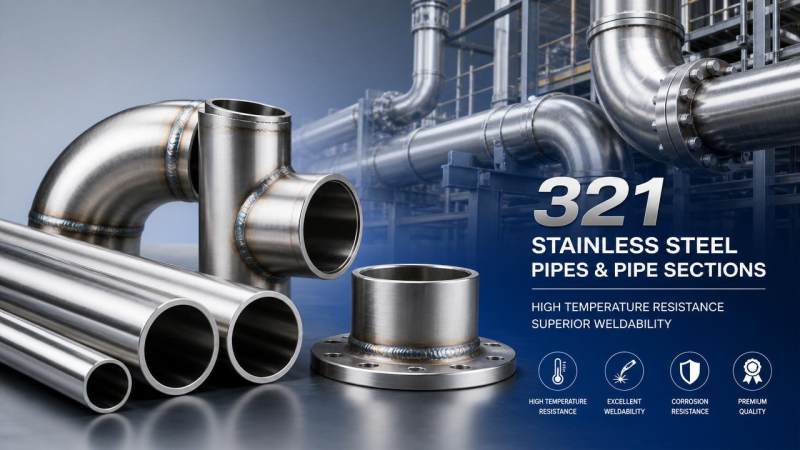
At first glance, 321 and 304 are both austenitic stainless steels with strong corrosion resistance and good formability. In many ordinary indoor or low-heat environments, 304 remains the default selection because it is widely available, easy to fabricate, and often more economical at the initial purchase stage.
The advantage of 321 stainless steel pipe comes from titanium stabilization. This addition helps reduce chromium carbide precipitation during exposure to elevated temperatures, especially in the range of approximately 427°C to 816°C. That temperature window matters because it is also where welded 304 components may become vulnerable to intergranular corrosion if the process conditions are demanding and the service cycle is long.
Why stabilization matters in project applications
For project teams, the issue is not only whether a pipe can survive day 1, but whether it can maintain performance over 3, 5, or 10 years with predictable maintenance. In heat-affected zones near welds, 321 stainless steel pipe can retain better corrosion resistance after fabrication, reducing the likelihood of early degradation in systems that cycle between ambient and high operating temperatures.
This is particularly relevant in fabricated spools, manifolds, expansion sections, stack liners, and thermal transfer lines where repeated exposure, shutdowns, and startup heating put extra stress on the material.
Basic performance comparison
The following comparison helps clarify where each grade generally fits in practical engineering decisions.
The key takeaway is simple: if the project does not involve prolonged high heat, significant welding, or sensitization risk, 304 may be enough. If those conditions are present, 321 stainless steel pipe often becomes the safer engineering choice despite a higher upfront cost.
A common decision mistake
One frequent error is specifying 304 based on room-temperature corrosion performance alone. In actual operation, a line that sees 500°C exhaust flow, cyclic heating 2 to 4 times per day, and multiple field welds behaves very differently from a static indoor tube installation. That gap between specification and service condition is where failures start.
When 321 Stainless Steel Pipe Clearly Outperforms 304
The best way to judge material fit is to map the grade against actual operating conditions. 321 stainless steel pipe delivers its strongest value in environments that combine heat, welding, and long service expectations.
1. High-temperature exhaust and process systems
If the system regularly operates above 427°C, and especially when exposure extends into the 500°C to 800°C range, 321 becomes more attractive. Typical examples include flue gas lines, furnace tubing, heat exchanger headers, thermal oxidizer ducting, and engine exhaust components in industrial settings.
In such projects, material stability matters more than minimum purchase price. A shutdown for replacing failed piping can cost far more than the difference between two stainless grades across a 50-meter or 200-meter line.
2. Welded systems with limited post-weld heat treatment options
Many project sites do not have the time, equipment, or budget for complex post-weld treatment. When a piping network includes dozens of joints, branch connections, reducers, and supports, 321 stainless steel pipe helps lower the risk associated with weld heat-affected zones. This is useful in modular fabrication and field assembly schedules where installation windows may be limited to 7 to 14 days.
3. Cyclic thermal service
Projects with repeated startup and shutdown cycles should not be assessed only by peak temperature. Thermal fatigue, expansion movement, and repeated exposure can accelerate weakness in less suitable grades. For lines that heat and cool several times each week, 321 may support better long-term reliability, especially when combined with proper expansion design and qualified welding procedures.
Typical decision scenarios
The table below translates technical theory into project-oriented selection logic.
For project managers, the practical threshold is not whether 321 is “better” in a general sense. It is whether the service profile includes enough heat and welding risk to justify a more durable specification. In many thermal systems, that answer is yes.
How to Evaluate Lifecycle Cost Instead of Unit Price Alone
Material selection decisions often stall because procurement teams focus on immediate tonnage cost while operations teams focus on long-term serviceability. A better method is to review the full lifecycle impact across at least 4 categories: material cost, fabrication impact, maintenance frequency, and downtime exposure.
Cost comparison should include these 4 items
- Initial pipe and fitting price difference by size, schedule, and quantity
- Welding complexity and inspection requirements across shop and field joints
- Expected maintenance interval over 3 to 8 years of operation
- Potential shutdown cost if replacement is needed earlier than planned
In a project with 100 to 300 welded joints, even one unplanned repair campaign can absorb the entire upfront savings gained by choosing 304. This is why 321 stainless steel pipe is often selected in plants where access is difficult, thermal insulation removal is expensive, or production interruption carries significant financial impact.
A procurement reminder for mixed-material projects
Not every project is built around stainless pipe alone. Structural frames, pipe racks, support systems, and enclosure members often involve carbon steel products alongside stainless process lines. In these mixed packages, sourcing coordination can affect schedule performance as much as material choice itself.
For example, projects that require supporting steel members for industrial structures may also specify Cold Rolled Steel Coil for construction and steel structures, with common dimensions such as thickness from 0.1mm to 300mm, width from 0.6m to 3m, and length from 4m to 12m or as required. Grades like Q355, Q345B, Q420, or Q690 are often selected based on load demand, fabrication route, and target structural self-weight.
For project managers handling both process materials and structural steel packages, suppliers with stable production, standard compliance such as ASTM, EN, JIS, and GB, and reliable export execution can help reduce interface risk between disciplines.
Where B2B sourcing discipline matters
Hongteng Fengda, as a structural steel manufacturer and exporter from China, supports global construction, industrial, and manufacturing projects with angle steel, channel steel, steel beams, cold formed steel profiles, and customized structural steel components. For buyers managing multi-category procurement, stable capacity, OEM support, and compliance with major international standards can reduce delays caused by fragmented sourcing.
Key Technical Checks Before You Specify 321 Stainless Steel Pipe
Choosing 321 is not enough by itself. The specification must also be complete. Project managers should verify at least 6 items before RFQ release or final approval to avoid mismatched quotations and fabrication issues.
Six specification checkpoints
- Service temperature range, including normal and upset conditions
- Pipe size, wall thickness, and pressure requirement
- Welded or seamless requirement by section of the line
- Applicable standard such as ASTM, EN, or JIS
- Surface finish, pickling, passivation, and testing scope
- Inspection documents, MTC needs, and delivery schedule
A vague specification can erase the benefit of choosing the right grade. If the bid package does not define testing, dimensions, and fabrication conditions, price comparisons will be inconsistent and project risk will move downstream to installation.
Checklist for RFQ and supplier review
Use the following matrix to make supplier evaluation more objective.
This approach helps project managers compare offers on technical completeness, not only on price per meter or price per ton. That is especially important when sourcing across international markets where quote assumptions may differ.
Common Misunderstandings and Practical Selection Advice
Mistake 1: Assuming all stainless grades behave the same after welding
They do not. Welding changes the local microstructure and can influence corrosion behavior in service. If the line will be heavily welded and exposed to sustained heat, 321 stainless steel pipe deserves serious consideration early in the design phase rather than after a failure review.
Mistake 2: Treating all high-temperature applications as identical
A dry exhaust line at 650°C is not the same as a humid process line with intermittent condensate and thermal cycling. Project managers should assess at least 3 environmental variables: temperature range, exposure duration, and media composition. The same grade can perform differently under different combinations of these factors.
Mistake 3: Ignoring project logistics
Even when 321 is technically the right choice, delivery timing, documentation quality, and fabrication coordination still decide project success. Global buyers often need stable supply, export packaging suitable for long-distance transport, and clear communication on standards and tolerances. These issues can affect commissioning dates just as much as metallurgical performance.
A practical selection rule
If the system is low-heat, low-risk, and easy to inspect or replace, 304 usually remains the efficient option. If the system is welded, heat-exposed, difficult to access, or costly to shut down, 321 stainless steel pipe often provides the stronger long-term value case.
For project managers, the best material decision is the one that matches actual service conditions, fabrication realities, and lifecycle economics. 321 stainless steel pipe outperforms 304 most clearly in welded high-temperature systems, cyclic thermal environments, and applications where failure would trigger expensive maintenance or operational disruption.
When your project also involves structural steel sourcing, coordinated supply can simplify execution. Hongteng Fengda supports international buyers with structural steel products, customized solutions, and dependable production aligned with ASTM, EN, JIS, and GB requirements. If you are evaluating stainless piping applications or broader steel procurement needs, contact us to get a tailored solution, discuss technical details, and reduce sourcing risk before final specification.
Please give us a message


Please enter what you want to find