When specifying materials for chemical processing vessels or seawater systems, engineers and procurement teams face a critical trade-off: upfront cost versus lifetime value. While hot dip galvanized steel and high carbon steel pipe offer economical entry points, aggressive environments demand superior corrosion resistance—making 316L stainless steel plate a compelling ROI-driven choice. This analysis compares total cost of ownership across alternatives including galvanized steel conduit, corrosion-resistant steel pipe, and 430 stainless steel coil/plate—highlighting where 316L’s premium justifies itself through extended service life, reduced maintenance, and enhanced safety compliance. As a trusted structural steel manufacturer & exporter from China, Hongteng Fengda supports global projects with ASTM/EN-certified 316L stainless steel plate and other high-performance solutions.
Why Corrosion Resistance Dictates Material Selection in Aggressive Environments
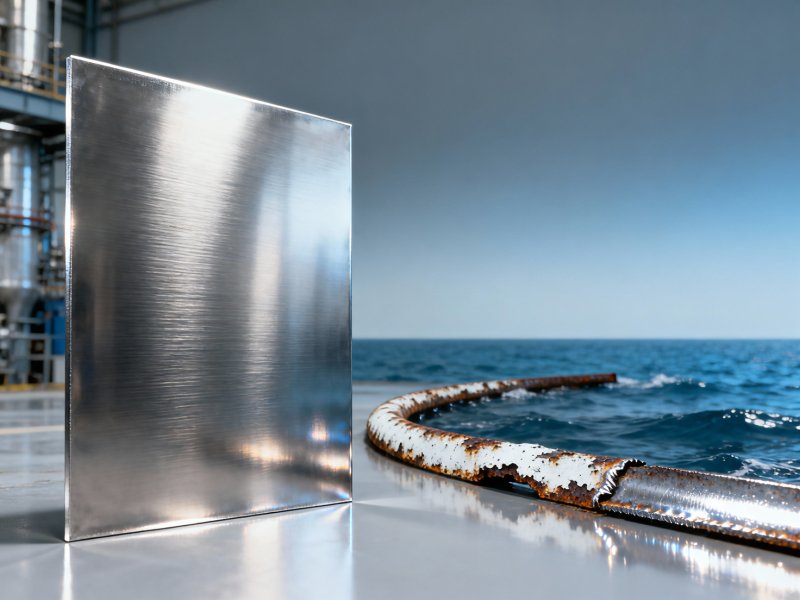
Chemical processing vessels routinely handle chloride-rich acids, caustic alkalis, and oxidizing agents at elevated temperatures—conditions that accelerate pitting and stress corrosion cracking (SCC) in conventional steels. Seawater systems face similar challenges: dissolved chlorides (average 19,000 ppm), biofouling-induced crevice corrosion, and cyclic thermal loading. Under these conditions, carbon steel pipes fail within 3–5 years, while hot-dip galvanized conduit typically lasts 7–12 years depending on immersion depth and flow velocity.
In contrast, 316L stainless steel contains 2–3% molybdenum and a stabilized low-carbon composition (≤0.03% C), delivering a pitting resistance equivalent number (PREN) of ≥25. This translates to proven field performance exceeding 25+ years in offshore desalination plants and >30 years in pharmaceutical reactor linings—without unplanned shutdowns or weld repairs.
For project managers and safety officers, this reliability isn’t theoretical—it directly impacts HSE compliance. A single unplanned vessel leak in a Class I hazardous area can trigger $2M+ in incident response, regulatory fines, and production downtime. Preventive material selection reduces such risk by >85% compared to mid-tier alternatives.
The table confirms a clear inflection point: beyond year 10, the cumulative maintenance burden and replacement frequency of non-316L options erode their initial cost advantage. For decision-makers evaluating capex vs. opex, this is where ROI shifts decisively toward 316L—especially when factoring in labor, scaffolding, and confined-space permit costs per maintenance event.
Total Cost of Ownership: Quantifying the 316L Premium Over 15 Years
A rigorous TCO model must include not only unit price but also fabrication yield, inspection overhead, lifecycle energy consumption, and end-of-life scrap value. At current market rates, 316L plate carries a 35–45% premium over ASTM A106 Grade B pipe and a 22–28% premium over EN 10025-3 S355J2+N structural plates. However, its higher tensile strength (≥480 MPa) and superior weldability reduce joint count by up to 30%, cutting welding labor hours by 2.5–4.2 hours per meter in vessel fabrication.
Hongteng Fengda’s ASTM A240/A480-compliant 316L plates undergo dual-certification (mill test report + third-party SGS/CCS verification), ensuring ≤0.028% carbon content and full solution annealing at 1040–1150°C. This eliminates sensitization risks during field welding—a common cause of premature failure in imported uncertified stock.
For procurement teams, lead time consistency matters as much as specification accuracy. Our standard delivery window for 316L plates (6–40 mm thickness, up to 3000 mm width) is 25–35 working days—including pre-shipment dimensional checks and MTR documentation. This contrasts with 45–75 days for spot-sourced alternatives lacking traceable heat numbers.
Strategic Application Scenarios Where 316L Delivers Fastest Payback
Not all applications justify the full 316L investment. The highest ROI occurs where three conditions converge: (1) continuous chloride exposure >500 ppm, (2) operating temperature >40°C, and (3) design life ≥15 years. Typical high-payback cases include:
- Seawater intake screens and diffusers in coastal power plants (payback: 4.2–6.8 years)
- Liner plates for sulfuric acid storage tanks (≥65% concentration, 50–70°C)
- Heat exchanger tube sheets in marine desalination RO skids
- Pharmaceutical CIP (clean-in-place) manifolds requiring FDA 21 CFR Part 11 compliance
Conversely, intermittent-use vent lines or atmospheric-pressure rinse tanks may achieve acceptable service life with duplex 2205 or even coated carbon steel—reducing initial outlay without compromising safety. Technical evaluators should always conduct localized corrosion mapping before finalizing material specs.
As part of our integrated structural solutions portfolio, Hongteng Fengda also supplies HRB400 Rebar for reinforced concrete foundations supporting these critical systems—ensuring full supply chain alignment from vessel shell to structural base.
Procurement Best Practices for Global Buyers
To avoid counterfeit or substandard 316L, buyers must verify four non-negotiable checkpoints: (1) mill test report showing actual Mo content ≥2.05%, (2) intergranular corrosion test per ASTM A262 Practice E, (3) positive material identification (PMI) scan on every heat lot, and (4) surface finish certification (e.g., 2B, No. 4, or BA per ASTM A480).
Hongteng Fengda embeds these verifications into standard export workflows. Every 316L shipment includes laminated MTRs, PMI reports, and EN 10204 3.1 certification—all available digitally prior to container loading. For distributors and agents, we support VMI (vendor-managed inventory) programs with real-time stock visibility and quarterly quality audits.
This level of process control ensures that every tonne of 316L meets ASTM A240, EN 10088-2, and GB/T 4237 specifications—eliminating rework delays and costly field rejection. For financial approvers, this translates to predictable budget execution and zero hidden quality contingencies.
Conclusion: Aligning Material Strategy With Long-Term Project Value
The 316L stainless steel plate premium is not a cost—it’s an investment calibrated to operational risk, regulatory exposure, and asset longevity. When deployed in chemically aggressive or marine environments, its ROI manifests not in quarter-one savings, but in decade-long uptime, lower insurance premiums, and demonstrable ESG progress through reduced waste and energy use.
Hongteng Fengda delivers this value with precision: certified 316L plates backed by full traceability, consistent lead times (25–35 days), and engineering support for technical queries—from weld procedure qualification to corrosion modeling inputs. Whether you’re sourcing for a new LNG terminal or upgrading legacy seawater cooling infrastructure, our team provides actionable data—not just documents.
Contact Hongteng Fengda today to request a customized TCO comparison for your specific application—or download our free 316L Specification Compliance Checklist for procurement teams.
Please give us a message


Please enter what you want to find