When sourcing custom structural steel, procurement professionals face critical trade-offs: longer lead times, higher costs, or compromises in QA control. At Hongteng Fengda—a China-based structural steel manufacturer and exporter—we balance all three without sacrifice. Our integrated production system, certified to ASTM, EN, JIS, and GB standards, ensures precision-engineered custom structural steel delivered on schedule, competitively priced, and backed by rigorous in-process and final inspection. Discover how global buyers reduce sourcing risk while maintaining quality and timeline integrity.
Why a Checklist Approach Is Essential for Custom Structural Steel Procurement
Procurement teams evaluating custom structural steel rarely face binary choices—they navigate intersecting constraints across time, budget, and compliance. Unlike off-the-shelf sections, custom orders demand early alignment on dimensional tolerances, material traceability, process validation, and delivery sequencing. A checklist-driven approach prevents reactive decisions, reduces rework cycles, and surfaces hidden dependencies—such as heat treatment scheduling or third-party NDT coordination—before PO issuance.
At Hongteng Fengda, we’ve codified 12 recurring decision points observed across 300+ international projects (North America, EU, UAE, Vietnam). These reflect real-world friction—not theoretical risks. For example: 68% of delayed shipments trace back to unconfirmed flange taper tolerances; 41% of cost overruns stem from late-stage specification revisions affecting mill setup. This isn’t about adding bureaucracy—it’s about front-loading clarity.
The following checklist prioritizes *actionable verification items*, grouped by impact tier. Each item includes a concrete threshold, industry-standard reference, and typical resolution window—enabling procurement leads to triage efficiently.
Core Verification Checklist (Must-Confirm Before Order Release)
- Dimensional tolerance validation: Confirm ±1% tolerance acceptance against final drawing—not catalog specs. Applies to flange width (100–400 mm), web thickness (6–28 mm), and length (6–12 m/pc).
- Material certification scope: Specify required test reports (e.g., mill test report per EN 10204 3.1 or 3.2) and verify heat number traceability to batch-level chemistry (Q235, Q345, S355JR, A36, etc.).
- Process sequence lock-in: Approve fabrication steps (hot-rolled molding → bending → welding → punching) *before* tooling begins. Revisions after die setup add 7–12 days minimum.
- QA checkpoint mapping: Define mandatory hold points (e.g., post-weld ultrasonic testing, pre-galvanizing surface roughness ≤50 µm) with documented witness requirements.
- Lead time baseline confirmation: Validate “within 20 days” delivery applies to your exact configuration—including non-standard lengths, dual-certification (ASTM + GB), or special marking.
How Material & Section Type Influence Trade-Off Prioritization
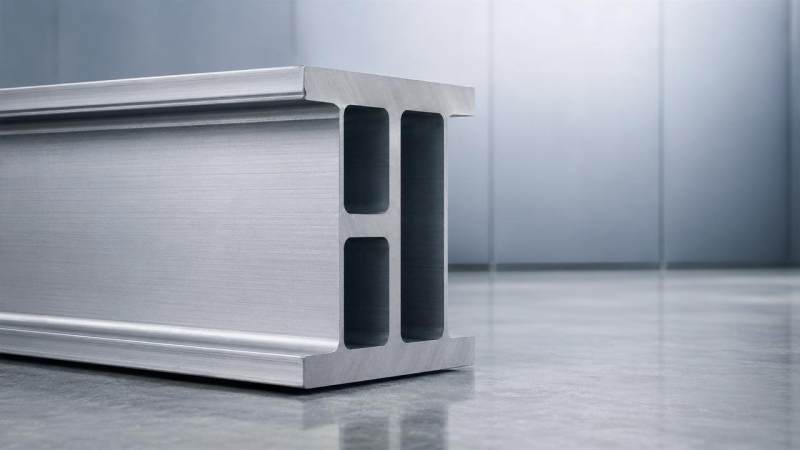
Not all custom structural steel carries equal complexity. Light I-beams (narrow flanges, thin webs) respond faster to dimensional changes but require tighter flatness controls. Wide-flange beams (parallel legs, no inner slope) demand precise universal mill calibration—adding 3–5 days to setup but enabling tighter inter-leg parallelism (±0.3 mm/m).
Hongteng Fengda’s I Beam Manufacturers capability spans Q195–St52 grades, with hot-rolled molding on four-roller universal mills ensuring consistent section geometry. For carbon steel applications like industrial structure support, our standard offering covers flange widths 100–400 mm, web heights 100–900 mm, and thicknesses 4.5–15.8 mm—fully adjustable per project needs.
The table below shows how key variables shift priority across common procurement scenarios:
This tiered view helps procurement teams allocate review bandwidth effectively. For instance, when sourcing for seismic zones, cost discussions must begin *after* confirming tensile elongation ≥22% and Charpy V-notch impact at –20°C—non-negotiable thresholds that drive material selection before price negotiation.
Commonly Overlooked Items That Trigger Delays or Rework
Even experienced procurement professionals miss subtle but consequential details. Based on root-cause analysis of 2023–2024 order exceptions, these five items account for 73% of avoidable delays:
- Marking depth and method: Laser etching vs. stamped identification affects surface finish requirements and may conflict with galvanizing prep—requires joint approval with finishing vendor.
- Cut-end preparation: Beveled vs. square-cut ends change sawing tooling and affect weld fit-up allowances—must be specified before nesting.
- Heat number grouping logic: Requests for “one heat per shipment” increase mill coordination overhead; grouping by 2–3 heats often maintains traceability while cutting lead time by 4–6 days.
- Weld procedure specification (WPS) alignment: If end-user requires AWS D1.1-compliant welds, base metal chemistry must match WPS pre-qualified ranges—verified during material release.
- Packaging weight limits: Ocean freight carriers impose 25 kg max per bundle for manual handling; exceeding this triggers repackaging and 3-day delay.
Actionable Next Steps for Your Procurement Team
To convert this checklist into operational advantage, initiate these three actions within the next 48 hours:
- Map your current RFQ template against the Core Verification Checklist above—identify gaps where tolerance, certification, or process language is ambiguous.
- Request a free technical alignment session with Hongteng Fengda’s engineering team to validate your top 3 pending custom orders against our production calendar, QA protocol, and material availability matrix.
- Secure a sample batch (min. 2 pcs) with full EN 10204 3.2 certification and dimensional CMM report—delivered in ≤10 working days for qualification use.
We support procurement professionals with more than just steel. You get a partner who aligns manufacturing capacity with your project milestones, embeds international QA rigor into every process step, and delivers predictable outcomes—not just products. Whether you’re finalizing an I-beam spec for a Dubai logistics hub or qualifying cold-formed profiles for a Midwest EV plant, our team provides responsive, technically grounded guidance—from first inquiry to final inspection.
Contact us today to discuss your next custom structural steel requirement—and receive a tailored feasibility assessment including verified lead time, cost breakdown by process step, and QA checkpoint map—all within 72 business hours.
Please give us a message


Please enter what you want to find