When procurement professionals search for a galvanized steel sheet manufacturer in China, they’re rarely looking for a list of suppliers or a definition of hot-dip galvanizing. What they actually need—and what delays projects, inflates costs, and strains supplier relationships—is a clear, field-tested framework to assess whether a given manufacturer can deliver *consistent, on-spec material* month after month, year after year, across shifting logistics, regulatory updates, and project cycles.
The core question isn’t “Who makes galvanized steel sheets in China?” It’s: Which manufacturers have built operational resilience into their production—not just claimed it in marketing materials? That resilience shows up not in brochures, but in four concrete, observable conditions: certified process control (not just product testing), vertical integration of coating capacity, documented batch traceability tied to mill origin, and contractual delivery discipline backed by real inventory buffers—not theoretical capacity charts.
1. Certification tells you what was tested. Process control tells you what’s repeatable.
Many Chinese mills hold ISO 9001, CE, or SGS certificates—and rightly so. But those reflect a point-in-time audit of documentation and sampling, not the day-to-day stability of zinc bath chemistry, strip tension control, or post-galvanizing cooling rates. For long-term reliability, look beyond the certificate to the *system* behind it.
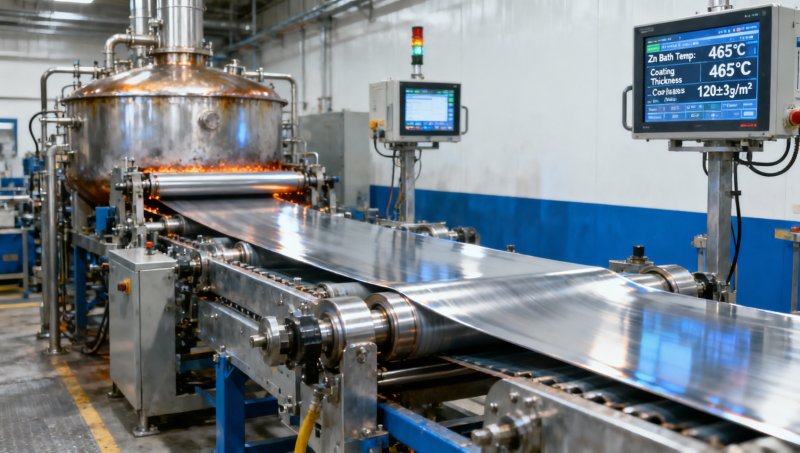
A manufacturer that calibrates its zinc bath temperature every 90 minutes—not just once per shift—and logs iron content, aluminum concentration, and immersion time for every coil, is managing variation at the source. That’s what prevents the “5% zinc thickness variance” that triggers rejection during third-party inspection in Rotterdam or Houston—even when the average meets ASTM A653 or EN 10346.
This level of control requires investment: automated bath monitoring systems, in-line thickness gauges (e.g., X-ray fluorescence), and metallurgists embedded in production—not just QA labs. If your supplier can’t share anonymized batch logs showing zinc thickness distribution across 10 consecutive coils (±0.5 µm standard deviation is realistic for mature lines), treat their consistency claims as aspirational—not operational.
2. Galvanizing in-house vs. outsourcing isn’t about cost—it’s about accountability.
A common misconception is that outsourcing galvanizing to a specialist coater improves quality. In practice, it introduces three hard-to-manage handoffs: material transfer timing, surface prep verification, and responsibility for coating defects like bare spots or excessive dross.
Manufacturers with integrated hot-dip lines—where cold-rolled base metal moves directly from pickling to galvanizing without storage or transport—eliminate those gaps. They control the critical interface between surface cleanliness and zinc adhesion. More importantly, they own the root cause when a batch fails: if it’s a cleaning issue, it’s fixable on-site; if it’s bath contamination, it’s traceable to a specific shift and raw material lot.
Ask explicitly: “Is galvanizing performed under your direct supervision, using your personnel and equipment, on your premises?” If the answer involves subcontractor names, shared facility access, or vague references to “partner plants,” you’ve just identified a hidden coordination risk—one that rarely appears in lead time quotes but routinely adds 7–12 days to corrective action cycles.
3. Traceability must go deeper than the coil ID.
“Full traceability” sounds reassuring—until you receive a non-conforming batch and discover the supplier’s system only links your PO number to a production date and furnace number. That doesn’t tell you which heat of steel was used, where the zinc came from, or whether the coil passed final surface inspection before packaging.
For long-term reliability, demand traceability that connects your order to: (a) the original steel melt (heat number + mill certificate), (b) galvanizing bath log entries (zinc alloy batch, immersion time, withdrawal speed), and (c) final inspection reports (thickness mapping, spangle uniformity, bend test results). This isn’t theoretical—it’s how top-tier structural suppliers isolate whether a corrosion issue stems from substrate variability or coating process drift.
Without this, every quality dispute becomes a forensic exercise. With it, you get resolution—not just replacement.
4. Lead time promises mean nothing without buffer logic.
A quoted 45-day lead time looks clean on paper. But if the manufacturer holds zero safety stock of prime-grade GI coils—and relies entirely on rolling-to-order—the moment a raw material shipment is delayed, or a furnace line goes down for unscheduled maintenance, your delivery slips. There’s no cushion.
Reliable long-term partners maintain strategic buffer inventory: not of finished goods, but of key base metal grades (e.g., DX51D+Z, S350GD) in standard thicknesses (0.4–1.2 mm) and widths (1000–1250 mm). This allows them to absorb short-term disruptions without renegotiating your schedule. It also signals they understand global demand patterns—not just local order flow.
You won’t see this in their catalog. You’ll see it in how they respond to your request for an expedited partial shipment—or how quickly they confirm availability for a repeat order placed 6 months after the first.
Where structural context changes the calculus
Galvanized steel sheets aren’t used in isolation. They’re integrated—into roofing systems, wall panels, or load-bearing components like purlins and wall beams. That integration exposes weaknesses that pure sheet specs won’t reveal.
Take the Z-beam: often fabricated from galvanized sheet or coil, then roll-formed into structural profiles. Here, coating integrity matters beyond corrosion resistance—it affects weldability, powder-coating adhesion, and mechanical performance under cyclic loading. A supplier that only certifies sheet thickness and zinc mass may miss edge thinning at the flange tips, or inconsistent coating on formed corners—issues that only emerge during fabrication or installation.
This is why the most reliable galvanized sheet manufacturers don’t operate in a silo. They understand downstream processes—whether you’re cutting, bending, welding, or assembling—and design their coating parameters accordingly. Their QC includes not just flat-sheet testing, but simulated forming trials and cross-section microscopy of bent edges. That depth of understanding separates transactional suppliers from true supply partners.
Long-term reliability isn’t built on volume discounts or flashy websites. It’s built on visible, verifiable process discipline—where every variable that affects your project’s durability, schedule, and total landed cost is measured, controlled, and owned. When evaluating a galvanized steel sheet manufacturer in China, start there—not with catalogs, certifications, or even price lists.
Please give us a message


Please enter what you want to find