When placing custom 304 stainless steel coil tubing orders, procurement teams need to balance material quality, dimensional accuracy, compliance standards, and supplier reliability. For global buyers, understanding these key factors helps reduce sourcing risks, control costs, and ensure the tubing meets project and manufacturing requirements from the start.
What procurement teams are really evaluating in a custom 304 stainless steel coil tubing order
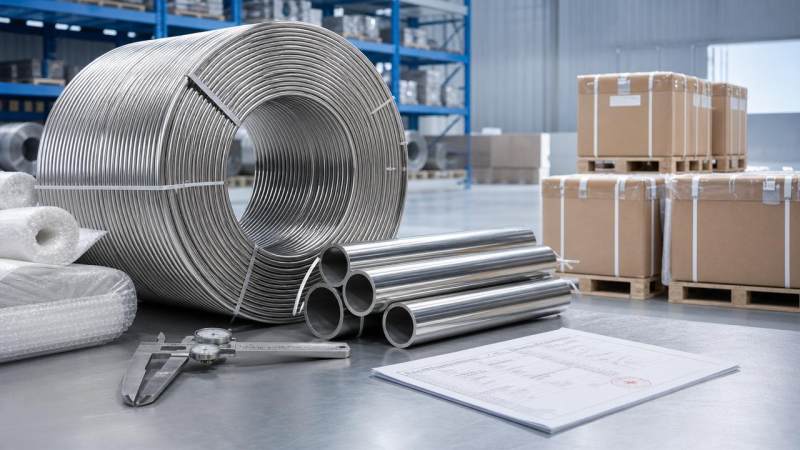
Buyers searching for custom 304 stainless steel coil tubing are usually not looking for basic material definitions. They want to know how to place an order that arrives on spec, on time, and without costly quality disputes.
The core issue is risk control. A tubing order may look simple on paper, but performance, fabrication efficiency, and total landed cost depend on details such as tolerances, surface finish, weld quality, and documentation.
For procurement professionals, the best approach is to evaluate custom tubing orders from three angles: technical suitability, supplier execution capability, and commercial predictability. Missing any one of these can create delays, rejects, or downstream rework.
Start with the exact application, not just the material grade
304 is one of the most widely used stainless steel grades because it offers a practical balance of corrosion resistance, formability, weldability, and cost. But grade selection alone does not guarantee the tubing fits the application.
Before asking for quotations, buyers should define where and how the coil tubing will be used. Is it for fluid transfer, instrumentation, heat exchange, food processing, architectural use, or general industrial fabrication?
Operating environment matters. Indoor dry conditions, mildly corrosive industrial settings, and chloride-rich outdoor or marine locations create different performance demands. In some cases, 304 is fully suitable; in others, 316 may be worth comparing.
Procurement specifications should also clarify whether the tubing must be bendable, pressure-resistant, polished, annealed, or compatible with automated fabrication. A supplier can only recommend the right production route when the application is clear.
Define the custom dimensions with procurement-grade precision
One of the biggest causes of confusion in custom 304 stainless steel coil tubing orders is incomplete dimensional information. “Custom” should never mean loosely defined. It should mean fully engineered and commercially confirmed before production starts.
Key dimensions usually include outside diameter, wall thickness, coil length, straightness requirements if recoiled later, inner coil diameter, outer coil diameter limits, and weight per coil. These factors affect packaging, transport, and line compatibility.
Tolerances are equally important. A competitive price means little if wall thickness variation causes welding inconsistency or fitting mismatch. Buyers should ask suppliers to state their achievable tolerances clearly rather than assuming common industry ranges.
If the tubing will be expanded, bent, flared, or cut on automated lines, tolerance control becomes even more important. Small dimensional deviations can reduce production efficiency and increase scrap rates at the customer’s facility.
Pay close attention to manufacturing method and weld quality
Procurement teams should confirm whether the tubing is welded or seamless, because the production method affects cost, lead time, availability, and performance expectations. For many applications, welded 304 coil tubing is the practical and economical choice.
However, welded tubing quality is not only about whether a seam exists. Buyers should verify weld integrity, bead treatment, eddy current or hydrostatic testing availability, and whether the tube is annealed and pickled after forming.
Inconsistent weld zones can create weak points during bending or service. If the tubing will be used in pressure-sensitive or cleanliness-sensitive environments, request details about non-destructive testing, welding process control, and defect inspection methods.
Surface condition around the weld is also worth checking. In high-visibility or sanitary applications, poor weld finishing may create both cosmetic issues and cleaning difficulties. Samples or production photos can help reduce misunderstanding before order confirmation.
Surface finish and cleanliness affect more than appearance
Many buyers focus first on chemistry and dimensions, yet surface finish can strongly influence actual usability. Coil tubing may be required in bright annealed, pickled, polished, or mill finish conditions depending on the end use.
For food, medical, instrumentation, or decorative applications, finish quality directly affects customer acceptance. Surface roughness, discoloration, oil residue, and protective film quality should be clarified in advance rather than negotiated after shipment.
Cleanliness is especially important for buyers supplying downstream manufacturers. Tubing contaminated with excessive oil, iron particles, or packaging debris may require additional cleaning, increasing total handling cost and delaying production schedules.
Procurement documents should specify both finish expectation and inspection standard. This makes claims easier to resolve and prevents suppliers from delivering a technically acceptable but commercially unsuitable product.
Verify material certificates, standards, and traceability
Reliable custom 304 stainless steel coil tubing sourcing depends on documentation as much as on physical product quality. Serious buyers should confirm which standards apply and what mill test documentation will be provided with each batch.
Depending on market and application, relevant standards may involve ASTM, EN, or JIS requirements for chemical composition, mechanical properties, tolerances, and testing. The order should state the exact standard edition if project compliance requires it.
Ask whether the supplier provides MTCs, heat number traceability, production batch identification, and test records. These documents are essential when goods must pass customer audits, third-party inspection, or internal quality approval procedures.
Traceability is particularly important for repeat orders. When performance is proven in the field, procurement teams often want to replicate the same specification and source route. Good recordkeeping makes future sourcing faster and safer.
Consider coil handling, packing, and shipping early
Custom tubing procurement does not end at manufacturing. Coil geometry, protective packing, container loading, and handling method can all affect whether the material arrives in usable condition. Damage during transit can erase any unit-price advantage.
Buyers should confirm whether coils are packed on wooden reels, steel spools, or export pallets, and whether moisture protection, end caps, desiccants, and corrosion-prevention wrapping are included. Packaging should match transport distance and destination climate.
It is also wise to discuss unloading conditions at the destination. A coil that is easy to produce may still be difficult to handle if the receiving warehouse lacks the right lifting equipment or space for oversized packaging.
Lead time discussions should include production time, inspection time, and shipment booking time. For export purchases, customs documentation accuracy is another practical issue that procurement teams should not leave until the last minute.
Evaluate the supplier’s customization capability, not just price
In custom orders, the supplier’s operational capability matters more than a low initial quotation. Procurement teams should assess whether the manufacturer can consistently control dimensions, schedule production accurately, and communicate clearly when adjustments are needed.
Ask how the supplier handles drawing review, sample approval, in-process inspection, and change management. A capable exporter should be able to translate technical requirements into production checkpoints rather than simply accepting a specification sheet.
It is also useful to review experience with international buyers. Suppliers familiar with export projects usually understand packaging standards, compliance documents, and lead time expectations better, helping reduce avoidable friction during order execution.
For companies sourcing multiple steel products, it can be valuable to work with a supplier network that supports broader project needs. For example, some buyers of stainless tubing also source structural materials for infrastructure or industrial construction.
In such cases, products like Hot Rolled Steel Sheet Pile may be relevant for retaining wall or water retaining wall projects. With U sheet pile options, materials such as S275, S355, S390, S430, SY295, SY390, and ASTM A690 are available for different engineering demands.
Production standards including EN10248, EN10249, JIS5528, JIS5523, and ASTM, along with interlock options like Larssen locks and hot rolled interlocks, show the importance of supplier versatility. For buyers managing larger procurement packages, broad manufacturing capability can improve coordination and reduce sourcing complexity.
Ask the right questions before issuing the purchase order
A strong inquiry helps suppliers quote accurately and helps buyers compare offers on equal terms. Procurement teams should avoid vague RFQs that invite hidden assumptions, because unclear inputs often lead to claims, delays, or revised pricing later.
A practical RFQ should include material grade, tube type, dimensions, tolerances, finish, coil length, quantity, application, testing requirements, certificates, destination port, packing requirements, and required delivery date. Drawings should be attached when necessary.
It is also smart to ask what is included and excluded in the quote. For example, are test fees, export packing, third-party inspection, and sample charges already included? Clear commercial scope makes supplier comparison more meaningful.
If the order is for a new project, requesting a pre-production sample or trial batch can reduce risk. The additional time and cost are often justified when the tubing will feed continuous manufacturing or support customer-critical applications.
Balance unit price with total procurement cost
Lowest price is not always lowest cost. Procurement teams should look beyond raw material pricing and consider the full commercial impact of quality variation, delay risk, documentation gaps, and packaging failures.
A cheaper coil tubing offer may become more expensive if it causes downtime, fitting problems, high rejection rates, or repeated communication over nonconformities. In contrast, a slightly higher quote from a reliable supplier may lower total project cost.
Useful comparison points include dimensional consistency, tested quality level, certificate completeness, export readiness, lead time reliability, and responsiveness during technical clarification. These are indicators of real purchasing value, not just sales presentation.
For repeat consumption items, buyers should also consider long-term stability. A supplier who can maintain quality across multiple batches supports better inventory planning and fewer emergency sourcing decisions later.
Common mistakes buyers should avoid
One common mistake is assuming all 304 tubing offers are equivalent. Differences in raw material source, tolerance control, annealing quality, and weld treatment can create significant performance differences even when quotations appear similar.
Another mistake is under-specifying inspection criteria. If acceptance standards are not written clearly, disputes become harder to resolve. Procurement teams should align technical and quality expectations before production, not after delivery.
Some buyers also overlook packaging and logistics details, especially when focusing on manufacturing specifications. Yet bent coils, damaged ends, or poor moisture protection can create immediate problems at the destination warehouse or production line.
Finally, rushing directly into bulk orders with a new supplier can be risky. A sample order, pilot lot, or structured first order often provides valuable evidence about consistency, communication, and actual execution capability.
Final takeaway for sourcing custom 304 stainless steel coil tubing
Successful custom 304 stainless steel coil tubing procurement depends on more than choosing a familiar stainless grade. The best orders are built on clear application requirements, precise dimensions, verified quality controls, and a supplier capable of executing consistently.
For procurement teams, the priority should be reducing uncertainty. Define the technical details fully, confirm standards and certificates, check manufacturing and packaging capability, and compare suppliers based on total sourcing reliability rather than headline price alone.
When these factors are managed well, buyers gain more than compliant tubing. They gain smoother production, fewer claims, more predictable landed cost, and stronger confidence in future repeat orders.
In short, a good custom order is not only about buying steel tubing. It is about building a sourcing process that protects quality, schedule, and commercial outcomes from the beginning.
Please give us a message


Please enter what you want to find