What to check before choosing an ASTM A53 galvanized steel pipe 2 inch supplier
Choosing an ASTM A53 galvanized steel pipe 2 inch supplier sounds simple until the first shipment arrives with the wrong coating finish, mixed wall thickness, unclear test records, or a delivery schedule that does not match the jobsite plan. For purchasing teams, this category is rarely just about finding the lowest unit price. A 2 inch galvanized pipe may be used in structural support, water-related utility lines, fabrication work, handrails, site installations, or light industrial systems. In each case, the cost of a bad purchase usually shows up later: rework, inspection delays, replacement freight, or disputes over whether the material actually met the agreed standard.
That is why the better question is not “Who can quote fast?” but “Who can supply the exact pipe standard, coating quality, documents, and delivery consistency this project needs?” If you are comparing suppliers from China or other export markets, that distinction matters even more.
Start with the actual ASTM A53 requirement, not just the product name
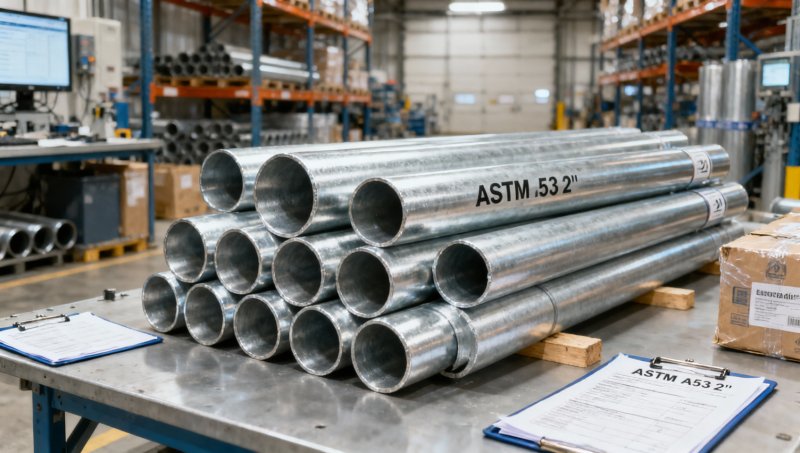
A common sourcing mistake is assuming that every supplier using the phrase “ASTM A53 galvanized steel pipe” is offering the same thing. ASTM A53 covers black and hot-dipped, zinc-coated, welded and seamless steel pipe, but buyers still need to confirm details such as type, grade, dimensions, end finish, length, and testing requirements. For a 2 inch pipe, that usually means verifying nominal pipe size, outside diameter, schedule, and whether the order calls for plain end, threaded end, or beveled end.
In practical terms, procurement should ask for the supplier’s proposed specification sheet before discussing price too deeply. If one quote is based on thinner wall, different tolerances, or different pipe end treatment, the comparison is already distorted. A low quote built on incomplete technical alignment often becomes the most expensive option after clarification.
It also helps to confirm whether the application truly requires A53, or whether another pipe standard has been included in drawings, local code references, or owner specifications. Some projects mention A53 casually, but inspection documents may require additional traceability or testing that must be agreed at purchase stage.
Galvanizing quality deserves a separate check
Many buyers focus heavily on pipe dimensions and overlook the zinc coating itself. That is risky. The pipe may satisfy size requirements and still perform poorly if the galvanizing is uneven, too thin for the environment, poorly adhered, or cosmetically inconsistent in a way that raises inspection questions.
When evaluating a supplier, ask how galvanizing is handled. Is the pipe hot-dip galvanized after forming? Is the process in-house or outsourced? What inspection points are used for coating appearance and surface defects? Can the supplier provide records tied to each batch? These are not small details. A supplier with weak control over galvanizing may still produce acceptable steel pipe, but export consistency becomes harder to manage.
Surface issues to watch for include excessive ash deposits, bare spots, rough runs, poor thread protection after galvanizing, and inconsistent finish between bundles. Some appearance variation is normal in galvanized products, but the supplier should be able to explain what is acceptable and what is considered nonconforming.
Documents tell you a lot about supplier discipline
A serious supplier should be comfortable discussing mill test reports, dimensional inspection, coating-related checks, packing lists, and export paperwork early in the process. This is especially important if your project involves third-party inspection, customs review, public tender documentation, or owner-submitted material approval.
What you want to see is not just whether documents exist, but whether they are organized, timely, and consistent with the purchase order. Experienced exporters usually understand that paperwork problems can hold up cargo just as easily as production problems. Companies serving North America, Europe, the Middle East, and Southeast Asia often build stronger habits around standard compliance because buyers in those markets tend to request ASTM, EN, JIS, or GB alignment and supporting records from the start.
That is one reason many procurement teams prefer working with manufacturers that already handle a wider structural steel range. A producer involved in angle steel, channels, beams, cold formed profiles, and custom structural components typically has more practice managing specification control across different product families. The benefit is not that every product is the same, but that the internal quality system is less likely to treat export orders casually.
Check production scope, not just trading capability
Some buyers do not mind sourcing through traders, and in some cases that works fine. But if project timing is tight or technical coordination is likely, you should understand whether you are talking to a mill, a processor, a stockholder, or an exporter combining several sources. Each model has trade-offs.
A manufacturer with modern facilities and strict quality control can usually respond faster on production scheduling, customization, and non-standard packaging. An exporter with stable mill relationships may offer flexibility across product categories. A pure trader may be competitive on price for spot volumes but less dependable when changes occur mid-order.
This is also where broader material knowledge matters. On many projects, galvanized pipe is purchased together with other steel items for fabrication or installation. If the supplier side understands adjacent materials, coordination gets easier. For example, a project sourcing pipe may also need round bars, beams, or fabricated supports. In that context, it is useful if the supplier can discuss related items such as A36 Carbon Steel Round Bar, including typical lengths from 2m to 12m, diameter range options, and surface treatments like oiling, phosphating, passivation, or anti-rust oil. Not because it replaces the pipe order, but because combined procurement often exposes whether a supplier really understands steel supply chains or is only forwarding quotations.
Lead time should be broken into stages
When a supplier says “delivery in 25 days” or “30 days after deposit,” that is not enough for a serious purchase decision. You need to know what that timeline includes. Raw material allocation? Rolling? Galvanizing? Threading? Inspection? Packing? Trucking to port? Booking vessel space?
This matters because galvanized pipe often involves more than one operation, and delays tend to happen at handoff points. If galvanizing is outsourced, your schedule risk changes. If export packing is done after final inspection, a failed review can push vessel booking. A dependable supplier should be able to explain the sequence in plain terms.
For project purchases, ask one additional question: what is the realistic lead time for repeat orders using the same specification? Initial orders can be smooth, but repeat demand is what tests actual capacity.
Price comparison only works after normalizing the offer
It is tempting to line up three quotes and choose the lowest FOB or CIF price. In steel procurement, that is often misleading. Two suppliers may quote the same ASTM A53 galvanized steel pipe 2 inch supplier keyword product, yet include different schedules, zinc coating assumptions, packing methods, tolerance control, or documentation support.
Before comparing cost, normalize these points:
Sometimes the better supplier is not the cheapest one, but the one whose quotation leaves fewer unresolved technical gaps.
Ask how the supplier handles nonstandard requests
Even for a common item like 2 inch galvanized pipe, real orders are often not standard. Buyers may need mixed lengths, special marks, palletized packing, OEM labels, or container loading plans tied to project sequence. The supplier’s response to these requests reveals a lot.
A capable exporter will tell you clearly what can be customized, what affects cost, and what may extend lead time. That kind of answer is more useful than a quick “yes, no problem.” In structural steel supply, disciplined communication is usually a stronger signal than aggressive sales language.
This is where established Chinese manufacturers and exporters can be practical partners if they are already set up for international business. Companies that routinely provide standard specifications plus OEM solutions, and that are used to matching ASTM, EN, JIS, and GB expectations, tend to reduce avoidable back-and-forth during approval and production.
After-sales support matters more than people think
Steel orders do not end when the vessel sails. Issues may appear during unloading, site inspection, installation, or document review. If there is a bundle identification problem, coating concern, quantity discrepancy, or mismatch between packing list and actual goods, you need a supplier that responds with traceable information, not vague promises.
A useful check is to ask before ordering: who handles claims, how soon can they review inspection feedback, and what evidence do they require? You are not hoping for a dispute, but a supplier’s answer shows whether they have a real system behind the sale.
For many procurement teams, the safest choice is a supplier with consistent export experience, stable production planning, and enough technical range to support related steel items when needed. That is usually more valuable than chasing the lowest quote from a source that cannot explain its coating process, capacity, or documentation flow.
If you are shortlisting an ASTM A53 galvanized steel pipe 2 inch supplier, keep the evaluation simple but strict: confirm the actual standard, verify galvanizing control, normalize the commercial offer, review delivery stages, and test how the supplier communicates when details get specific. That is where procurement risk usually reveals itself, long before the material reaches the site.
Please give us a message


Please enter what you want to find