Choosing the right galvanized steel pipe supplier can directly affect project quality, delivery reliability, and total sourcing cost.
Before placing an order, it is wise to verify standards, zinc coating, production stability, export capability, and after-sales response.
A dependable galvanized steel pipe supplier helps control risk, improve compliance, and keep construction or industrial schedules on track.
What should you verify first in a galvanized steel pipe supplier?
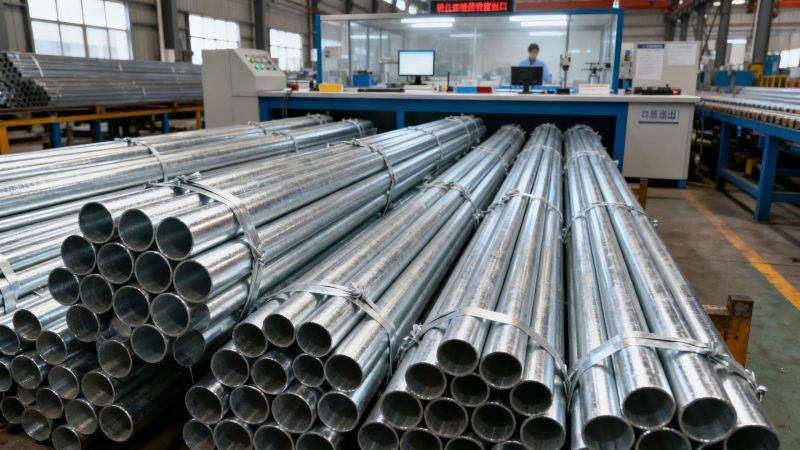
Start with the basics: product range, standards, and traceability.
A qualified galvanized steel pipe supplier should clearly state which standards are available, such as ASTM, EN, JIS, DIN, AISI, and GB.
The supplier should also provide material grade details, dimensional tolerances, coating method, and inspection records.
If the quotation only shows price and size, the sourcing risk is already higher.
Ask whether the pipe is hot-dip galvanized or electro-galvanized.
This difference affects corrosion resistance, service life, and application suitability.
Also confirm mill test certificates, batch marking, and whether third-party inspection can be arranged before shipment.
These documents are important when projects need compliance review or customs support.
How do you judge coating quality and pipe durability?
Coating quality is one of the most important selection points for any galvanized steel pipe supplier.
Galvanizing exists to increase corrosion resistance and extend service life.
That means surface appearance alone is not enough.
Check coating thickness, adhesion, uniformity, and whether the zinc layer matches the target environment.
Coastal, chemical, mining, and outdoor applications usually need stronger corrosion protection.
Review tolerance data carefully.
For example, thickness tolerance such as ±0.15mm may be acceptable for many industrial uses, but the final requirement depends on design and code.
A serious galvanized steel pipe supplier should explain how coating is tested.
Common checks include coating weight, salt spray performance, bend testing, and visual inspection for bare spots.
It is also helpful to ask for past supply references in highways, bridges, oil pipeline systems, industrial buildings, and support frame structures.
Which production and supply factors matter most before ordering?
A low quote means little if the supplier cannot ship on time.
Delivery reliability depends on production capacity, raw material control, planning discipline, and export coordination.
Ask practical questions before choosing a galvanized steel pipe supplier:
- What is the normal monthly output?
- Can mixed sizes be supplied in one shipment?
- How are urgent orders handled?
- What is the average lead time in peak season?
- Can OEM or customized lengths be produced?
In the middle of supplier evaluation, it helps to review an actual product profile.
For example, Galvanized Pipe can be used in construction, machinery, coal mining, chemical industry, electric power, bridges, containers, agriculture, and oil systems.
Available standards include ASTM, DIN, JIS, GB, AISI, SUS, and EN.
Typical dimensions may include length 1-12m, width 0.6m-3m, and thickness 0.1mm-300mm, depending on application and customization needs.
This kind of flexibility is useful when comparing one galvanized steel pipe supplier against another.
Why does export experience matter when selecting a galvanized steel pipe supplier?
Export experience reduces hidden risk in documentation, packaging, standards matching, and port handling.
A supplier serving North America, Europe, the Middle East, or Southeast Asia usually understands different market expectations.
That includes marking rules, customs paperwork, and project documentation.
A reliable galvanized steel pipe supplier should be able to discuss:
- Export packing methods for sea freight
- Container loading plans
- Protection against rust during transit
- Document accuracy for customs clearance
- Response speed if claims happen after arrival
Business background matters here.
A structural steel manufacturer and exporter with stable facilities, strict quality control, and international standard compliance is usually easier to work with long term.
Companies with experience in angle steel, channels, beams, cold formed profiles, and custom components often understand broader project needs.
That can simplify combined sourcing and reduce coordination cost.
How can you compare price without missing hidden costs?
The cheapest galvanized steel pipe supplier is not always the best value.
A better comparison looks at total landed cost and total risk.
Review these cost factors together:
When comparing offers, request the same basis from each galvanized steel pipe supplier.
That means identical standard, thickness, coating requirement, length, inspection method, packaging, and trade term.
Without this, a lower quote may simply reflect a lower specification.
What common mistakes should be avoided during supplier selection?
Several sourcing mistakes appear often in steel purchasing.
They can be avoided with a structured review of the galvanized steel pipe supplier.
- Focusing only on unit price
- Skipping coating verification
- Ignoring export packaging details
- Accepting vague lead time promises
- Not checking standards against project drawings
- Ordering samples too late
Another mistake is overlooking service support.
A dependable partner should respond clearly about technical questions, documentation, delivery updates, and quality concerns.
Strong communication is often a good sign of future order stability.
FAQ summary: how do you shortlist the right galvanized steel pipe supplier?
Selecting a galvanized steel pipe supplier should never rely on one factor alone.
The best decision comes from checking standards, coating quality, production reliability, export experience, and service response together.
For steel projects that require stable quality and dependable lead times, it is worth requesting detailed specifications, certificates, and shipment planning before final approval.
A well-chosen galvanized steel pipe supplier can support compliance, reduce sourcing pressure, and create better long-term value across construction and industrial applications.
Please give us a message


Please enter what you want to find