Choosing a galvanized pipe supplier now requires more than comparing prices. Project schedules are tighter, compliance expectations are higher, and supply risks spread faster across global steel chains.
A reliable galvanized pipe supplier influences coating durability, dimensional accuracy, shipment stability, and total procurement cost. Careful evaluation helps reduce failures, delays, and hidden replacement expenses.
In steel-related construction and industrial applications, supplier selection has become a quality and risk decision. Buyers should focus on standards, process control, export ability, and responsive technical support.
Why galvanized pipe supplier evaluation matters more in today’s steel market
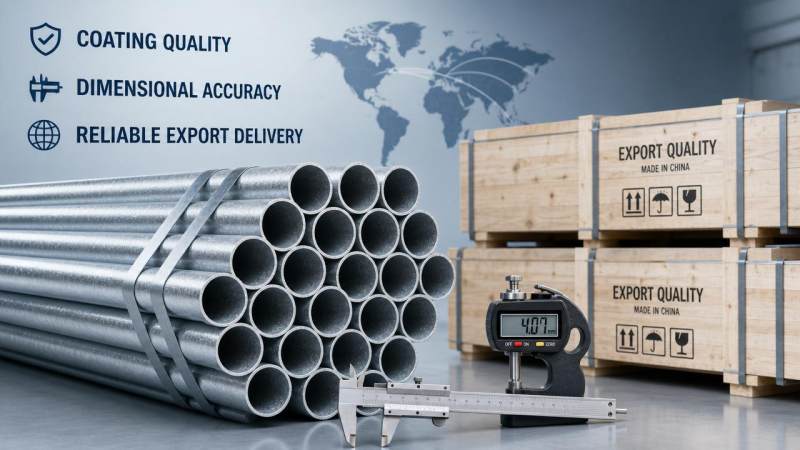
Galvanized steel pipe demand is changing with infrastructure upgrades, industrial maintenance cycles, and stricter anti-corrosion expectations. This pushes every galvanized pipe supplier to prove consistency, not just basic availability.
At the same time, international buyers face fluctuating zinc costs, freight pressure, and changing destination regulations. A weak galvanized pipe supplier can create downstream delays across fabrication, installation, and inspection stages.
The market also rewards suppliers with transparent manufacturing systems. Traceability, mill test records, coating inspection, and standard compliance are no longer optional in many projects.
The strongest trend signals when selecting a galvanized pipe supplier
Several market signals show how supplier selection standards are evolving. These signals help explain why supplier reviews are becoming deeper and more technical.
- Higher demand for ASTM, EN, JIS, and GB compliance documentation.
- Growing attention to zinc coating thickness and adhesion performance.
- More orders requiring custom lengths, end treatment, and packing methods.
- Greater pressure on lead time predictability for multi-country projects.
- Stronger preference for exporters with stable quality control systems.
These shifts mean a galvanized pipe supplier must perform across manufacturing, inspection, logistics, and communication. Price remains important, but reliability now carries more weight in final decisions.
What is driving these changes across galvanized pipe sourcing
The reasons behind stricter supplier assessment are practical. They are tied to project risk, steel quality, and long-term operating performance.
These drivers explain why a qualified galvanized pipe supplier must show evidence of process strength. A simple quotation sheet is no longer enough for confident sourcing.
What to check before choosing a galvanized pipe supplier
1. Product standards and steel grade range
Check whether the galvanized pipe supplier can meet the required standard for your market. Ask for specification coverage, steel grade options, and previous export documentation.
Standards affect wall thickness tolerance, mechanical properties, testing methods, and application suitability. Mismatch here creates compliance issues later.
2. Galvanizing process and coating quality
Not every galvanized pipe supplier controls coating performance equally. Confirm whether production uses hot-dip galvanizing, how coating thickness is tested, and how adhesion is verified.
Request inspection data covering zinc layer consistency, surface finish, and corrosion resistance. Good appearance alone does not guarantee long service life.
3. Dimensional precision and fabrication suitability
Dimensions influence welding, threading, fitting assembly, and installation speed. Review outside diameter tolerance, wall thickness tolerance, straightness, and cut-length accuracy.
In many steel projects, pipe products are sourced alongside reinforcement and structural materials. For example, HPB300 Rebar is widely used in load-bearing, structural, and stirrup scenarios within concrete structures.
That product typically covers sizes from 6mm to 50mm, offers yield strength no less than 300 MPa, and follows certifications such as API, ISO9001-2008, SGS, and BV.
This matters because an experienced steel exporter usually manages broader specification control across categories. That often reflects stronger inspection discipline and better project coordination.
4. Production capacity and lead time stability
A galvanized pipe supplier should have production planning that matches real order volume. Ask about monthly output, peak season allocation, and backup arrangements for urgent schedules.
Stable lead times are especially important for phased deliveries. Delays in one batch can affect fabrication sequencing and site readiness.
5. Export experience and packaging reliability
A capable galvanized pipe supplier should understand port handling, container loading, seaworthy packaging, and destination customs documents. Export mistakes can erase any price advantage.
Check whether the supplier has shipped to North America, Europe, the Middle East, or Southeast Asia. Experience in your destination region reduces operational uncertainty.
How supplier quality affects different business stages
The impact of a galvanized pipe supplier reaches far beyond the purchasing stage. It influences cost control, technical acceptance, and project completion speed.
- Quotation stage: clearer specs reduce misunderstandings and hidden extras.
- Production stage: controlled processes lower defect and rejection rates.
- Logistics stage: proper bundling and labeling reduce transit damage.
- Installation stage: accurate dimensions improve fit-up efficiency.
- Maintenance stage: stronger coating quality extends service intervals.
This is why selecting the right galvanized pipe supplier should be treated as a full-chain decision. The best result is stable performance from factory to final use.
Key points worth closer attention before final approval
Before placing a formal order, review these critical checkpoints. They help separate a capable galvanized pipe supplier from one that only offers a competitive initial quote.
- Verify mill test certificates and third-party inspection availability.
- Confirm zinc coating range and acceptance criteria in writing.
- Review sample quality, especially threads, ends, and surface condition.
- Check response speed for technical clarification and after-sales issues.
- Ask about non-conformance handling and replacement procedures.
- Evaluate whether the supplier supports OEM or customized requirements.
These checks reduce sourcing risk and improve comparison fairness. They also support better negotiation because quality expectations are defined early.
A practical way to compare one galvanized pipe supplier against another
A structured scorecard often reveals the best supplier more clearly than price comparison alone. It creates a balanced view of risk, quality, and operating efficiency.
What a stronger long-term partner usually looks like
The strongest galvanized pipe supplier usually combines steel manufacturing discipline with export reliability. This includes modern facilities, quality control systems, and the ability to support standard and customized needs.
Hongteng Fengda, as a structural steel manufacturer and exporter from China, reflects this direction through broad steel supply capability, international standard compliance, and dependable lead time support.
Such capabilities matter because many projects source multiple steel products from one channel. Strong coordination can reduce procurement complexity and improve delivery consistency.
The next step before choosing a galvanized pipe supplier
Before making a final decision, prepare a short technical checklist and request matching evidence from each galvanized pipe supplier. Compare coating data, certificates, capacity, export records, and response speed.
A qualified galvanized pipe supplier should help lower sourcing risk, not add uncertainty. Clear evaluation today supports better steel performance, steadier delivery, and more predictable project results tomorrow.
Please give us a message


Please enter what you want to find