Before buying steel plate for shipbuilding, verify grade, class approval, tolerance, weldability, and corrosion resistance first. These checks prevent rework, failed inspections, delivery disputes, and safety risks that can affect vessel life, repair cost, and construction progress.
A reliable supply source matters just as much as the plate itself. Stable quality, complete mill records, and predictable lead times help maintain fabrication flow, reduce sourcing uncertainty, and support compliance with major marine standards.
Why a checklist matters when sourcing steel plate for shipbuilding
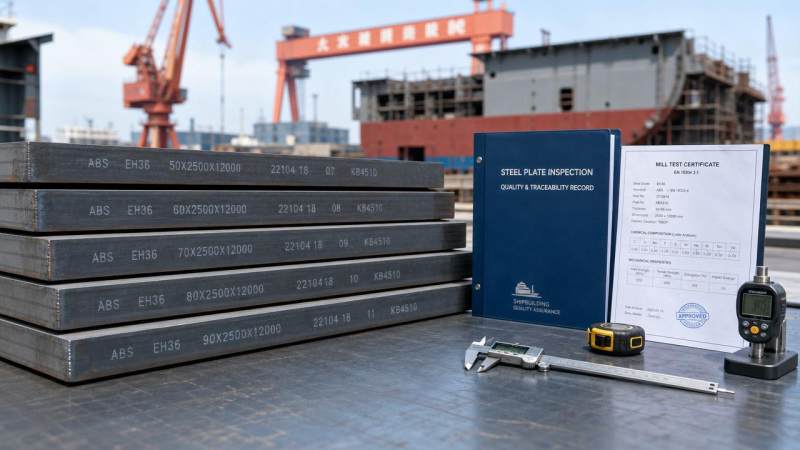
Ship structures operate under cyclic loading, saltwater exposure, temperature variation, and strict inspection regimes. A wrong material choice can create cracking, distortion, coating failure, or rejection during class survey.
Using a checklist makes evaluation consistent. It helps compare suppliers, confirm technical suitability, and identify hidden gaps before cutting, welding, blasting, or exporting the steel plate for shipbuilding.
Core checklist before buying steel plate for shipbuilding
- Confirm the exact grade required by the design, such as normal strength or high strength marine steel, and match it with project drawings, class rules, and intended hull location.
- Check classification society approval, including ABS, DNV, LR, BV, CCS, or equivalent, and make sure certificates cover the actual heat number and delivered batch.
- Review chemical composition and mechanical properties carefully. Pay attention to yield strength, tensile strength, impact toughness, and carbon equivalent for welding performance.
- Measure thickness tolerance, width, length, flatness, and edge condition against the order. Dimensional inconsistency can slow nesting, cutting accuracy, fit-up, and assembly alignment.
- Verify low-temperature toughness requirements if the vessel will operate in cold regions. Charpy impact values at specified temperatures are often critical for approval.
- Assess weldability early. Ask for carbon equivalent data, recommended preheat range, and prior welding experience to reduce cracking, porosity, and repair frequency.
- Inspect surface condition for rust, laminations, scale, pitting, or rolling defects. Surface issues can increase blasting cost and may hide deeper material defects.
- Request traceable documentation, including MTC, test reports, heat numbers, stamping, and packing lists. Full traceability is essential for marine audits and export claims.
- Confirm corrosion resistance strategy. Base plate selection must align with coating systems, cathodic protection, and service environment, especially in ballast or splash zones.
- Check production capacity and delivery reliability. Even compliant steel plate for shipbuilding creates risk if rolling schedules, port handling, or packaging are unstable.
Documents to request before order confirmation
- Mill test certificate with heat number linkage
- Classification approval certificate
- Dimensional inspection report
- Ultrasonic or NDT report if specified
- Packing, marking, and shipping specification
Key material points that affect vessel performance
Not every marine plate faces the same stress. Bottom shell, deck, bulkhead, tank boundary, and offshore support parts may require different property balances. That is why buying steel plate for shipbuilding should start from service conditions, not price alone.
Strength and toughness
Higher strength can reduce weight, but toughness remains vital. Plates used in cold or dynamic zones must resist brittle fracture and fatigue crack propagation under repeated loading.
Welding compatibility
Marine fabrication involves extensive welding. Plate chemistry, thickness, and heat input sensitivity affect distortion control, welding speed, and repair rates across long seam structures.
Corrosion behavior
Hull and internal compartments experience different corrosion patterns. Salt spray, cargo residue, humidity, and stagnant water all influence whether standard marine steel is sufficient.
In some related ship parts, stainless materials may be considered for auxiliary components exposed to chemicals, moisture, or hygiene-sensitive service. For example, 316 Stainless Steel Coil is used in chemical, food, medical, and ship-related applications where corrosion resistance, formability, and dependable strength are important. Its available finishes, ISO/SGS/BV certifications, and sizes from 2.5mm to 10.0mm support broader industrial fabrication planning.
Additional checks for different shipbuilding scenarios
Hull structure and deck areas
Focus on strength grade, flatness, and weldability. Large deck panels and shell plates need consistent thickness and low distortion behavior to keep panel assembly efficient.
Also review coating compatibility. Poor surface quality can reduce blast-cleaning efficiency and shorten coating life in exposed marine environments.
Ballast tanks and wet compartments
Give more weight to corrosion allowance, coating specification, and plate cleanliness. Mill scale, pits, or contamination can reduce coating adhesion and increase maintenance frequency.
When the design includes severe internal moisture exposure, confirm whether the selected steel plate for shipbuilding works with the planned anti-corrosion system and inspection schedule.
Cold-region or offshore service
Pay close attention to impact test temperature and fracture toughness. Materials acceptable for mild waters may not meet low-temperature operating demands.
Confirm class notes, testing frequency, and any supplemental requirements before shipment, not after fabrication starts.
Commonly overlooked risks
Mismatch between certificate and delivered plate
A valid certificate is useless if heat numbers do not match physical markings. Always cross-check traceability at receiving inspection.
Buying by nominal grade only
Two plates may share a grade name but differ in approval scope, impact test condition, or thickness range. Read the full specification line.
Ignoring edge and flatness condition
Cutting and panel line efficiency depend on shape accuracy. Re-leveling or trimming can consume labor and delay block assembly.
Underestimating supplier consistency
The best quotation is not always the safest choice. Inconsistent batches create welding variation, inspection delays, and stock planning problems.
Practical execution steps before purchase
- List grade, thickness, standard, class society, and impact requirement directly from approved drawings.
- Send a technical inquiry sheet, not just a price request, for each steel plate for shipbuilding item.
- Review MTC samples and approval documents before placing the bulk order.
- Define acceptance rules for tolerance, NDT, marking, packaging, and delivery timing in the contract.
- Arrange incoming inspection to verify dimensions, markings, surface condition, and paperwork immediately after arrival.
For broader structural steel supply needs, Hongteng Fengda supports international projects with stable production, strict quality control, and products aligned with ASTM, EN, JIS, and GB standards. This helps reduce sourcing risk and improve delivery confidence across industrial steel applications.
Final takeaway
Choosing the right steel plate for shipbuilding is a technical decision with direct effects on compliance, fabrication efficiency, and vessel durability. A clear checklist keeps the process disciplined and prevents costly surprises.
Start with grade, approval, toughness, weldability, tolerance, corrosion strategy, and traceability. Then confirm supplier reliability and delivery control. When these points are checked in order, the buying decision becomes faster, safer, and easier to defend.
Please give us a message


Please enter what you want to find