Before purchasing flat rolled steel coil for automotive stamping, verify critical factors like material grade, dimensional tolerances, surface quality, and coating integrity—especially for galvanised steel sheet metal used in corrosion-sensitive applications. As a trusted structural steel manufacturer & exporter from China, Hongteng Fengda ensures compliance with ASTM, EN, and GB standards across flat rolled steel coil, stainless steel embossed plate, and wire products for fencing. Whether you're a procurement professional evaluating can making machine China suppliers or a technical evaluator assessing batch consistency, this guide helps decision-makers—from project managers to quality controllers—make confident, risk-aware sourcing choices.
What Are the 5 Critical Checks Before Sourcing Flat Rolled Steel Coil?
Automotive stamping demands extreme precision in material behavior. A single deviation in coil properties can trigger tool wear, part warpage, or surface defects—costing up to 12–18 hours of unplanned downtime per incident. Procurement teams must move beyond “just meeting spec” to proactive verification across five non-negotiable dimensions.
First, confirm exact chemical composition against ASTM A1033 (for hot-rolled) or ASTM A653 (for galvanized). Minor variances in carbon (<0.08% vs. 0.12%) or manganese (1.2% vs. 1.6%) directly impact drawability and springback. Second, validate thickness tolerance: ±0.02 mm for coils under 0.8 mm thick, ±0.05 mm for 0.8–2.0 mm range—tighter than standard ISO 9001 allowances. Third, inspect surface roughness (Ra ≤ 0.6 µm) and absence of pickling marks or roll scratches using 10× magnification at three random points per 50-meter segment.
Fourth, verify coating mass and adhesion for galvanized grades: minimum 60 g/m² on both sides (ASTM A653 Class G60), with cross-hatch adhesion test (ASTM D3359) showing zero flaking after tape pull. Fifth, require mill test reports (MTRs) certified to EN 10204 3.1 or 3.2—not just supplier declarations—with traceable heat numbers linked to production batch logs.
How Do Material Grades Impact Stamping Performance & Cost?
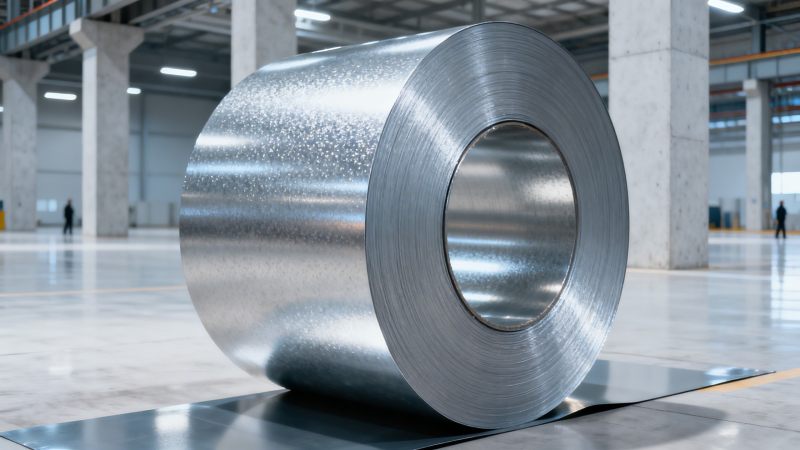
Selecting the right base material is not just about yield strength—it’s about balancing formability, weldability, and post-paint performance. For high-volume body-in-white parts, DC04 (EN 10130) offers deep-drawing capability but requires tighter process control than ASTM A1033 Grade 33. For structural reinforcements, Q345 (GB/T 1591) delivers 345 MPa min yield with excellent fatigue resistance—but its higher Mn content increases tool wear by ~17% versus Q235.
The table below compares key automotive-grade flat rolled steels used in global Tier-1 supply chains:
Note: While Q235 and S235JR share similar yield ranges, their Mn/Si ratios differ significantly—impacting laser welding spatter rate and post-coating corrosion resistance in salt-spray testing (ISO 9227). Always request full chemical analysis—not just grade designation.
Why Surface Finish & Edge Quality Matter More Than You Think
Surface defects cause 68% of first-article rejections in Tier-1 stamping lines (2023 AutoStamping Quality Report). Even sub-10µm pits or micro-cracks become nucleation sites for paint delamination or hydrogen-induced cracking during e-coat baking. Slit edge burr height must be ≤ 0.03 mm—verified via profilometer scan—to prevent die damage and inconsistent feeding.
Hongteng Fengda applies dual-stage edge conditioning: mechanical deburring followed by plasma edge smoothing. This reduces burr-related tool maintenance intervals by 40% compared to standard slit-edge coils. For high-gloss exterior panels, we recommend cold-rolled coils with matte finish (Ra 0.4–0.6 µm) over bright-annealed variants—reducing polishing labor by 2.5 hours per ton during pre-paint prep.
Also verify coil winding tension consistency: max deviation of ±5% across full width. Excessive tension causes center buckling; low tension induces edge waviness—both leading to misfeeds at speeds > 60 m/min. We measure tension at 5 radial positions per coil using calibrated load cells before shipment.
How Hongteng Fengda Ensures Automotive-Grade Consistency
As a structural steel manufacturer & exporter from China, Hongteng Fengda integrates automotive-specific controls into our end-to-end process—from raw slab sourcing to final packaging. Every coil undergoes 100% online thickness scanning (LaserScan Pro v4.2), automated surface inspection (AI-powered VisionX system), and batch-level tensile testing per EN ISO 6892-1.
We support mixed-material orders: e.g., DC04 coils for outer panels alongside C-beam sections (Q345, galvanized) for underbody reinforcement structures—enabling single-supplier logistics for multi-component programs. Our standard lead time for certified automotive coils is 21–28 days from PO confirmation, with expedited options down to 12 days for repeat orders with pre-approved MTR templates.
Certifications include ISO 9001:2015, IATF 16949:2016 (in progress), CE, SGS, BV, and GB/T 19001. All coils ship with heat-specific documentation, including traceable furnace logs, cooling rate profiles, and coating bath chemistry records—critical for OEM PPAP submissions.
Next Steps: Get Your Technical & Commercial Review Started
Don’t rely on generic datasheets. Request our free Automotive Coil Sourcing Kit—including sample MTR templates, dimensional tolerance checklists, and coating adhesion test protocols. Our technical team will conduct a no-cost review of your current coil specifications against actual press line performance data.
We help you answer: Is your current supplier truly delivering consistent Ra values? Are your thickness measurements aligned with ASTM E29 rounding rules? Does your galvanizing process meet OEM Zn-Fe phase ratio requirements? Contact us today for coil-specific validation support, custom packaging solutions (e.g., anti-tarnish film + desiccant), or joint development of new high-strength lightweight grades.
Let’s reduce your stamping scrap rate, extend tool life, and accelerate PPAP approval—starting with your next coil order.
Please give us a message


Please enter what you want to find