Choosing among i beam steel suppliers in 2026 requires more than checking price lists. For steel sourcing, the strongest partners prove value through stable quality, standard compliance, dependable delivery, and responsive support.
When comparing i beam steel suppliers, buyers should connect supplier capability with actual project scenarios. A warehouse, bridge extension, industrial workshop, and export distribution program rarely need the same supply approach.
In the structural steel market, the right evaluation method reduces delays, avoids compliance disputes, and improves total cost control. That is why supplier comparison should begin with application fit, not only with unit price.
Why project scenario matters when comparing i beam steel suppliers
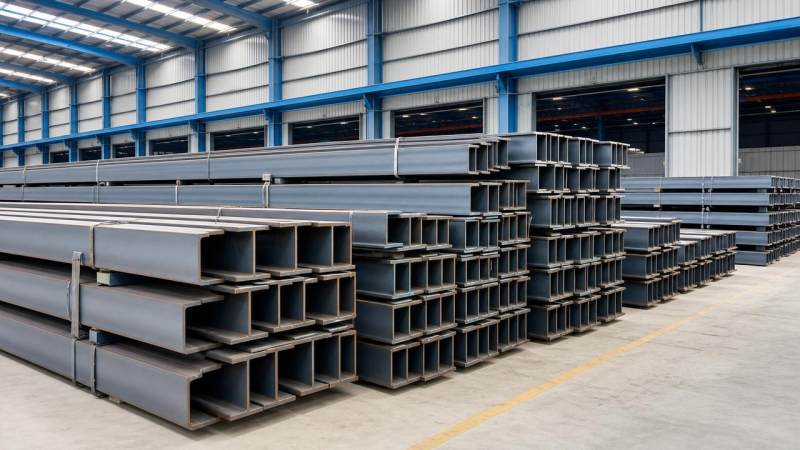
Different projects place different demands on i beam steel suppliers. Some projects need strict section tolerances. Others depend on fast replenishment, special grades, coating options, or mixed container loading support.
A supplier that works well for standard building frames may not fit offshore, industrial, or OEM component programs. Comparing by scenario helps reveal hidden risks before orders are placed.
For example, global construction projects often require ASTM, EN, JIS, or GB compliance. In those cases, i beam steel suppliers must provide traceable mill documentation, clear inspection procedures, and consistent export packing.
Scenario one: standard building structures need consistency over low headline price
Commercial buildings, warehouses, and workshop frames usually consume large volumes of repeated sections. Here, the main comparison point is consistency across batches, not just the first quoted number.
Reliable i beam steel suppliers should maintain dimensional accuracy, chemical composition stability, and mechanical property consistency. Small variations can create fit-up problems during fabrication and erection.
Key checks for this scenario
- Monthly production capacity for repeated orders
- Tolerance control for web thickness and flange dimensions
- Material traceability and heat number records
- Stable lead times during peak construction seasons
- Packing methods that reduce handling damage
This is also where experienced structural steel exporters stand out. Hongteng Fengda supports global building projects with steady production, major standard compliance, and customized structural steel supply options.
Scenario two: infrastructure and heavy industrial jobs require stronger compliance review
Bridges, transport facilities, energy projects, and heavy industrial structures often carry stricter engineering and certification requirements. In this scenario, i beam steel suppliers must prove more than basic manufacturability.
The review should include material grades, third-party inspection support, welding suitability, and documentation completeness. Delivery reliability also matters because missing one shipment may interrupt several linked contractors.
Questions worth asking
- Can the supplier deliver ASTM, EN, JIS, or GB compliant sections consistently?
- Are SGS, BV, ISO, or similar inspections available when needed?
- How are non-conforming batches identified and isolated?
- Can production schedules align with phased project shipments?
Among i beam steel suppliers, the better choice for heavy projects is often the one with lower execution risk, even if the quote is slightly higher.
Scenario three: OEM and fabricated component programs need customization flexibility
Some buyers do not purchase only standard beams. They need punched, coated, cut-to-length, or combined structural profiles for fabrication lines, equipment frames, and light steel assemblies.
In these cases, comparing i beam steel suppliers should include secondary processing support, drawing review capability, and custom packaging for downstream use.
For adjacent applications, a supplier with broader structural profile expertise can simplify sourcing. For instance, Z-beam solutions may suit purlins, wall beams, lightweight roofs, brackets, and light manufacturing structures.
Options such as galvanized coated surfaces, perforated designs, customized lengths from 2 to 12 meters, and grades like Q235B, S355, A36, or A572 can improve fit for multi-profile projects.
Scenario four: import and distribution programs depend on logistics performance
Distributors and importers often compare i beam steel suppliers across several countries. Their challenge is not only procurement cost, but also freight planning, mixed specifications, and inventory turnover.
A supplier with stable export experience can reduce port delays, document errors, and loading inefficiencies. This matters more in 2026 as shipping uncertainty and compliance checks remain important cost drivers.
Logistics-focused comparison points
- Container and break bulk loading experience
- Export documentation accuracy
- Batch labeling and bundle identification
- Damage prevention during long-distance shipping
- Communication speed on schedule changes
How different project scenarios change supplier selection priorities
Practical ways to evaluate i beam steel suppliers before ordering
A strong comparison process should turn marketing claims into measurable checkpoints. This approach helps separate capable i beam steel suppliers from traders with limited quality control visibility.
Useful evaluation actions
- Request mill test certificates for recent shipments.
- Check whether section sizes match target market standards.
- Review photos or videos of production and packing.
- Confirm monthly capacity and realistic delivery windows.
- Ask how quality complaints are handled and documented.
- Test communication speed during quotation revisions.
For ongoing structural steel programs, supplier stability usually creates more value than short-term price advantages. This is especially true when projects require repeated deliveries over several months.
Common mistakes when reviewing i beam steel suppliers in 2026
One common mistake is treating all i beam steel suppliers as interchangeable once the size and grade appear similar. In reality, processing control, raw material sourcing, and export execution vary widely.
Another mistake is overlooking total delivered cost. Lower beam prices can be offset by late shipment penalties, higher scrap rates, repacking needs, or missing compliance documents.
Some buyers also ignore product range. A supplier that can support beams, channels, angles, cold formed profiles, and custom components may reduce coordination effort across one project.
A smarter next step for selecting i beam steel suppliers
The best way to compare i beam steel suppliers is to match evaluation criteria to project scenario. Start with the real application, required standards, volume pattern, and delivery model.
Then build a short comparison sheet covering quality consistency, compliance capability, customization support, and logistics reliability. That process creates clearer decisions and reduces sourcing risk.
Hongteng Fengda, as a structural steel manufacturer and exporter from China, supports global construction and industrial supply with dependable quality, customized solutions, and stable production for long-term cooperation.
If you are reviewing i beam steel suppliers for 2026 projects, the most effective next move is to prepare a specification list, target standard, destination market, and delivery schedule for side-by-side supplier assessment.
Please give us a message


Please enter what you want to find