What Separates a Good Carbon Steel Sheet Supplier?
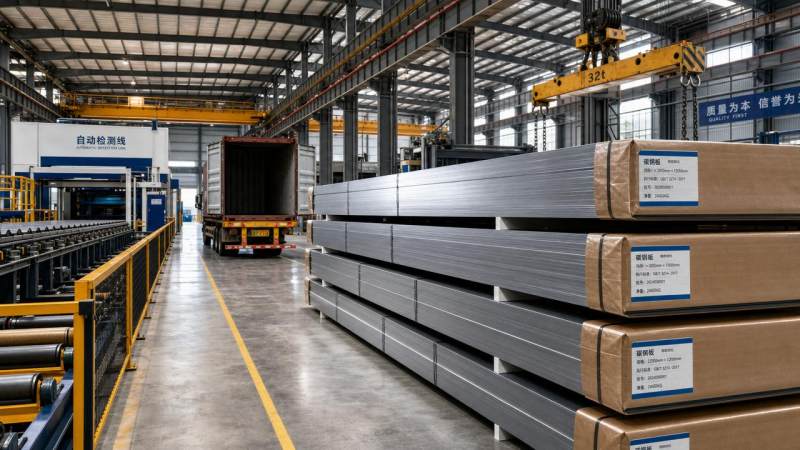
Choosing the right carbon steel sheet supplier can directly affect pricing stability, delivery reliability, and long-term customer trust.
Beyond competitive costs, a dependable partner should provide consistent quality, flexible specifications, international compliance, and responsive export support.
For steel trading, construction, manufacturing, and industrial supply chains, supplier selection is not only a purchasing decision.
It is a risk-control decision that influences project schedules, inventory planning, and customer retention.
What Defines a Reliable Carbon Steel Sheet Supplier?
A reliable carbon steel sheet supplier does more than quote a low unit price.
The real value comes from stable material performance, transparent communication, and predictable delivery execution.
Carbon steel sheets are widely used in structures, machinery, fabrication, containers, automotive parts, and industrial components.
Different applications may require specific grades, thickness tolerances, surface conditions, and mechanical properties.
A good carbon steel sheet supplier understands these differences before confirming production or shipment.
This ability helps reduce mismatch, rework, claim disputes, and costly delivery delays.
Key signs of dependable supply
- Clear product specifications and available steel grades.
- Documented quality inspection and mill test certificates.
- Consistent thickness, flatness, surface finish, and edge condition.
- Export experience with packaging, customs documents, and logistics.
- Responsive support before, during, and after shipment.
When these elements are missing, even a cheap offer can become expensive during implementation.
How Important Is Material Quality and Standard Compliance?
Quality is the core difference between an ordinary vendor and a professional carbon steel sheet supplier.
Carbon steel sheet performance depends on chemistry, rolling process, heat control, thickness accuracy, and surface protection.
For international projects, compliance with standards such as ASTM, EN, JIS, or GB is especially important.
A qualified carbon steel sheet supplier should provide traceable documentation that matches the agreed grade and specification.
This documentation may include chemical composition, tensile strength, yield strength, elongation, and dimensional inspection results.
Without proper records, downstream acceptance becomes harder, especially for infrastructure and industrial fabrication projects.
Why inspection consistency matters
Quality should not depend on one successful shipment.
A professional carbon steel sheet supplier maintains repeatable inspection procedures across different batches and order sizes.
Stable quality allows distributors to build confidence with customers who require repeat orders and predictable fabrication results.
Hongteng Fengda supports global structural steel projects with strict quality control and products aligned with major international standards.
This background is valuable when buyers need both standard steel products and customized structural steel solutions.
Can the Supplier Support Flexible Specifications and Related Steel Needs?
A strong carbon steel sheet supplier should not treat every inquiry as a fixed catalog order.
Real projects often require adjustments in thickness, size, surface finish, cutting method, packaging, or delivery schedule.
Flexibility is especially important when serving construction, machinery, bridge, rail, and industrial fabrication markets.
A supplier with wider structural steel capability can support mixed orders and reduce coordination complexity.
For example, structural projects may combine sheets with angle steel, channel steel, beams, cold formed profiles, or customized components.
Hongteng Fengda also supplies Rail for applications such as railway tracks, bridge railings, deck handrails, and industrial guide systems.
Available materials include carbon steel and medium manganese steel, with models such as U74, U71Mn, PD2, PD3, Q235, and 55Q.
Typical lengths range from 12m to 30m, with finishes including oil, black, galvanized, and painted surfaces.
Such product range shows whether a steel exporter can handle broader project needs beyond one single product line.
How Do Delivery, Stock, and Export Experience Affect Supplier Choice?
Delivery reliability is one of the most practical tests for a carbon steel sheet supplier.
Late shipments can interrupt fabrication schedules, delay site installation, and create extra inventory pressure.
A capable supplier should communicate production status, loading plans, vessel schedules, and document preparation clearly.
For export orders, experience matters because steel cargo requires suitable bundling, anti-rust protection, labeling, and container planning.
A good carbon steel sheet supplier understands how to protect sheets during ocean transportation and inland handling.
This prevents surface damage, deformation, moisture issues, and unloading disputes at destination ports.
Questions to ask before confirming shipment
- Is the required grade in stock or produced after order confirmation?
- What is the realistic lead time, including inspection and packing?
- Can the supplier provide photos before loading?
- Are mill test certificates and export documents prepared on time?
- Who handles communication if port or customs issues occur?
A dependable carbon steel sheet supplier will answer these questions directly instead of avoiding operational details.
What Pricing Factors Should Be Compared Beyond the Quotation?
Price comparison is necessary, but the lowest number is not always the best sourcing choice.
A carbon steel sheet supplier may quote lower by reducing thickness tolerance, changing origin, limiting inspection, or using weaker packaging.
These differences can create hidden costs after delivery.
The right comparison should include steel grade, actual weight, tolerance range, surface quality, packaging, payment terms, and lead time.
Stable pricing also depends on production capacity, raw material sourcing, and supplier inventory management.
A trustworthy carbon steel sheet supplier explains market changes without sudden, unclear price adjustments.
What Risks Appear When Choosing the Wrong Supplier?
The wrong carbon steel sheet supplier can create problems that are difficult to fix after arrival.
Common risks include inconsistent thickness, incorrect grade, poor flatness, rust, missing certificates, and unstable communication.
In some cases, the shipment may meet a vague quotation but fail actual customer requirements.
This is why detailed specification confirmation is essential before payment and production.
A dependable carbon steel sheet supplier will clarify technical details instead of rushing order confirmation.
Warning signs to avoid
- The quotation lacks grade, standard, or tolerance details.
- Certificates are promised but not shown clearly.
- Delivery time sounds unrealistic compared with stock status.
- Packaging details are ignored for ocean shipment.
- Communication becomes slow after payment discussion begins.
Avoiding these risks protects both immediate orders and long-term customer relationships.
FAQ: How to Evaluate a Carbon Steel Sheet Supplier?
How to Make the Final Supplier Decision?
A good carbon steel sheet supplier combines material quality, specification flexibility, cost control, and export reliability.
The decision should be based on facts, not only promises or attractive pricing.
Before confirming an order, prepare a clear requirement sheet covering grade, dimensions, tolerance, surface, quantity, destination, and deadline.
Then compare supplier responses according to clarity, technical understanding, document support, and delivery feasibility.
Hongteng Fengda provides structural steel products and customized solutions for global construction, industrial, and manufacturing projects.
With modern facilities, strict quality control, and export experience, it supports stable sourcing across multiple regions.
For long-term cooperation, choose a carbon steel sheet supplier that reduces uncertainty and communicates before problems appear.
The next step is to share your required specification, target standard, order quantity, and delivery plan for a practical supply proposal.
Please give us a message


Please enter what you want to find