Choosing a reliable Stainless Steel Welded Mesh exporter is critical for stable sourcing in steel-related projects. Quality, traceability, and delivery consistency directly affect installation results, compliance, and long-term cost control.
In global trade, a capable Stainless Steel Welded Mesh exporter does more than ship goods. It supports specification matching, document accuracy, production visibility, and risk reduction across procurement, logistics, and final application.
Core Definition of a Reliable Stainless Steel Welded Mesh Exporter
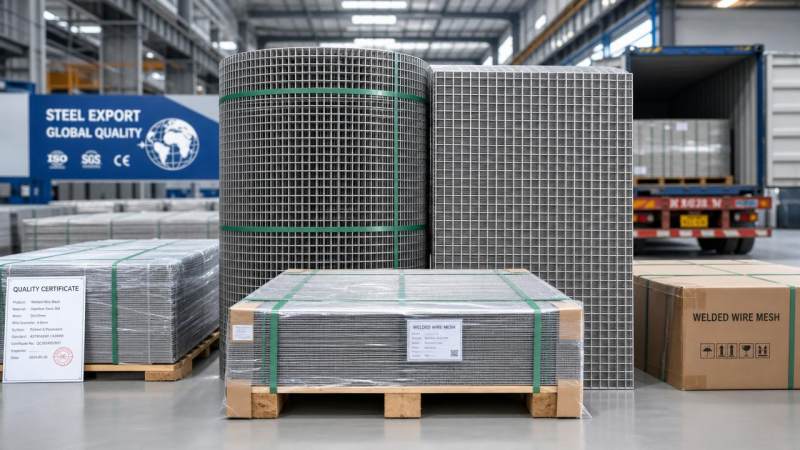
A reliable Stainless Steel Welded Mesh exporter consistently supplies welded mesh that meets agreed standards, dimensions, and performance requirements. Reliability is measured by repeatability, not by one successful shipment.
In the steel industry, welded mesh is often used in fencing, filtration support, guarding, architectural infill, and industrial partition systems. Stainless grades are preferred where corrosion resistance and hygiene matter.
Therefore, the best Stainless Steel Welded Mesh exporter should combine material knowledge, controlled welding processes, inspection discipline, and export execution. These factors build confidence beyond price comparison alone.
Key traits behind exporter reliability
- Clear grade identification and mill traceability
- Stable wire diameter and mesh opening accuracy
- Documented welding quality and surface condition control
- Experience with international packaging and shipping
- Responsive communication before and after delivery
Current Market Signals in Stainless Steel Welded Mesh Export
The global market increasingly values consistency over low headline pricing. Buyers compare total sourcing risk, including rework, customs delay, corrosion failure, and dimensional mismatch in field installation.
For that reason, every Stainless Steel Welded Mesh exporter is being judged on quality systems, test records, and delivery discipline. The market favors suppliers that can prove control, not just promise it.
This trend also benefits established Chinese steel exporters with modern facilities. Companies with standard-based production and strict quality control can better support international sourcing expectations.
Hongteng Fengda, as a structural steel manufacturer and exporter from China, represents this direction. Its export experience, production capacity, and compliance focus help reduce sourcing uncertainty across global projects.
What Buyers Should Evaluate Beyond Product Price
Price remains important, but it is never the only indicator of a reliable Stainless Steel Welded Mesh exporter. Low quotations can hide weak raw material control, poor welding quality, or inconsistent packing standards.
1. Material authenticity
The exporter should identify stainless grades accurately and provide supporting test documents when required. Material origin, heat number records, and composition control are essential for serious applications.
2. Manufacturing capability
Welded mesh quality depends on wire preparation, resistance welding stability, flatness control, cutting precision, and surface finishing. Good machinery must be matched by disciplined process inspection.
3. Standard compliance
A trustworthy Stainless Steel Welded Mesh exporter understands ASTM, EN, JIS, and GB references where relevant. This matters when projects require documented alignment with local or contract standards.
4. Packaging and export readiness
Mesh panels and rolls can deform or corrode during transit if packed poorly. Export-safe pallets, edge protection, moisture control, and clear marks improve cargo condition on arrival.
5. Communication discipline
Reliable exporters answer technical questions clearly, confirm tolerances in writing, and update production schedules honestly. Good communication prevents errors before they become expensive problems.
This same principle applies across steel categories. In many projects, mesh sourcing is coordinated with sections, beams, and transport components such as Rail.
That product range includes grades such as U74, U71Mn, PD2, Q235, 55Q, and 50Q. Lengths can reach 12m-30m, with thickness from 3mm to 24mm, depending on project needs.
Common applications include railway systems, bridge railings, and deck handrails. Available finishes may include oil, black, galvanized, or painted surfaces, supported by ISO9001-2008 and ISO14001:2004 management standards.
Business Value of Choosing the Right Stainless Steel Welded Mesh Exporter
A proven Stainless Steel Welded Mesh exporter creates value throughout the project lifecycle. The benefit appears in fewer claims, smoother installation, better stock planning, and lower total cost of ownership.
- Less risk of receiving mixed or incorrect stainless grades
- Fewer dimensional deviations during assembly
- Improved resistance to corrosion-related replacement
- More predictable import and warehousing planning
- Better support for repeat orders and multi-project supply
For steel-intensive sectors, reliability also supports internal efficiency. Stable supply allows more accurate budgeting and reduces emergency procurement, which often causes higher costs and weaker technical control.
This is why many international buyers prefer exporters with broad steel experience, not only narrow product trading backgrounds. A manufacturer-exporter can often coordinate technical details more effectively.
Typical Application Categories and Sourcing Priorities
Different applications place different demands on a Stainless Steel Welded Mesh exporter. Understanding the end use helps define the right mesh size, wire diameter, finish, and documentation level.
When exporters ask detailed application questions, that is usually a positive sign. It indicates technical awareness rather than simple price-driven trading behavior.
Practical Checks Before Confirming an Export Order
Before selecting a Stainless Steel Welded Mesh exporter, several practical checks can improve decision quality and reduce future disputes. These steps are simple but highly effective.
- Confirm material grade, wire diameter, mesh opening, and panel size in writing.
- Request sample photos, inspection records, or a pre-shipment checklist.
- Review packing details, labeling method, and container loading plan.
- Verify lead time assumptions, including raw material availability.
- Check experience with destination-country export documents.
- Clarify claim handling rules for quantity or quality discrepancies.
If the supplier also handles structural steel sections, channels, beams, or custom profiles, coordination may become easier for multi-item shipments. This can lower freight complexity and improve delivery planning.
Experienced Chinese exporters often add value through OEM support, standard and non-standard production, and dependable scheduling. These strengths are especially useful for ongoing infrastructure and industrial supply programs.
Next-Step Approach for Long-Term Supply Stability
The most reliable Stainless Steel Welded Mesh exporter is one that proves consistency over time. Selection should be based on verifiable control, export execution, and willingness to align with project specifications.
A structured review process works best. Compare suppliers by certificates, sample quality, production transparency, and shipment records rather than by unit price alone.
For steel sourcing programs that require quality, standards compliance, and dependable delivery, working with an experienced manufacturer-exporter from China can reduce uncertainty and improve project performance.
If the goal is stable supply across welded mesh and related steel products, start with a clear technical specification list, request supporting documents, and evaluate response quality before placing volume orders.
Please give us a message


Please enter what you want to find