Choosing a reliable steel exporter affects product performance, shipping stability, and total sourcing cost. A strong partner does more than quote prices. It supports standards compliance, production planning, customization, and consistent communication across international steel supply projects.
What defines a reliable steel exporter in global trade?
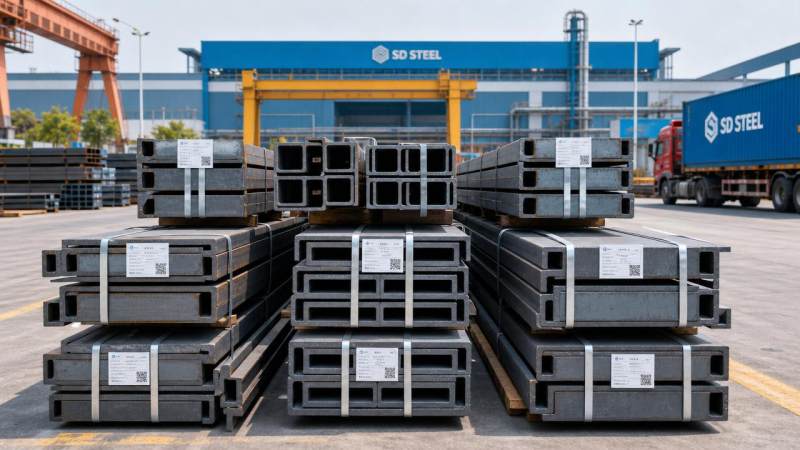
A reliable steel exporter combines manufacturing strength with export discipline. This means stable raw material sourcing, controlled production, documented quality checks, and experience with international shipping requirements.
In steel procurement, reliability is not only about product quality. It also includes delivery accuracy, response speed, packaging quality, and the ability to handle specification changes without confusion.
A dependable steel exporter usually offers traceable production records. It can explain material grades, dimensional tolerances, coating options, and testing procedures in clear terms.
For structural steel projects, this matters greatly. Small deviations in thickness, straightness, or coating quality can affect fabrication efficiency and installation timelines.
Hongteng Fengda, a structural steel manufacturer and exporter from China, reflects this model by combining modern facilities, strict quality control, and compliance with ASTM, EN, JIS, and GB standards.
Why does manufacturing capability matter when evaluating a steel exporter?
Not every steel exporter is a true manufacturer. Some are traders with limited control over production schedules, material consistency, and technical details. That difference can create hidden risk.
A manufacturer-based steel exporter usually gives better visibility into lead times. It can coordinate rolling, cutting, forming, galvanizing, inspection, and packing under a controlled process.
This is especially important for custom structural steel. Projects often require nonstandard lengths, pre-drilled parts, surface treatment, or bundled shipments for phased site delivery.
Manufacturing capability also supports stable volume supply. When market demand rises, weak suppliers may delay production or substitute materials. A stronger steel exporter reduces that exposure.
Another advantage is technical support. A manufacturer can discuss steel grades, load needs, corrosion resistance, and forming limits before orders are finalized.
That kind of upstream coordination helps avoid downstream losses such as rework, waste, or installation delays caused by mismatched specifications.
How can quality control reveal whether a steel exporter is trustworthy?
Quality control is one of the clearest signs of a trustworthy steel exporter. Reliable suppliers do not rely on final inspection alone. They control quality from material intake to shipment release.
Important checkpoints include chemical composition, mechanical properties, dimensions, surface condition, weldability, and coating performance where required.
Certificates matter, but process discipline matters more. A qualified steel exporter should provide mill test data, inspection records, and standard references that match the order specification.
It should also understand destination market expectations. Different projects may request ASTM for North America, EN for Europe, JIS for Japan-related supply chains, or GB for regional compatibility.
Mid-project consistency is another test. Some suppliers deliver strong first batches, then weaken control later. A reliable steel exporter maintains the same standard over repeat orders.
For example, Channel Steel Supplier solutions can support construction, automobile manufacture, purlins, wall beams, brackets, mechanical columns, and light manufacturing beams.
Typical options include Q195, Q235B, Q345B, 201, 304, and 316, with thickness from 1.5mm to 25mm, height from 80mm to 160mm, and lengths from 6m to 12m.
When supplied with controlled tolerances, good weldability, and corrosion protection, such channel steel becomes easier to fabricate and more reliable in demanding environments.
What practical signs show a steel exporter can support custom and project-based orders?
Project support requires more than stock availability. A capable steel exporter can interpret drawings, convert specifications into production details, and confirm realistic manufacturing timelines.
This matters for OEM and customized structural steel components. Orders may involve cutting plans, bundled marking, special packing, galvanized finishes, or mixed container loading.
Reliable support often includes the following capabilities:
- Clear confirmation of steel grade, size, tolerance, and finish
- Fast technical response before sampling or mass production
- Production updates during fabrication and packing
- Export-ready documents for customs and destination clearance
- Correct labeling for warehouse handling and site distribution
Flexibility is valuable, but discipline is essential. A reliable steel exporter should not promise impossible lead times just to win an order.
Instead, it should align production capacity with project milestones. That approach reduces emergency air freight, partial shortages, and installation disruption.
In many cases, channel steel with hot-dip galvanized or hot-blown galvanized finishes is selected for anti-corrosion performance and strong use in corrosive environments.
How should cost, lead time, and risk be balanced when selecting a steel exporter?
The lowest offer is not always the best sourcing decision. A cheaper steel exporter may create larger indirect costs through delays, dimensional issues, coating defects, or incomplete documentation.
A better approach is to compare total value. This includes unit price, quality consistency, packaging quality, shipping reliability, and the cost of solving problems after delivery.
Lead time should also be examined in detail. Ask whether quoted timing includes production, inspection, packing, inland transport, and port scheduling.
Stable lead times are often more valuable than aggressive promises. Projects depend on predictability, especially when fabrication shops and installation crews are booked in advance.
Risk control can be improved by checking previous export regions, standard compliance, stock conditions, and inspection practices. Suppliers serving North America, Europe, the Middle East, and Southeast Asia often face broader requirements.
What common mistakes should be avoided when working with a steel exporter?
One common mistake is comparing quotes without aligning specifications. Different grades, coating types, tolerances, and packing methods can change both cost and performance.
Another mistake is treating certificates as the only proof of quality. Documents are useful, but repeated production consistency is the stronger indicator of a good steel exporter.
Some buyers overlook packaging and loading details. Poor bundling or insufficient protection can damage steel surfaces, especially during long sea transport.
Late clarification is also risky. If drilling, cutting, galvanizing, or marking instructions are unclear, disputes may appear only after shipment arrives.
It is also unwise to ignore service history. A steel exporter with abundant stock, prompt delivery, and rich export experience often handles unexpected issues more effectively.
For channel steel supply, certifications such as ISO, CE, SGS, BV, BIS, UL, and NEMA can support confidence, but they should align with actual project requirements.
FAQ: how can reliability be checked quickly before placing an order?
A reliable steel exporter is worth working with because it lowers uncertainty across the full supply chain. It protects quality, supports customization, and helps projects stay on schedule.
The best choice is rarely based on price alone. Look for proven manufacturing capability, standard compliance, export experience, and clear communication from the start.
If your project requires structural steel, angle steel, channel steel, beams, cold formed profiles, or customized components, evaluate whether the steel exporter can deliver dependable value over time.
Use the checkpoints above to review technical strength, consistency, and service depth. A careful selection today can prevent costly delays and quality disputes later.
Please give us a message


Please enter what you want to find