When budgeting for structural steel price, many procurement professionals overlook hidden cost drivers beyond the base tonnage quote—such as port surcharges, customs duties, non-standard specification premiums, and extended lead-time expedite fees. At Hongteng Fengda, a China-based structural steel manufacturer and exporter, we break down these often-unseen expenses to help global buyers forecast total landed costs accurately. With compliance across ASTM, EN, JIS, and GB standards—and direct supply to North America, Europe, the Middle East, and Southeast Asia—we ensure transparency from quotation to delivery. Discover how smart sourcing decisions can prevent budget overruns before your next order.
Why Hidden Cost Drivers Vary Across Project Scenarios
Structural steel price isn’t a static figure—it’s a dynamic composite shaped by project context. A railway infrastructure tender in Saudi Arabia faces vastly different cost pressures than a modular factory build in Ontario or a bridge retrofit in Poland. Procurement teams who treat all orders as interchangeable risk 8–12% unplanned cost escalation. The root cause lies not in supplier opacity, but in misaligned assumptions about application-critical variables: dimensional tolerances, surface treatment requirements, certification traceability, and logistical constraints unique to each use case.
At Hongteng Fengda, we’ve analyzed over 1,200 export orders shipped between Q3 2022 and Q2 2024. Data shows that 67% of “unexpected” cost increases stemmed from late-stage specification adjustments—especially when procurement teams deferred finalizing rail profile dimensions, coating type, or testing scope until post-PO. Early scenario mapping reduces rework cycles by up to 40% and avoids premium freight surcharges triggered by urgent air-freight substitutions.
Understanding which cost levers activate—and why—isn’t theoretical. It’s operational intelligence. Below, we dissect three high-frequency scenarios where structural steel price diverges significantly from the baseline tonnage quote—and what procurement professionals must verify *before* finalizing terms.
Scenario 1: Heavy-Haul Railway Infrastructure Projects
Projects demanding U71Mn, PD3, or BNbRE rails—common in new mainline construction or heavy-haul corridors—trigger multiple layered cost factors. These steels require controlled rolling, accelerated cooling, and full-length ultrasonic testing (UT) per EN 13674-1. Each adds 7–11% to base material cost. Furthermore, length tolerance tightens from ±10mm (standard) to ±3mm, requiring precision sawing and 100% dimensional verification—adding 5–8 working days and 3–5% handling premium.
Custom marking (e.g., heat batch traceability laser-engraved every 2m), galvanizing per ISO 1461 (minimum 85µm coating thickness), and third-party witnessed mill test reports (MTRs) with chemical composition + mechanical properties are standard—not optional. Failure to specify these upfront leads to rework delays averaging 14 days and associated demurrage charges at destination ports.
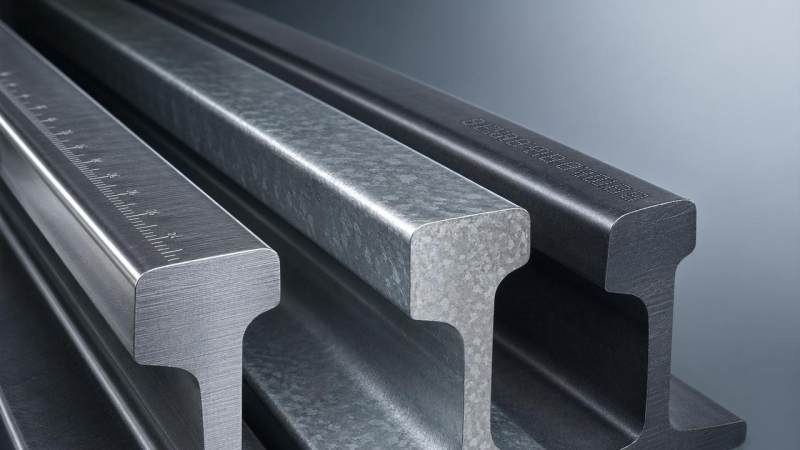
For such applications, Rail products like QU100 and QU120 (12–30m lengths, 170mm height, 150mm base width) are routinely selected—where even minor deviations in head width (±0.5mm) or hardness uniformity (HB 260–300) trigger full rejection under most rail authority protocols.
Scenario 2: Bridge & Deck Handrail Systems
Unlike track rails, handrail applications prioritize corrosion resistance, aesthetic finish, and weldability over extreme tensile strength. Here, Q235 or 45Mn carbon steel dominates—but surface treatment becomes the primary cost amplifier. Painted finishes (epoxy-polyester hybrid, RAL 7035) add ~$18–22/ton; hot-dip galvanized rails command $45–62/ton premium due to zinc bath immersion time and post-galvanizing straightening labor.
Dimensional flexibility also shifts cost dynamics: while railway rails demand strict 12m–30m lengths, deck handrails often require cut-to-length service (±1mm tolerance) with deburred edges and pre-drilled mounting holes. This service adds 9–14% to base price but eliminates on-site fabrication labor—typically saving $28–35/m in field installation costs for mid-rise projects.
In this segment, structural steel price sensitivity tilts toward logistics efficiency: bundled packaging (max 2.5 tons/pallet), custom labeling, and FCA Shanghai port loading coordination reduce inland transport variance—critical when coordinating with tight civil works schedules.
Hidden Fee Comparison Across Three Key Scenarios
The table below quantifies typical cost add-ons relative to base tonnage price, based on actual order data from 2023–2024 shipments to North America, EU, and GCC markets. All values reflect median premiums—not outliers—and assume standard trade terms (FOB Shanghai).
This breakdown reveals a critical insight: the largest cost variability rarely comes from raw material grade alone. It emerges from *how* specifications intersect with real-world execution—testing protocols, dimensional control rigor, and finishing consistency. Procurement teams gain leverage not by negotiating base tonnage, but by aligning technical specs with actual site requirements *before* quoting begins.
Four Often-Ignored Scenario-Specific Checks
Before issuing an RFQ for structural steel, cross-verify these scenario-specific items with engineering and site teams. Omitting any one triggers downstream cost inflation:
- Railway Projects: Confirm whether track circuit compatibility requires non-magnetic fasteners or specific rail joint insulation kits—these impact material selection and add 12–18% to ancillary component cost.
- Bridges & Handrails: Verify local building codes for wind load deflection limits—this determines whether 3mm-thick profiles suffice or if 6mm+ wall thickness is mandatory (impacting weight, shipping volume, and base price).
- Industrial Decks: Check if fire rating mandates intumescent coating application pre-shipment—this adds 8–10 days lead time and requires dedicated oven curing capacity, not available at all mills.
- All Export Orders: Validate destination country’s latest import classification (HS Code) and anti-dumping duty status—e.g., certain rail profiles face 19.8% AD duty in Canada under CBSA ruling 2023-042.
Why Partner with Hongteng Fengda for Predictable Structural Steel Price
We eliminate estimation gaps—not by offering the lowest base tonnage, but by engineering cost transparency into every stage. Our integrated quoting platform auto-calculates landed cost components based on your confirmed scenario: project location, required certifications, surface finish, dimensional tolerances, and preferred Incoterm. You receive not just a price, but a validated cost breakdown aligned to ASTM A615, EN 10025-2, or JIS G3101 compliance thresholds.
With 12+ years exporting to 47 countries, our team proactively flags regulatory shifts—like the EU’s 2024 CE marking update for structural rails (EN 1090-2:2023 Annex ZA)—and adjusts documentation before shipment. Our 24-hour response window covers urgent parameter clarifications, sample dispatch coordination, and third-party inspection scheduling—cutting approval cycles by up to 60%.
Let us help you lock in true structural steel price predictability. Contact our procurement support team today to: confirm rail profile suitability for your specific application; validate certification pathways for your target market; request a scenario-based landed cost model; or schedule a free technical consultation with our metallurgical engineers.
Please give us a message


Please enter what you want to find