For procurement professionals, understanding the factors behind 1 1 2 stainless steel pipe price is essential for controlling budgets and reducing sourcing risks. From raw material costs and grade selection to wall thickness, surface finish, order volume, and global supply conditions, every detail can influence today’s pricing. This article explains the key cost drivers and helps buyers make more informed and competitive purchasing decisions.
What 1 1 2 Stainless Steel Pipe Price Means in Today’s Steel Market
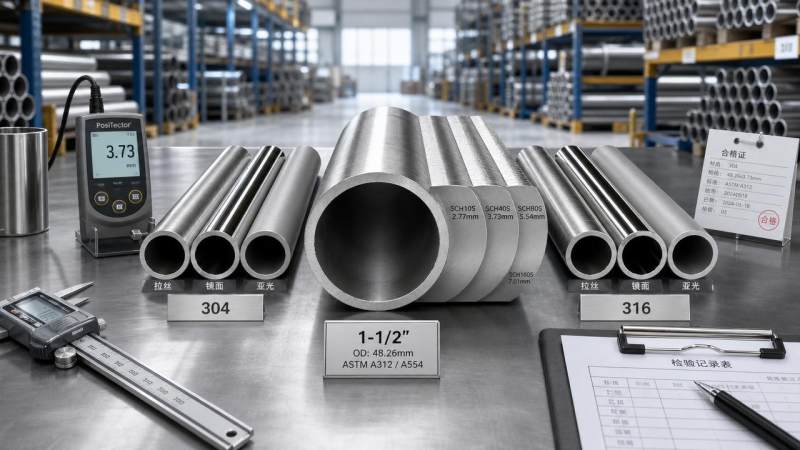
The term 1 1 2 stainless steel pipe price usually refers to the market cost of 1-1/2 inch stainless steel pipe in a specific grade, size, and finish.
This price is never based on diameter alone. Buyers must also review schedule, wall thickness, alloy family, production method, and delivery requirements.
In the steel industry, small specification changes often create meaningful price differences. That is why today’s quote may vary across suppliers and regions.
When discussing 1 1 2 stainless steel pipe price, the most common reference grades are 201, 304, 316, and duplex alternatives for demanding environments.
A reliable comparison should always match standard, unit length, tolerance, and testing scope. Without that, low prices can hide specification gaps.
Core Cost Drivers Behind 1 1 2 Stainless Steel Pipe Price
Raw material cost is the first major driver. Nickel, chromium, molybdenum, and scrap steel prices directly influence stainless pipe production cost.
Grade selection is equally important. A 316 pipe usually costs more than 304 because of added molybdenum and stronger corrosion resistance.
Wall thickness changes weight per meter. Heavier schedules require more steel, so the 1 1 2 stainless steel pipe price rises accordingly.
Manufacturing route matters as well. Seamless pipe often costs more than welded pipe because of more complex processing and stricter dimensional control.
Surface finish also affects final cost. Pickled, polished, or sanitary finishes require additional processing, inspection, and handling.
Testing and certification can add value and expense. Requirements such as PMI, hydro testing, EN 10204 3.1 documents, or third-party inspection influence pricing.
Main variables to check in every quote
- Steel grade: 201, 304, 316, duplex
- Pipe type: seamless or welded
- Schedule and wall thickness
- Surface finish and end treatment
- Length, tolerance, and packing method
- Standards and test certificate requirements
Current Market Signals That Affect 1 1 2 Stainless Steel Pipe Price Today
Today’s 1 1 2 stainless steel pipe price is closely linked to global steel and alloy market movement. Stainless pricing reacts faster than many carbon steel products.
Energy cost remains a strong factor. Melting, rolling, welding, and heat treatment all consume significant power, especially in large-scale production.
Freight volatility also matters. Ocean shipping, inland trucking, container availability, and port congestion can shift total landed cost quickly.
Trade policy may create sudden changes. Anti-dumping rules, import duties, and customs procedures often reshape regional stainless steel pipe competitiveness.
Lead time pressure can raise prices during peak demand. Fast delivery orders often require priority production and less flexible inventory planning.
Why Specification Matching Matters More Than a Low Unit Price
A lower 1 1 2 stainless steel pipe price can look attractive, but incomplete specifications often create hidden cost later.
Different standards may allow different tolerance ranges. If dimensions are inconsistent, fabrication loss and installation delays can offset any early savings.
Corrosion environment must also match the selected grade. A cheap option may fail faster in chloride, marine, or chemical service.
Documentation quality is another pricing factor. Mill test certificates, heat numbers, and traceability support quality assurance and project compliance.
This same logic applies across broader steel sourcing. For example, projects involving marine retaining structures may compare specification value, not only base cost.
In such cases, Steel Sheet Piles are often selected for high strength, deep-water construction, and reusable cofferdam solutions.
Available grades include S275, S355, S390, S430, SY295, SY390, and ASTM A690, with standards such as EN10248, EN10249, JIS5528, JIS5523, and ASTM.
Common Purchasing Scenarios for 1 1 2 Stainless Steel Pipe Price Evaluation
Different projects review 1 1 2 stainless steel pipe price through different priorities. The same size pipe does not serve every application equally.
These scenarios show why the best 1 1 2 stainless steel pipe price is not always the cheapest quote. It is the most suitable total cost.
Practical Ways to Control 1 1 2 Stainless Steel Pipe Price Without Lowering Quality
Start by confirming the actual service environment. Correct grade selection prevents over-specifying or under-specifying the material.
Standardize dimensions whenever possible. Fewer custom lengths and more common schedules usually improve production efficiency and pricing stability.
Bundle orders when timing allows. Larger consolidated quantities often reduce per-ton processing, packaging, and shipping costs.
Request clear quote breakdowns. Material, processing, testing, packing, and freight should be shown separately for better comparison.
Check inventory options against mill production. In some periods, stock material offers faster delivery and lower total cost than new rolling.
Evaluate supplier quality systems carefully. Consistent mills with ASTM, EN, JIS, and GB compliance can reduce claim risk and project interruption.
Recommended quotation checklist
- Confirm outside diameter, wall thickness, and length.
- Define stainless grade and required standard.
- Specify seamless or welded construction.
- State finish, end preparation, and packing.
- List inspection, documents, and destination port.
Business Value of Working With a Stable Structural Steel Supply Partner
Stable sourcing is important when tracking 1 1 2 stainless steel pipe price and related steel categories across international projects.
Hongteng Fengda is a professional structural steel manufacturer and exporter from China, supporting global construction, industrial, and manufacturing demand.
The company supplies angle steel, channel steel, steel beams, cold formed profiles, and customized structural steel components under strict quality control.
Products comply with major international standards, including ASTM, EN, JIS, and GB, helping reduce sourcing uncertainty across different project requirements.
With service experience in North America, Europe, the Middle East, and Southeast Asia, supply continuity and dependable lead times become easier to manage.
Action Points for Evaluating 1 1 2 Stainless Steel Pipe Price Today
To assess 1 1 2 stainless steel pipe price accurately, compare like-for-like specifications first. Then review alloy movement, process route, testing scope, and logistics.
A strong buying decision combines market awareness with technical clarity. That approach helps control budget while protecting long-term performance.
Before requesting offers, prepare a complete technical list and target delivery window. This simple step improves quote quality and supports faster supplier feedback.
When the project includes multiple steel products, coordinated sourcing can also improve freight efficiency and negotiation results across the wider steel package.
Please give us a message


Please enter what you want to find