Choosing a dependable steel wire rope supplier is about more than price—it means consistent quality, certified standards, and reliable delivery for demanding projects. Whether you source from a steel wire rope manufacturer or compare related materials like angle iron for construction, deformed rebar for concrete, and structural steel bending solutions, the right partner helps reduce risk, improve performance, and support long-term project success.
For buyers, engineers, project managers, and quality teams, supplier reliability directly affects lifting safety, installation efficiency, shutdown risk, and total procurement cost. In steel-related industries, a weak supply partner can create delays of 2–6 weeks, inconsistent mechanical performance, documentation gaps, or traceability issues that only become visible after goods arrive on site.
A reliable supplier stands out through verifiable production control, responsive communication, standard compliance, and the ability to support related structural steel requirements. For global buyers working across construction, industrial manufacturing, marine handling, or infrastructure projects, the real question is not simply who can quote faster, but who can deliver stable quality shipment after shipment.
Why Reliability Matters More Than Initial Price
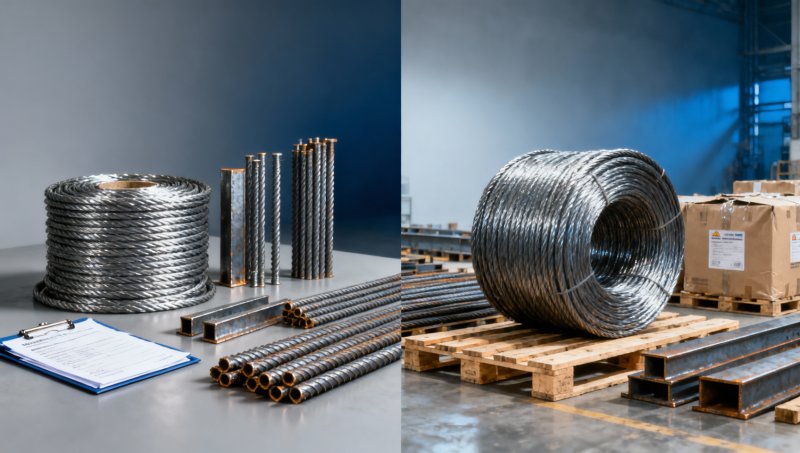
Steel wire rope is often used in applications where failure is not a minor inconvenience but a serious operational and safety event. Cranes, hoists, mining systems, marine equipment, and industrial handling lines depend on predictable tensile behavior, fatigue resistance, and dimensional consistency. A supplier that cuts corners on material selection or process control may offer a lower unit price, yet the downstream cost can be several times higher.
In many B2B projects, the purchase value of the rope itself may represent only 5%–15% of the total installed system cost. However, if the delivered rope lacks certification, has uneven lay, inconsistent diameter tolerance, or poor lubrication, the project may face reinspection, replacement labor, equipment downtime, or even compliance penalties. This is why experienced procurement teams evaluate reliability before negotiating the final number.
A dependable supplier also reduces communication risk. Fast replies within 24 hours, clear technical documentation, and transparent lead time updates are practical signs of operational discipline. For overseas projects, especially those moving cargo between Asia, Europe, North America, or the Middle East, this level of responsiveness matters as much as the product itself.
Hidden costs behind a low-price offer
Some offers look attractive because they exclude key elements such as third-party inspection, export packing, test records, or controlled production schedules. Once these are added later, the original price advantage often disappears. Worse, buyers may discover after delivery that the rope does not match the specified standard or intended duty cycle.
- Shorter service life due to poor wire quality or inconsistent strand compaction
- Higher maintenance frequency, sometimes increasing inspection intervals from monthly to weekly
- Project delays caused by missing mill test certificates or incorrect marking
- Unexpected replacement and freight costs when batch quality varies
These issues are not theoretical. In industrial procurement, batch inconsistency is one of the most common reasons buyers change suppliers after 1–2 purchase cycles. Reliability, therefore, should be assessed as a measurable supply capability rather than a marketing claim.
The table below shows how purchase decisions differ when buyers focus only on price versus total operating value.
The key takeaway is simple: the lowest quote may reduce purchase cost on paper, but reliable sourcing usually lowers lifecycle risk, protects project schedules, and supports safer operation over the full service period.
Core Signs of a Reliable Steel Wire Rope Supplier
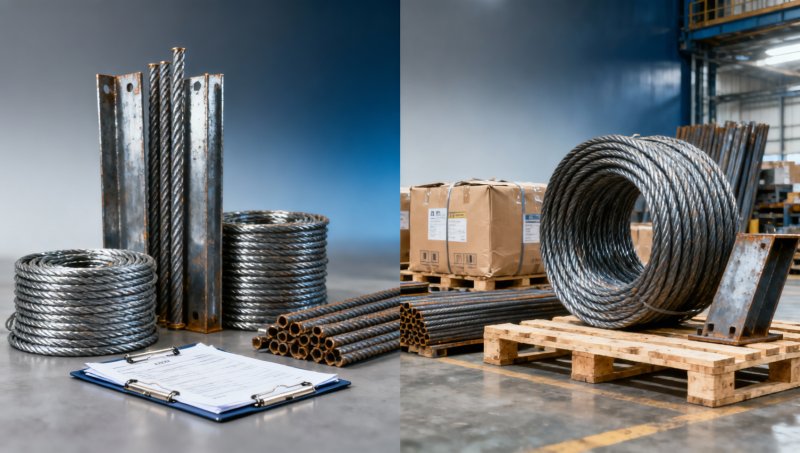
A trustworthy supplier should be evaluated through evidence, not impressions. The best partners can explain raw material sourcing, production controls, testing methods, packaging standards, and export procedures in a way that both technical teams and commercial buyers can verify. Reliability is visible in process transparency.
For example, strong suppliers usually work with clear specification matching. They confirm rope construction, diameter tolerance, breaking load requirements, surface finish, lubrication type, and end-use conditions before production begins. This reduces mismatch risk and improves first-order accuracy, which is especially important for projects with installation windows of only 7–10 days.
Documentation is another differentiator. A dependable partner provides mill test certificates, inspection reports, packing lists, standard references, and shipment marks in a consistent format. For international buyers, this improves customs clearance and internal quality review.
Key evaluation checkpoints
1. Production and quality discipline
Ask how the supplier controls dimensional variation, wire cleanliness, tensile properties, and final inspection frequency. Even when exact values differ by product type, a serious supplier should define checkpoints at raw material entry, in-process control, and pre-shipment inspection. A 3-stage inspection structure is common in better-managed operations.
2. Standards and export readiness
International buyers often require alignment with ASTM, EN, JIS, or GB-related specifications depending on end market and project documents. A supplier experienced in export business should understand how to prepare markings, bundled packing, seaworthy packaging, and document sets for multiple regions.
3. Communication and problem-solving
If a supplier takes 4–5 days to clarify a technical point during quotation, it is reasonable to expect similar delays during production or after-sales support. Reliable partners typically reply in less than 24–48 hours, issue revised drawings or confirmations quickly, and provide realistic, not optimistic, lead times.
The following checklist can help procurement, QA, and engineering teams evaluate suppliers in a structured way before placing a bulk order.
When suppliers can answer these points clearly and consistently, buyers gain stronger confidence not only in the current order but also in long-term sourcing stability.
How Strong Steel Supply Capabilities Support Wire Rope Buyers
In practice, many buyers do not source steel wire rope in isolation. They often manage broader material packages that include structural sections, fabricated steel parts, and corrosion-resistant piping for industrial systems. This is where a supplier or manufacturing group with wider steel expertise can create additional value by reducing vendor fragmentation.
Hongteng Fengda, as a structural steel manufacturer and exporter from China, supports global construction, industrial, and manufacturing projects with angle steel, channel steel, steel beams, cold formed steel profiles, and customized structural steel components. For procurement teams handling multi-category purchases, this kind of manufacturing background improves coordination across specifications, packaging plans, and delivery schedules.
This broader capability matters when a project includes support frames, handling structures, machinery bases, or corrosion-resistant pipelines alongside lifting and tensile components. Instead of managing 4 or 5 disconnected vendors, buyers can simplify technical communication and inspection planning by working with a partner familiar with international standards such as ASTM, EN, JIS, and GB.
Inserted product example for related industrial sourcing
In many industrial and energy projects, rope systems work close to piping, supports, and fabricated steel assemblies. For environments involving petroleum, chemical processing, biotechnology, foodstuff, shipbuilding, boiler fields, or electric power, corrosion resistance and thermal stability become critical across the full material package. One example is 316 Stainless steel pipe, which is widely used in applications requiring stronger resistance than base 304 tubing.
This pipe option is available in outer diameters from 6mm to 2500mm and wall thickness from 1mm to 150mm, with common lengths such as 4000mm, 5800mm, 6000mm, and 12000mm. It can be supplied with polishing, annealing, pickling, or bright finish, and is produced to standards including ASTM A213, A312, A269, A778, A789, DIN 17456, JIS G3459, EN10216, BS3605, and GB13296.
For buyers, the relevance is clear: a supplier familiar with structural steel and industrial-grade stainless products is usually better prepared to understand project-wide material compatibility, packing coordination, and documentation discipline. That capability often translates into smoother procurement, especially on export orders with strict approval sequences.
When broader steel knowledge becomes an advantage
- Projects requiring both load-bearing steel components and corrosion-resistant auxiliary materials
- OEM orders where customized dimensions, bundled shipments, and drawing confirmation must be aligned
- Multi-region supply where ASTM, EN, JIS, and GB references may all appear in one procurement package
For distributors, contractors, and engineering buyers, this cross-category support can save 1–2 rounds of supplier qualification work and reduce the chance of document inconsistency at final inspection.
Practical Supplier Selection Criteria for Procurement and Technical Teams
A strong supplier assessment should combine technical, commercial, and operational factors. Procurement may focus on cost and lead time, while engineering looks at performance and compliance. Quality teams need traceability, and finance often wants lower risk of claims or rework. The best sourcing decisions balance all four views instead of relying on one department alone.
A practical method is to score suppliers across 6 dimensions: specification accuracy, quality documentation, production capacity, export experience, communication speed, and issue resolution. If a supplier performs well in only 2 out of 6, the apparent savings may not justify the long-term exposure. Many buyers use a pass threshold such as 75 out of 100 before approving a new vendor for repeat orders.
Before placing bulk volume, it is also wise to test the supplier with a sample order, pilot batch, or smaller mixed shipment. This allows the buyer to check packaging quality, marking clarity, dimensional stability, and actual delivery performance under real operating conditions rather than relying only on quotation-stage promises.
A 5-step evaluation process
- Define the service environment, expected load condition, standard reference, and acceptance criteria.
- Request a detailed quote with production lead time, MOQ, packaging method, and test documentation.
- Verify manufacturing capability, quality process, and export handling through documents or remote review.
- Place a trial order and inspect dimensions, finish, labeling, and document consistency on arrival.
- Approve for long-term supply only after performance remains stable across at least 2–3 shipments.
The table below can be used as a decision matrix when comparing multiple suppliers for steel wire rope or related steel products.
A structured matrix helps prevent subjective decisions and gives purchasing, quality, and management teams a common basis for approval.
Common Risks, Maintenance Concerns, and Questions Buyers Should Raise
Even after a supplier is approved, buyers should maintain control over usage conditions, inspection frequency, and replacement planning. Reliable sourcing reduces risk, but it does not remove the need for proper application management. End users, maintenance teams, and safety managers should all be involved in the feedback loop.
One common mistake is selecting on nominal size only. In reality, performance depends on the full combination of rope construction, load pattern, bending condition, environment, and maintenance practice. Another frequent issue is underestimating logistics and storage. If products are exposed to moisture, poor handling, or mislabeling before installation, even a good supplier’s product can underperform.
For long-term partnerships, after-sales support is an important differentiator. Buyers should know who handles claims, how quickly nonconformance is reviewed, what evidence is required, and whether replacement or corrective action can be processed within a workable time frame such as 3–7 business days for first response.
FAQ for sourcing and operations teams
How can I verify a supplier before a large order?
Start with a document review, sample confirmation, and pilot order. Check whether the supplier can provide clear specifications, standards references, inspection records, and packaging details. A small first shipment often reveals more than a long sales presentation.
What delivery time is reasonable for export supply?
For standard items, 2–4 weeks is a common planning range, while custom dimensions or mixed product packages may take 4–8 weeks depending on production load, testing, and shipping schedule. Reliable suppliers explain this early rather than promising unrealistic dates.
Which documents are most important?
At minimum, buyers usually need a mill test certificate or equivalent quality record, packing list, invoice, shipping marks, and standard reference confirmation. For regulated sectors, additional inspection or origin documents may be required.
What should maintenance teams monitor after installation?
Monitor wear, lubrication condition, surface damage, deformation, and any unusual operating behavior. Inspection intervals vary by duty cycle, but high-use systems may require weekly visual checks and scheduled detailed review every 1–3 months.
A reliable steel wire rope supplier stands apart by combining stable product quality, standard-compliant manufacturing, clear documentation, and dependable delivery. For buyers managing broader steel packages, added value also comes from supply partners that understand structural steel, customized fabrication, export procedures, and related industrial materials.
Hongteng Fengda supports global customers with consistent steel manufacturing capabilities, strict quality control, and solutions for construction, industrial, and manufacturing applications. If you are evaluating suppliers, planning a new project, or looking to reduce sourcing risk across multiple steel categories, now is the right time to discuss your specifications, delivery goals, and customization needs.
Contact us today to get a tailored solution, review product details, or explore more steel supply options for your next project.
Please give us a message


Please enter what you want to find