What Really Drives Structural Steel Selection in Mid-Rise Construction
Selecting construction structural steel for a mid-rise project is rarely just a matter of choosing a beam size from a table. On paper, the decision looks technical: load, span, grade, section, coating, code. On site, it becomes broader. The wrong choice can slow shop drawing approval, complicate fabrication, create avoidable waste, or turn procurement into a schedule problem. For project managers, that is usually where the real pressure sits.
Mid-rise buildings occupy an awkward middle ground. They are not simple low-rise sheds where standard sections solve almost everything, and they are not supertall towers with fully bespoke engineering and procurement structures. That means the steel package needs to be disciplined enough for structural performance, but practical enough for fabrication, shipping, erection, and cost control.
The most useful way to evaluate steel at this stage is not “which product is strongest,” but “which steel solution best fits the project’s structural demand, local compliance requirements, fabrication route, and delivery reality.” Those four factors tend to separate smooth projects from frustrating ones.
Start with the load path, not the catalog
A common procurement mistake is to begin with available sections rather than the building’s structural behavior. In mid-rise work, gravity loads are only part of the picture. Lateral performance matters more than many early-stage buyers expect, especially where wind or seismic design governs member sizing, connection detailing, or drift limits.
That changes what “efficient” steel actually means. A beam that looks economical by unit price may become expensive if it forces heavier connection plates, more complex stiffeners, or longer fabrication hours. Likewise, a lighter section may not save much if local erection crews prefer a more familiar profile that reduces alignment issues and field welding.
For this reason, project teams usually benefit from reviewing steel selection around a few practical questions:
- Are the governing loads primarily gravity, wind, or seismic?
- Will the framing system rely on moment connections, braced bays, composite action, or a mixed approach?
- Does the project need long-span members that are easy to source, or custom built-up components?
- Are tolerances and connection complexity suitable for the fabricator and erector actually handling the job?
These decisions directly affect whether angle steel, channel steel, standard steel beams, cold formed profiles, or customized structural steel components make sense in the package. Manufacturers with broad section capability are often more useful at this stage than suppliers limited to one product family, because the efficient answer may involve a mix of standard and fabricated members rather than a single section type throughout.
Compliance is not just a checkbox
Code compliance sounds straightforward until the project team works across borders. A section that is routine in one market can become difficult in another if design references, testing expectations, or documentation formats differ. For internationally sourced construction structural steel, the issue is often less about whether the steel is “good” and more about whether its grade, dimensional tolerances, mill documentation, and testing records line up with the project’s governing standard.
In practice, that usually means checking compatibility with ASTM, EN, JIS, or GB requirements early, not after the purchase order is already in motion. If the engineer of record expects one standard and the supplier quotes another, the technical gap may be manageable, but only if it is addressed before approvals, not during production.
This is one reason experienced buyers often prefer manufacturers that regularly export into different regions. A supplier used to North America may understand one style of documentation and inspection expectation; one supplying Europe or the Middle East may already be familiar with different submittal practices. Hongteng Fengda, for example, positions itself around that export-facing model, offering angle steel, channel steel, steel beams, cold formed steel profiles, and custom structural components with production aligned to ASTM, EN, JIS, and GB frameworks. That kind of standard familiarity does not remove engineering review, but it can reduce unnecessary back-and-forth.
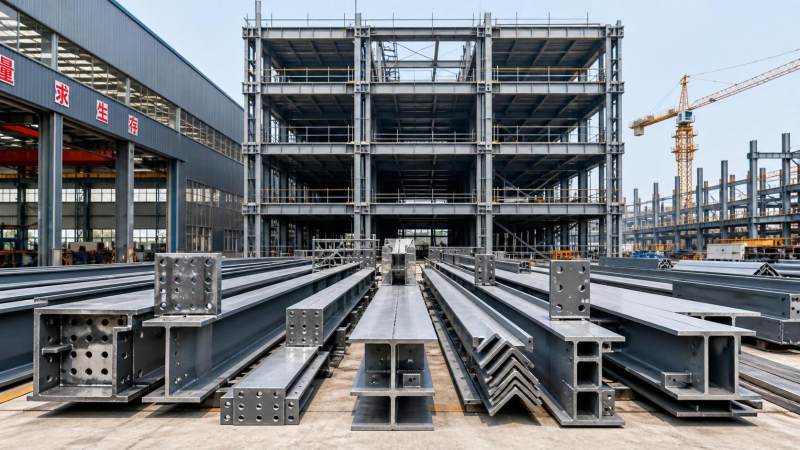
Material consistency matters more than headline strength
Buyers sometimes focus too heavily on nominal strength grade because it is easy to compare. But on a real mid-rise project, consistency often matters more than the top-line number. If chemistry, straightness, thickness tolerance, camber, or hole-making performance vary too much from batch to batch, the fabrication shop feels it first. Then the site team feels it later.
That is why quality control should be treated as a selection factor, not an afterthought. Ask how the supplier handles incoming raw material control, in-process dimensional inspection, traceability, and final verification. If custom components are involved, ask who owns detailing responsibility and how revisions are controlled. A mid-rise frame can absorb some complexity, but only when the information flow is stable.
This becomes even more important when the package includes secondary steel, façade support members, rooftop equipment frames, or galvanized accessories exposed to weather. Corrosion protection strategy needs to match actual service conditions. Over-specifying coatings can waste money; under-specifying them can create a maintenance problem that shows up after handover, when nobody wants to revisit the steel package.
In some projects, the steel scope also touches lifting, temporary support, or equipment integration. For those cases, teams may source related components such as Hot dipped Galvanized Steel Wire Rope for cranes, tower cranes, pile-driving, marine-facing work, or other corrosive environments. The useful lesson is not that every building project needs wire rope procurement from the same source, but that corrosion class, working condition, and applicable standards should be judged by application rather than by habit.
Fabrication efficiency is a cost issue disguised as a technical issue
Some steel selections look economical until they reach the fabrication floor. Excessive section variety, nonstandard hole patterns, difficult coping details, and avoidable weld volume can all increase shop hours without improving building performance. Mid-rise projects are especially sensitive to this because they often run on tighter commercial margins than landmark towers.
When comparing options, it helps to think beyond tonnage price. The cheaper quote is not always the lower project cost if it creates more waste, more handling steps, or longer production lead time. Standardizing member families where possible, simplifying connection logic, and limiting unnecessary customization often produces better schedule reliability than chasing the lowest unit cost on paper.
This is where manufacturers with both standard sections and OEM capability can be useful. If the project needs mostly common beams and channels, with a smaller number of custom brackets or transition members, one coordinated supply chain may reduce interface risk. But that only helps if shop drawings, tolerances, and packaging details are managed properly. Otherwise, bundling everything together can just concentrate the problem.
Lead time should be evaluated as a technical risk
Procurement delays in structural steel rarely come from one dramatic failure. More often they come from small mismatches: unclear grade substitution rules, late connection design decisions, missing approval documents, or a supplier that can produce but cannot ship in the sequence the site requires. For mid-rise projects, erection sequence matters. Delivering all steel eventually is not the same as delivering the right assemblies when the site needs them.
When reviewing suppliers, project teams should ask practical questions:
Export-oriented suppliers that regularly serve North America, Europe, Southeast Asia, and the Middle East often build their value around this exact issue: stable production capacity, documentation discipline, and more predictable lead times. That does not guarantee a perfect project, but it reduces one of the main procurement risks in overseas sourcing.
Do not separate structural choice from environment and lifecycle
For many mid-rise buildings, the steel is not hidden in a benign indoor condition. Parking structures, rooftop frames, exposed canopies, industrial add-ons, coastal sites, and humid regions all change the selection logic. Coating strategy, maintenance access, and expected service environment can influence whether galvanized, painted, or otherwise protected components are more sensible.
That applies not only to main structural members but to associated steel items working in tougher conditions. Where galvanized rope or related accessories are involved, coating thickness may need to vary by exposure. Some products in that category are specified with thin, medium, or thick galvanized groups depending on corrosion severity, and tensile strength can fall within ranges such as 1470 MPa to 1960 MPa. The point is not to copy those figures into a building frame decision, but to remember that service environment should drive material detailing across the entire steel scope.
A good selection process is usually narrow, not broad
The best steel packages for mid-rise work are often the result of disciplined simplification. Not the cheapest theoretical option, not the most overengineered one either. The project team usually gets better outcomes when it narrows the decision around a few essentials: structural suitability, standards alignment, fabrication practicality, corrosion exposure, and supplier reliability.
If one supplier can offer standard sections, custom structural steel components, quality control visibility, and export experience across major standards, that can be a strong advantage. But it should still be tested against the actual project: connection details, submittal expectations, delivery sequence, and local erection conditions. Steel selection is never just about the member. It is about how that member behaves in the chain from design office to fabrication yard to jobsite.
For mid-rise projects, that is usually what matters most. Not finding a perfect steel product in isolation, but finding a steel solution that the structure, the schedule, and the site can all live with.
Please give us a message


Please enter what you want to find