When shipping I beams internationally, the weight of I beam per meter isn’t just a technical detail—it directly impacts freight costs, container loading efficiency, customs duties, and structural compliance on-site. For procurement teams, project managers, and structural engineers evaluating hot rolled steel coil, A36 steel plate, galvanized steel channel, or corrosion-resistant pipes like 316 stainless steel pipe, accurate unit weight data is critical for logistics planning and budget control. At Hongteng Fengda—a certified structural steel manufacturer and exporter from China—we provide precise weight specifications across all standard and custom steel beams, ensuring seamless integration with your global supply chain, whether you’re sourcing steel sheet for roofing, stainless steel tube, or galvanized steel pipe price-sensitive orders.
Why “Weight Per Meter” Is a Hidden Cost Driver in Global Steel Procurement
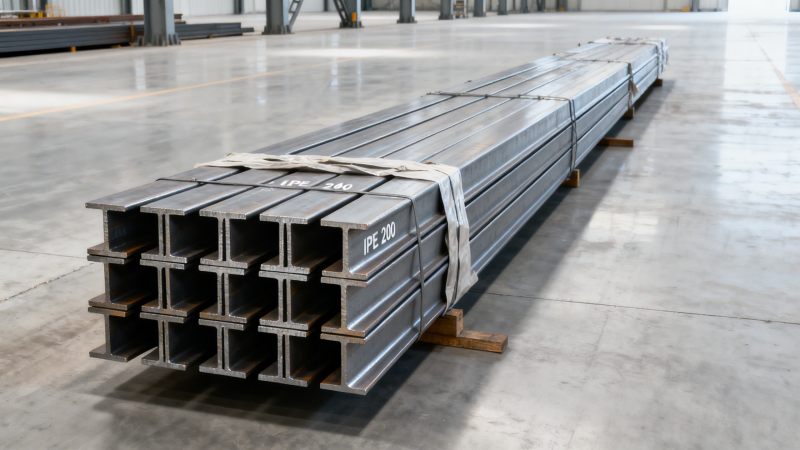
Freight charges for structural steel are typically calculated by either gross weight or volumetric weight—whichever is higher. A seemingly minor miscalculation in I beam weight per meter can inflate shipping costs by 8–15% on a full 40-foot container load. For example, misestimating a 300×150×8×12mm IPE beam’s unit weight by just 0.8 kg/m adds ~192 kg per 24-meter bundle—enough to trigger overweight surcharges or require additional container space.
Customs valuation in key markets—including the EU (under TARIC), US (HTSUS Chapter 73), and Saudi Arabia (SASO)—often references declared unit weight to determine duty rates and anti-dumping assessments. An inconsistency between mill test reports and commercial invoices may delay clearance by 3–7 business days or trigger audit requests.
On-site handling also depends on predictable weight distribution. Cranes, rigging plans, and temporary support structures rely on verified linear density—not theoretical or catalog values. A 5% deviation in actual vs. assumed weight per meter risks non-compliance with OSHA 1926.251 or EN 13001-1 lifting safety standards.
How Weight Accuracy Shapes Your Material Selection Process
Selecting the right I beam isn’t only about section modulus or moment capacity—it’s about balancing mechanical performance with transportability. For projects spanning multiple jurisdictions (e.g., modular construction shipped from China to Germany then assembled in Poland), weight consistency becomes a cross-border compliance anchor.
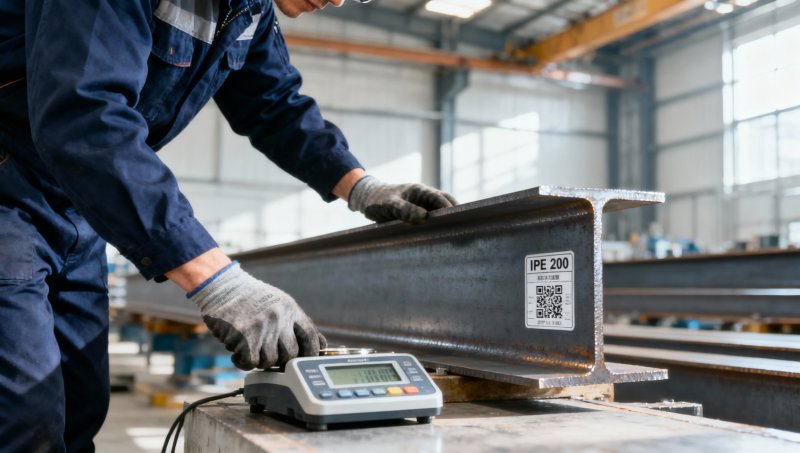
Hongteng Fengda calculates weight per meter using ASTM A6/A6M-23 formulas: W = (A × ρ) / 1000, where A is cross-sectional area (mm²), and ρ = 7.85 g/cm³ for carbon steel. All hot-rolled beams undergo third-party verification via SGS-certified weighing systems before packaging—ensuring ±0.3% tolerance against nominal values.
This precision extends to specialty alloys. For instance, when specifying 316 Stainless Steel Plate for marine or chemical plant applications, its higher density (7.98 g/cm³ vs. 7.85 for carbon steel) directly affects payload planning—even if dimensions remain identical.
Key weight-related selection criteria for international buyers:
- Container utilization rate: Maximize tonnage within 26,500 kg payload limit (standard 40-ft HC container) while staying under height/width constraints (2.35m × 2.35m).
- Duty classification: Confirm HS Code alignment—e.g., 7301.10 for I-beams vs. 7301.20 for channels—to avoid misclassification penalties.
- Structural redundancy: Verify that delivered weight matches design assumptions in ETABS or STAAD.Pro models—especially for seismic or wind-load-critical zones.
- Traceability requirements: Ensure mill test reports include certified weight per meter, batch heat number, and EN 10204 3.1 certification.
Comparative Weight Impact Across Common Structural Profiles
Different profiles deliver varying strength-to-weight ratios—and their linear mass determines how many units fit per container. Below is a comparison of typical hot-rolled sections at comparable yield strength (≥235 MPa), based on real production data from Hongteng Fengda’s 2024 export batches to North America and Southeast Asia:
Note: Units per container assume standard 24-meter lengths, bundled in 3-ton layers, and comply with IMO cargo securing guidelines. HE-series beams offer higher load-bearing capacity but reduce quantity per shipment by up to 68% versus IPE equivalents—making them optimal for high-strength, low-volume infrastructure projects.
Integrating Weight Data Into Your Supply Chain Workflow
At Hongteng Fengda, we embed weight intelligence into every stage—from quotation to delivery. Our ERP system auto-generates weight-based packing lists, integrates with TMS platforms (e.g., Oracle TMS, Manhattan SCALE), and exports ISO-compliant XML manifests for customs brokers in 12 languages.
For buyers managing multi-source portfolios, we provide free access to our Steel Weight Calculator API, supporting real-time validation of I beam, angle steel, channel steel, and cold-formed profiles—including alloy variants like 316 Stainless Steel Plate. This tool accepts EN, ASTM, JIS, and GB dimensional inputs and returns weight per meter, total bundle weight, and container optimization score (0–100).
All export shipments include dual-labeled weight tags: one affixed to each bundle (with QR-coded traceability), and one sealed in the original packaging with mill test report, EN 10204 3.1 certificate, and ISO 9001:2015 compliance statement.
Your next steps—verified, actionable, and partner-supported:
- Request a customized weight report for your exact beam specification—including tolerance bands and thermal expansion impact on loaded length.
- Validate container loading plans using our free online calculator—compatible with Excel import/export and AutoCAD DWG reference layers.
- Schedule a joint review with our technical team to align beam weight data with your structural modeling software (STAAD.Pro, Tekla Structures, or Robot Structural Analysis).
- Confirm lead time, payment terms, and Incoterms® (FOB Shanghai, CIF Rotterdam, DAP Dubai) for your target destination and volume tier (small-batch: 5–20 tons; mid-volume: 20–100 tons; bulk: 100+ tons).
Why Global Buyers Trust Hongteng Fengda for Precision Steel Sourcing
We don’t just ship steel—we de-risk your international procurement. With ISO 9001, ISO 14001, and ISO 45001 certifications; over 12 years of export experience to 37 countries; and a dedicated logistics coordination team fluent in English, Spanish, Arabic, and Russian, Hongteng Fengda ensures your I beams arrive on time, within spec, and fully documented.
Our manufacturing facility in Hebei Province features automated rolling lines calibrated to ±0.1 mm dimensional accuracy and inline laser-based weight verification at 3 points per meter. Every order receives pre-shipment inspection (PSI) by BV or SGS upon request—with results shared digitally within 24 hours.
Whether you need standard IPE/HEB beams, custom cold-formed profiles, or corrosion-resistant solutions like 316 Stainless Steel Plate for food-grade conveyors or offshore platforms, we deliver verified weight data—not estimates—and back it with contractual guarantees.
Contact us today for a no-obligation weight validation, sample request, or tailored export quotation—including freight cost breakdown, duty calculation, and documentation support for your specific destination market.
Please give us a message


Please enter what you want to find