When evaluating structural integrity for complex construction projects, choosing between W-shape and S-shape steel beams is a critical decision that directly impacts load-bearing performance and overall material costs. While W-shapes feature wider flanges ideal for heavy bending moments, S-shapes offer distinct advantages in specific shear and taper applications. This comprehensive technical guide breaks down the precise specifications, yield strengths, and design considerations to help technical evaluators confidently select the optimal steel beams for their unique engineering requirements.
The Geometric Reality: Parallel vs. Tapered Flanges
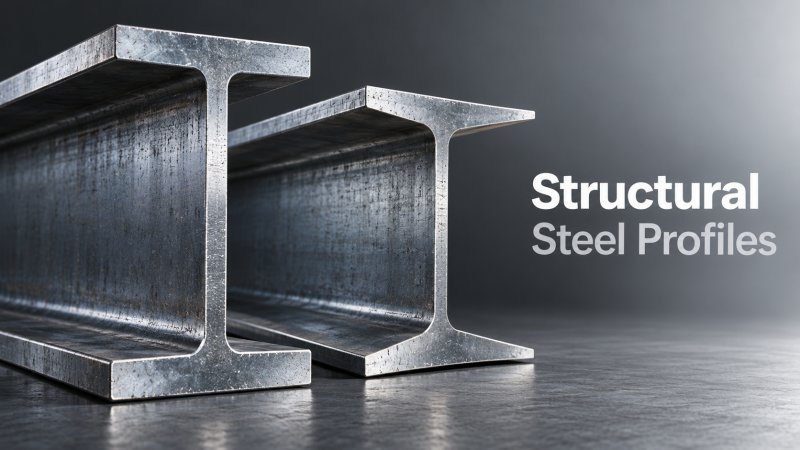
Before diving into load tables, it is crucial to understand the physical geometry that dictates how these profiles behave under stress. The W-shape, or Wide Flange beam, is characterized by its parallel inner and outer flange surfaces. This geometry allows the material to be distributed further away from the neutral axis, resulting in a higher moment of inertia and section modulus for a given weight. In simple terms, it resists bending exceptionally well.
On the other hand, the S-shape, or American Standard beam, features a tapered inner flange surface, typically with a slope of 2:12. This taper means the flange is thickest where it meets the web and thins out toward the edges. While this reduces its overall bending efficiency compared to a W-shape of the same weight, it concentrates material exactly where the shear forces and web-flange junction stresses are highest.
Scenario-Based Selection: Where Each Profile Wins
Selecting the right profile is rarely just about picking the highest strength-to-weight ratio. It is about matching the beam to the specific mechanical and architectural demands of the project.
W-shapes are the undisputed workhorses for modern structural frameworks. If you are designing high-rise building frames, long-span bridge girders, or heavy industrial roof systems, the W-shape is usually the default choice. Its wide flanges provide excellent lateral-torsional buckling resistance and offer ample surface area for connecting other members, such as moment frames or bracing connections.
S-shapes, however, are far from obsolete. They excel in specific niche applications where their unique geometry provides a functional advantage. The tapered flange is naturally suited for crane runways, monorails, and hoistway tracks. The slope allows trolley wheels to ride smoothly while the thicker web-flange junction handles the intense localized wheel loads without excessive deformation. S-shapes are also frequently specified in bridge cross-frames and retrofit projects where matching the exact dimensions of existing, older infrastructure is non-negotiable.
Fabrication and Connection Headaches: The Real-World Trade-offs
A design might look perfect on a screen, but if it causes headaches on the shop floor, it will eat into your project's budget and schedule. Technical evaluators must consider how these beams are actually fabricated and erected.
When it comes to bolted connections, W-shapes are incredibly forgiving. Because the flanges are parallel, standard flat washers work perfectly, ensuring the bolt tension is applied evenly and perpendicularly. S-shapes, due to their tapered flanges, require special beveled washers (tapered washers) to compensate for the slope. If a fabricator forgets to use these washers, or uses them incorrectly, the bolt will be pulled at an angle, compromising the joint's slip resistance and overall structural integrity. This is a common quality control issue on sites where S-shapes are used but standard hardware is mistakenly applied.
Welding also presents different challenges. The varying thickness of the S-shape flange can complicate full-penetration welds if the joint preparation is not meticulously planned. W-shapes, with their uniform flange thickness, allow for more predictable and straightforward welding procedures, which translates to faster fabrication times and fewer ultrasonic testing rejections.
Material Grades, Standards, and Global Sourcing Realities
The choice of profile often dictates the available material grades. In the US market, W-shapes are predominantly rolled in ASTM A992, which offers a minimum yield strength of 50 ksi and excellent weldability. S-shapes are more commonly produced in ASTM A36 (36 ksi yield) or ASTM A572 Grade 50. When specifying S-shapes, you must verify that the mill actually produces that specific size in your required grade, as some smaller S-shapes are only rolled in A36.
From a global sourcing perspective, the landscape shifts. International projects often blend standards, and the W-shape philosophy has been widely adopted globally under different naming conventions. Modern manufacturing has pushed the boundaries of profile optimization. For projects requiring high-efficiency profiles with optimized cross-sectional area distribution, an H Section Beam often serves as the global equivalent to the W-shape, offering strong bending resistance in all directions while keeping the weight light. Whether you are sourcing standard ASTM A572 grades or specific EN10025 S355JR materials, working with a manufacturer that understands both the geometric nuances and the metallurgical requirements is critical to avoiding supply chain bottlenecks.
Common Pitfalls for Technical Evaluators
Even experienced engineers can fall into traps when switching between these profiles. Here are a few practical reminders to keep your design and procurement on track:
First, do not blindly substitute an S-shape for a W-shape to save weight without checking the flange width. W-shapes are significantly wider. Swapping them might cause the beam to clash with architectural clearances, interfere with mechanical routing, or require the redesign of connection plates because the flange edges no longer align with the supporting columns.
Second, pay close attention to local buckling limits. While S-shapes have thick flanges at the web, the tips of the flanges are quite thin. If your design involves heavy localized loads or unbraced lengths that push the beam into the inelastic range, the thin flange tips may buckle locally before the beam reaches its full plastic moment capacity.
Finally, consider procurement lead times. W-shapes and standard H-beams are high-volume items stocked by most global mills and service centers. S-shapes, particularly the less common sizes, are often produced on a campaign basis. If your project schedule is tight, specifying an obscure S-shape size could result in lead times stretching from weeks to months. Always check mill stock availability during the schematic design phase.
Making the Final Call
Choosing between W-shape and S-shape steel beams is not just an academic exercise in calculating section modulus. It requires a holistic view of structural performance, fabrication feasibility, connection detailing, and supply chain realities. W-shapes will continue to dominate general construction due to their versatility and efficiency, but S-shapes remain indispensable for specific mechanical and heavy-load applications.
As a technical evaluator, your goal is to look beyond the basic load tables. Evaluate the connection details, consult with your fabricators early in the design process, and verify the global availability of your specified grades and sizes. By balancing structural efficiency with practical constructability, you ensure that the final design is not only safe and compliant but also economically viable to build.
Please give us a message


Please enter what you want to find