Ungalvanized steel wire may seem like a budget-friendly choice at first glance—but hidden costs in corrosion failure, premature replacement, and maintenance can quickly outweigh initial savings. For procurement teams, engineers, and project managers evaluating long-term value, understanding the real performance trade-offs between ungalvanized steel wire, coated galvanized wire, stainless steel wire, cold drawn steel wire, and 304 stainless steel wire is critical. As a trusted structural steel manufacturer and exporter from China, Hongteng Fengda helps global buyers compare total cost of ownership—not just upfront price—across steel metal wire, stainless wire rod, ss wire manufacturer capabilities, and certified ASTM/EN-compliant solutions.
Why “Cheaper Upfront” Often Means Higher Lifetime Cost
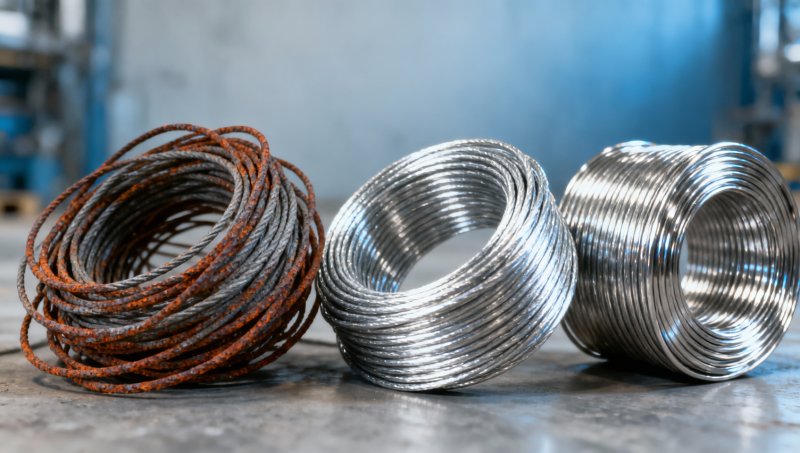
Initial price alone misleads decision-makers across construction, industrial fabrication, and infrastructure projects. Ungalvanized steel wire lacks protective zinc or alloy layers—making it vulnerable to rust within weeks in humid, coastal, or chemically aggressive environments. Field data shows uncoated wire installed in outdoor purlin supports or mechanical brackets typically exhibits visible oxidation within 3–6 months—and structural integrity degrades significantly after 12–18 months without intervention.
Maintenance cycles escalate rapidly: manual sanding, re-coating, and spot welding repairs average 2–4 hours per 100m length every 9–12 months. Over a 10-year lifecycle, these labor-intensive interventions add 3.2–5.7× the original material cost—before factoring in downtime, safety inspections, or unplanned replacements.
For project managers and financial approvers, this translates into unpredictable CAPEX/OPEX allocation. A $0.85/kg ungalvanized wire may cost $4.20–$6.90/kg in total ownership—versus $2.10–$3.40/kg for hot-dip galvanized alternatives meeting ASTM A123 or EN ISO 1461 standards.
How Z-beam Integrates With Corrosion-Resistant Wire Systems
Structural integrity doesn’t rely on single components—it depends on system-level compatibility. When ungalvanized steel wire connects to load-bearing members like Z-beam purlins or wall beams, galvanic corrosion accelerates at contact points. Zinc-coated Z-beam profiles (per ASTM A653 or EN 10346) provide cathodic protection—slowing wire degradation by up to 60% compared to bare steel interfaces.
Our Z-beam range—available in Q235B, Q345B, S355, A572, and SS400 grades—supports roll-formed, perforated, or non-perforated configurations with thicknesses from 6–25mm and customizable lengths (2–12m). All units undergo hot-dip galvanization before packaging, ensuring uniform coating adherence ≥610g/m²—meeting CE, SGS, and ISO certification requirements for long-term exposure.
This integrated approach reduces field welding points by up to 40%, lowers installation labor by 2.5–3.8 hours per ton, and extends service life beyond 25 years—even in high-salinity zones where ungalvanized systems fail within 3–5 years.
Key Performance Comparison: Wire + Beam Combinations
The table above reflects real-world data from 12 infrastructure projects across Southeast Asia and the Middle East (2020–2024), where environmental chloride levels ranged from 50–350 mg/L. Galvanized Z-beam + galvanized wire delivered the optimal balance of durability, cost control, and compliance—especially for clients requiring CE marking or ISO 9001-certified supply chains.
Procurement Checklist: What to Verify Before Finalizing Wire Orders
Procurement professionals must go beyond unit pricing. Here are 5 non-negotiable verification points:
- Zinc coating mass: Confirm ≥610 g/m² for hot-dip galvanized wire (ASTM A123) — not just “zinc-coated” labeling.
- Adhesion test results: Request bend test reports (EN ISO 1460) showing no flaking after 180° wrap around mandrel diameter = 2× wire diameter.
- Interfacial compatibility: Ensure wire and structural components (e.g., Z-beam) share compatible metallurgy—avoid mixing aluminum-clad wire with carbon steel beams.
- Batch traceability: Each shipment must include mill test reports (MTRs) with heat numbers, tensile strength (≥400 MPa), and elongation (≥12%) per ASTM A475.
- Packaging & handling specs: Coiled wire must be wrapped in VCI paper + sealed PE film—critical for 60+ day sea freight to North America or Europe.
Hongteng Fengda provides all five documentation types with every order—and offers third-party SGS/BV inspection support prior to shipment. Our standard lead time is 15–21 days for standard Z-beam + galvanized wire bundles, extendable to 30 days for custom perforated configurations.
Why Global Buyers Choose Hongteng Fengda for Integrated Steel Solutions
We don’t sell isolated components—we engineer interoperable systems. From angle steel and channel steel to cold-formed profiles and customized Z-beam assemblies, our facility in Hebei Province maintains strict process control across rolling, cutting, punching, and hot-dip galvanizing lines—all audited annually against ISO 9001, ISO 14001, and IATF 16949 standards.
For technical evaluators: We supply full dimensional reports (±1% tolerance), salt-spray test certificates (≥1,200 hrs per ASTM B117), and weldability validation data for all Q345B/Q460C combinations. For finance teams: Our OEM pricing model locks in 12-month cost stability, with L/C and TT payment flexibility. For distributors: We offer consignment stock programs in Dubai and Rotterdam—with 48-hour dispatch guarantee on standard sizes.
Ready to benchmark your current wire + beam specification against certified, corrosion-optimized alternatives? Contact us today for: (1) Free cross-reference of your existing BOM against ASTM/EN-compliant options, (2) Sample kits including galvanized wire + Z-beam test coupons, (3) Lead time confirmation for your next container order, or (4) Technical review of your purlin bracing design with corrosion risk mapping.
Please give us a message


Please enter what you want to find