In food and chemical processing, choosing the right tube stainless steel is critical for product purity, corrosion resistance, and regulatory compliance. For quality control and safety teams, the most important specs go beyond basic dimensions—they include material grade, surface finish, weld integrity, pressure performance, and standard certification. This guide outlines the key factors that directly affect line reliability, inspection results, and long-term operating safety.
What Buyers Are Really Asking When They Search for Tube Stainless Steel
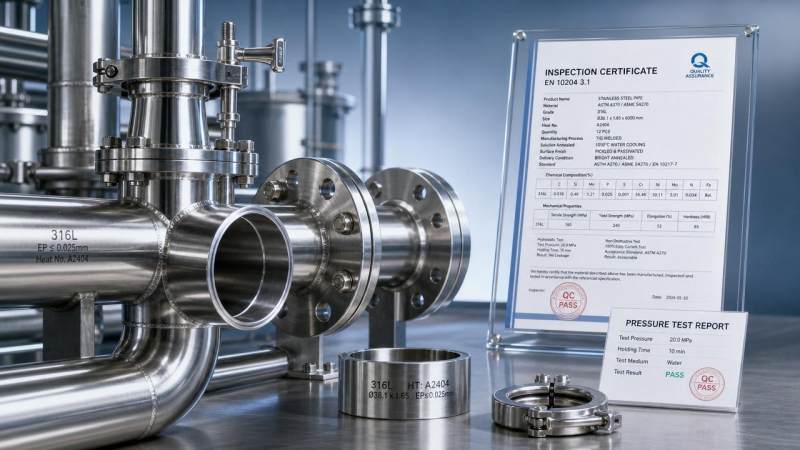
When quality and safety professionals search for tube stainless steel, they usually are not looking for generic product definitions. They want to know which specifications actually determine sanitary performance, corrosion resistance, and audit readiness.
In practical terms, the core search intent is simple: how to select stainless tubing that will pass inspection, protect product quality, and avoid failure in demanding food or chemical service.
For this audience, the biggest concerns are contamination risk, unexpected corrosion, poor weld quality, pressure-related incidents, and missing documentation. Cost matters, but not as much as traceability, compliance, and predictable long-term performance.
That is why the most useful article structure should focus on selection criteria, inspection checkpoints, common specification mistakes, and how to match tubing to media, cleaning method, and operating conditions.
Why Basic Size Information Is Never Enough
Many purchasing documents start with outer diameter, wall thickness, and length. Those dimensions are important, but they do not tell a QC or safety manager whether the tube stainless steel is suitable for hygienic transfer or aggressive chemicals.
If the tubing grade is wrong, chloride attack may start even when dimensions are correct. If the internal surface is too rough, residues can remain after cleaning. If welds are poorly controlled, crack initiation and contamination become real risks.
In other words, a line may look compliant on paper while still failing in service. For food and chemical lines, specification depth matters more than basic geometry alone.
Material Grade: The First Spec That Affects Safety and Service Life
The stainless grade is usually the most important starting point. In many food applications, 304 or 304L is used because it offers good corrosion resistance, cleanability, and cost efficiency under mild process conditions.
However, 316 or 316L is often preferred where chlorides, acidic cleaning agents, salt-containing products, or more aggressive process media are involved. The added molybdenum improves pitting and crevice corrosion resistance, which can be decisive for line longevity.
Low-carbon grades such as 304L and 316L are especially relevant when welding is involved. They reduce the risk of sensitization and improve corrosion performance in heat-affected zones, which is important for fabricated systems.
For highly specialized chemical duties, standard austenitic grades may still be insufficient. Duplex stainless, higher-alloy materials, or even non-stainless alternatives may be required depending on temperature, concentration, and cleaning chemistry.
QC teams should never approve grade selection based only on “stainless steel” as a label. Mill certificates, heat numbers, and standard references must confirm the exact material supplied.
Surface Finish: A Key Factor for Cleanability and Product Purity
In food lines, internal surface finish directly affects hygiene. Rougher surfaces can trap product residues, support biofilm formation, and make cleaning less reliable. That increases both quality risk and cleaning validation difficulty.
For sanitary service, buyers often specify maximum internal roughness values, such as Ra limits, rather than relying on visual descriptions like “smooth” or “polished.” A measurable requirement is easier to inspect and enforce.
Electropolished or mechanically polished surfaces may be used depending on the process requirement. Electropolishing can improve cleanability and corrosion behavior by reducing microscopic surface irregularities and enriching the chromium-rich passive layer.
In chemical lines, the finish requirement may be driven less by hygiene and more by corrosion control, deposit reduction, or process consistency. The correct finish depends on both media behavior and maintenance practice.
Surface finish should also be protected during transport and installation. A well-finished tube can lose value quickly if it is scratched, contaminated by iron particles, or handled without proper packaging controls.
Weld Integrity: Where Many Tube Failures Begin
Welded stainless tubing is widely used and can perform very well, but weld quality must be tightly controlled. For food and chemical systems, poor weld seams are frequent sources of corrosion, leakage, and inspection failure.
Important checkpoints include weld bead uniformity, full penetration where required, absence of cracks or undercut, proper shielding, and post-weld cleaning or passivation. These factors directly affect corrosion resistance and sanitary reliability.
Some applications require tubing produced to standards that include specific weld testing, eddy current examination, hydrostatic testing, or radiographic inspection. The required test level should match the risk profile of the system.
Fabrication quality in the field matters as much as factory quality. Even if the original tube stainless steel is compliant, poor orbital welding parameters, bad purge practice, or contaminated filler material can compromise the entire line.
For critical systems, weld logs, welder qualification records, boroscope inspection, and passivation documentation are often worth requiring. They make quality verification much more objective during project closeout or internal audits.
Pressure, Temperature, and Wall Thickness Must Be Evaluated Together
Wall thickness is not just a dimensional choice. It affects pressure capacity, mechanical durability, corrosion allowance, and resistance to damage during installation or maintenance.
QC and safety teams should confirm that the specified tubing matches the maximum operating pressure, pressure fluctuation pattern, process temperature, and cleaning cycle conditions. A tube that works at room temperature may behave very differently under hot CIP service.
Thin-wall sanitary tubing may be ideal for hygienic flow and efficient fabrication, but it must still be suitable for process pressure and handling loads. Chemical lines may require a more conservative wall selection if corrosion or impact is possible.
Specification review should include not only nominal dimensions, but also tolerance range, ovality, straightness, and minimum actual wall. These details affect both fit-up quality and pressure integrity.
Standards and Certifications: What Documentation Should Be Mandatory?
For quality control teams, documentation is not paperwork for its own sake. It is how you prove that the tubing delivered is the tubing ordered, tested, and approved for the intended service.
Common references may include ASTM, ASME, EN, JIS, or ISO-related requirements, depending on project location and customer expectations. The correct standard should define material chemistry, manufacturing method, testing, and tolerances.
Mill test certificates should verify chemical composition, mechanical properties, heat number traceability, and applicable standard compliance. For regulated sectors, additional declarations or third-party inspection may also be necessary.
If the line serves food production, sanitary expectations may include material traceability, internal finish certification, and process-contact suitability. For chemical systems, pressure test records and corrosion-related material confirmation may take priority.
Do not accept vague statements such as “meets international standards.” The relevant standard number, edition if needed, and testing scope should be listed clearly in purchase and receiving documents.
How to Match Tube Stainless Steel to Food Lines Versus Chemical Lines
Food processing usually prioritizes cleanliness, low residue retention, flavor protection, and resistance to cleaning chemicals. Smooth internal finish, sanitary welds, and chloride-aware grade selection are often the main decision factors.
Chemical processing may involve acids, alkalis, solvents, oxidizers, elevated temperatures, or concentration cycling. In that environment, chemical compatibility becomes the first screen, followed by pressure, weld performance, and inspection strategy.
One common mistake is assuming that a food-grade stainless selection automatically works for chemical duty. Another is assuming that a corrosion-resistant chemical selection automatically satisfies hygienic surface expectations for food contact.
The right selection process starts with the real operating profile: product or media composition, temperature range, cleaning method, disinfection chemicals, downtime pattern, and expected service life.
Inspection Checklist for Receiving and Pre-Installation Approval
A practical inspection checklist helps QC teams catch problems before installation. At receiving stage, verify grade marking, certificate consistency, dimensions, heat traceability, and quantity against the purchase order.
Then inspect the tube condition itself. Look for dents, end damage, weld seam irregularities, rust contamination, oil residue, improper packaging, or scratches on process-contact surfaces. Small defects can become major sanitation or corrosion issues later.
Where surface finish is critical, request roughness verification or supporting finish records. Where pressure or safety is critical, confirm required nondestructive testing and pressure test documentation before release to installation.
During pre-installation review, make sure storage conditions prevent contact with carbon steel, moisture accumulation, and mixed-material contamination. Stainless tubing can lose corrosion performance if handling discipline is poor.
Common Specification Mistakes That Create Audit and Safety Risks
One of the most frequent mistakes is specifying only “SS tube” without naming grade, manufacturing standard, finish, and test requirements. That leaves too much room for inconsistent interpretation across suppliers.
Another common issue is ignoring the cleaning regime. A tube that handles the process fluid well may still fail prematurely because repeated CIP or sanitizing cycles are more corrosive than the product itself.
Buyers also sometimes overlook weld seam quality requirements, especially in projects focused mainly on price and delivery speed. The result can be hidden corrosion initiation points that appear only after commissioning.
Traceability gaps are another major problem. If heat numbers, MTCs, and inspection records cannot be matched, quality teams may struggle to release the line or defend it during customer or regulatory review.
How Suppliers Can Support Better Risk Control
Reliable sourcing is not only about delivering metal. Good suppliers help customers define the correct specification, maintain documentation discipline, and reduce mismatch between design intent and actual delivered product.
For industrial buyers working across multiple steel categories, supplier capability in standards control and custom processing can be valuable. Companies serving global projects often support broader material procurement needs beyond tubing alone.
For example, structural applications around processing facilities may require products such as Carbon Steel Plate Manufacturer solutions for frames, supports, brackets, tanks, or mechanical parts, while stainless tubing is selected separately for process-contact duties.
That distinction matters because not all steel products face the same hygiene or corrosion requirements. QC teams should evaluate each material class according to its service environment, not apply one specification logic to everything.
What a Strong Tube Stainless Steel Specification Should Include
A robust purchase specification should state grade, standard, dimensions, wall thickness, tolerance requirements, manufacturing method, finish level, and required testing. It should also define documentation and traceability expectations.
Where relevant, include roughness limits, passivation requirements, weld inspection standards, pressure test needs, and packaging conditions. If the tubing will be used in regulated food environments, make that application explicit.
It is also wise to list the actual service conditions: media, temperature, pressure, cleaning chemistry, and any chloride exposure. This helps suppliers identify if the requested tube stainless steel is under-specified for the job.
The more clearly the technical and compliance expectations are written, the lower the risk of dispute, delay, or field rejection after delivery.
Final Takeaway for QC and Safety Teams
The most important specs for tube stainless steel in food and chemical lines are not limited to size. Material grade, internal surface finish, weld quality, pressure suitability, and certification control are what most directly affect safety and reliability.
If your goal is to protect product purity, pass inspections, and reduce lifecycle risk, start with actual process conditions and then build a specification around verifiable requirements. Avoid generic descriptions and insist on traceable documentation.
For quality control and safety professionals, the best decision is usually the one that prevents hidden corrosion, sanitation failures, and compliance gaps before the line ever enters service. That is where specification discipline creates real operational value.
Please give us a message


Please enter what you want to find