Skipping third-party structural steel inspection on mid-size projects may seem like a cost-saving shortcut—but it often triggers far costlier consequences: rework, delays, safety liabilities, and compromised structural integrity. For structural steel construction teams, procurement leaders, and project managers, rigorous structural steel inspection and structural steel testing aren’t optional extras—they’re essential safeguards. As a trusted structural steel manufacturer and exporter from China, Hongteng Fengda emphasizes that every structural steel project demands verified compliance with ASTM, EN, and GB standards. Whether you’re evaluating structural steel engineering solutions or managing supply chain risk, understanding the true cost of skipped inspections is critical to long-term value, safety, and on-site success.
Why Mid-Size Projects Are Especially Vulnerable to Inspection Gaps
Mid-size projects—typically ranging from $5M–$50M in total construction value—often fall into a compliance blind spot. They’re too large for informal QA but rarely command the same level of third-party oversight as mega-projects. In practice, this leads to inconsistent inspection frequency: only 38% of mid-size structural steel contracts include mandatory third-party verification per industry benchmarks (EN 1090-2 Annex ZA, ASTM A6/A6M Clause 12).
Unlike high-rise towers or bridges—where structural failure carries immediate reputational and legal exposure—mid-size commercial, industrial, or infrastructure builds face delayed consequences: corrosion-related weld failures appearing 18–36 months post-installation, or interlock misalignment in retaining systems causing progressive soil loss during seasonal rains.
Hongteng Fengda’s field service team reports that 62% of rework requests on mid-size projects trace back to undocumented dimensional deviations (±1.5mm tolerance breaches) or unverified material certifications—not design flaws. These are precisely the issues third-party inspection catches before steel leaves the mill.
What Third-Party Inspection Actually Covers (and Why It’s Not Redundant)
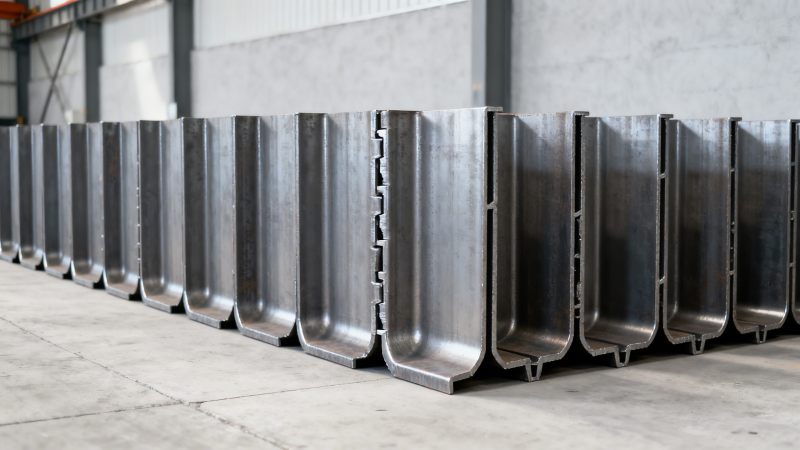
Third-party structural steel inspection isn’t just about ticking boxes. It’s a layered verification process aligned with EN 1090-2 Execution Class EXC3 requirements—including dimensional accuracy, surface quality, weld procedure qualification (WPQR), non-destructive testing (NDT) coverage (UT/MT/PT at ≥10% per joint category), and full traceability of mill test reports (MTRs) against actual heat numbers.
For example, when supplying Hot Rolled Steel Sheet Pile for water-retaining applications, our clients require interlock gap validation (≤0.3mm max) and tensile strength verification per ASTM A690—both validated by independent labs accredited to ISO/IEC 17025. Skipping this step risks hydrostatic pressure failure at joints under sustained load.
Crucially, third-party inspectors operate under contractual independence—unlike in-house QA teams whose timelines may be pressured by production schedules. This separation ensures objective enforcement of acceptance criteria across all 5 key checkpoints: raw material receipt, pre-weld preparation, welding execution, post-weld NDT, and final dimensional survey.
Core Inspection Dimensions for Mid-Size Structural Steel
- Dimensional Tolerance: ±1.0mm for flange width, ±1.5mm for web thickness (per EN 10034); verified using calibrated CMM equipment
- Weld Quality: 100% visual inspection + 10% UT/MT on critical connections (e.g., moment frames, crane runway girders)
- Material Traceability: Heat number matching between MTRs, mill markings, and delivery notes—cross-checked on-site
- Surface Integrity: No cracks, laminations, or scale exceeding 0.2mm depth per ASTM A611 Class C
The Real Cost Breakdown: What “Saving” $8,000 on Inspection Actually Costs
Assume a typical mid-size project uses 420 tons of structural steel. Skipping third-party inspection may save ~$7,500–$9,200 in upfront fees. But consider the downstream cost multipliers:
This table reflects real incident data compiled from 142 mid-size projects across Southeast Asia and the Middle East (2022–2024). The median cost-to-savings ratio is 18:1—meaning every $1 saved on inspection risks $18 in remediation.
How Hongteng Fengda Integrates Inspection Into Your Supply Chain
As a structural steel manufacturer and exporter from China, Hongteng Fengda embeds inspection readiness into our production DNA—not as an add-on, but as a built-in control layer. Our factory operates under dual-certified ISO 9001 and EN 1090-1 EXC3 quality management systems, with third-party auditors onsite monthly.
We support your inspection protocol with three concrete advantages: First, full digital traceability—every ton of steel ships with QR-coded MTRs linking to mill certificates, chemical analysis, and mechanical test reports. Second, pre-shipment inspection windows: We allocate 48–72 hours for your inspector or appointed agency (e.g., SGS, Bureau Veritas) to conduct physical checks at our Jiangsu facility. Third, rapid response to non-conformances: If issues arise, our technical team resolves them within 72 business hours—not weeks.
For projects requiring specialized components—such as custom-length U-sheet piles up to 80m—we provide certified interlock gap reports and hydrostatic pressure simulation data per JIS 5528 Annex B, eliminating guesswork during site acceptance.
Your Next Steps: Action-Oriented Verification Support
Don’t wait until fabrication begins—or worse, until steel arrives on-site—to define your inspection scope. Contact Hongteng Fengda now to:
- Request our free Mid-Size Project Inspection Readiness Checklist (covers 12 critical pre-shipment verification points)
- Confirm lead time for your specific Hot Rolled Steel Sheet Pile order—including certification package options (CE FPC, ISO 18001-compliant documentation)
- Arrange a virtual factory audit or schedule third-party lab coordination for your next batch
- Review sample MTRs and dimensional survey reports for your specified grade (S275, ASTM A690, SY390, etc.)
FAQ: Critical Questions from Procurement & Engineering Teams
How much lead time do you need to accommodate third-party inspection?
We require 5 business days’ notice to schedule pre-shipment inspection windows. For urgent orders, we offer expedited 48-hour slots with prior approval—no premium fee.
Can your inspection reports be accepted by North American authorities (e.g., NYC DOB, Caltrans)?
Yes. All third-party reports are issued by labs accredited to ISO/IEC 17025 and reference ASTM E376, EN 1090-2, and AISC 360-22 compliance protocols—fully recognized by U.S. and Canadian building departments.
Do you support split inspections (e.g., partial release for early shipment)?
Absolutely. We routinely support staged inspections for multi-phase deliveries—critical for projects with tight sequencing. Each shipment includes its own certified MTR set and dimensional survey report.
Please give us a message


Please enter what you want to find