Choosing the right structure H beam is critical for the safety, cost control, and long-term performance of multi-story steel frames.
For complex buildings, beam selection affects load paths, fabrication speed, floor efficiency, and future maintenance.
This guide explains practical questions about structure H beam selection, comparison, risk control, and supply planning.
What is a structure H beam, and why is it preferred in multi-story steel frames?
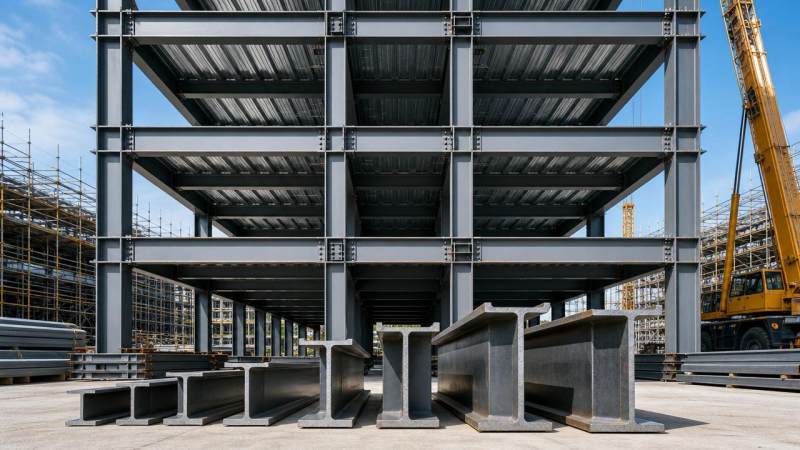
A structure H beam is a steel member with wide flanges and a relatively thick web.
Its shape provides strong bending resistance, stable load transfer, and efficient use of steel in frame systems.
In multi-story buildings, a structure H beam often supports floors, secondary framing, and lateral load systems.
Compared with lighter sections, it usually offers better stiffness under heavy service loads and longer spans.
That stiffness matters because excessive deflection can damage finishes, disturb occupants, and increase vibration problems.
Another advantage is connection convenience.
The flange width can simplify bolted or welded joint design in columns, beams, and bracing nodes.
For export projects, standard sections aligned with ASTM, EN, JIS, or GB also help reduce engineering confusion.
How do load requirements determine the right structure H beam size?
Load is the first filter when choosing a structure H beam.
Dead load includes slabs, finishes, partitions, and MEP systems.
Live load depends on building use, such as offices, warehouses, hotels, or mixed-use towers.
Wind and seismic effects become more important as the frame rises.
Selection should not focus only on strength.
A beam may pass stress checks but fail serviceability limits for deflection, vibration, or drift compatibility.
A practical review should cover these factors:
- Clear span and support conditions
- Composite or non-composite floor behavior
- Concentrated equipment loads
- Opening requirements for ducts and services
- Fireproofing thickness and corrosion environment
Longer spans usually push designers toward deeper or heavier structure H beam sections.
However, increasing beam depth can affect ceiling height, façade alignment, and transport efficiency.
The best solution balances strength, stiffness, architectural limits, and fabrication practicality.
Which standards, grades, and tolerances should be checked before ordering?
A structure H beam is only reliable when material grade, dimensional tolerance, and testing requirements are clearly defined.
Projects crossing borders often mix design codes and procurement standards.
That creates risk if the ordered section differs from the engineer’s assumed properties.
Before production, confirm these points:
- Applicable section standard, such as ASTM, EN, JIS, or GB
- Steel grade and yield strength
- Mill test certificate requirements
- Straightness, flange thickness, and length tolerance
- Surface treatment, blasting, primer, or galvanizing needs
It is also wise to check whether the structure H beam will be shop-fabricated into assemblies.
Cutting, drilling, welding, and trial fitting can change the lead time more than raw rolling availability.
In some building packages, steel framing is combined with utility supports or protective pipe systems.
For corrosion-sensitive service routes, Electrical Conduit Galvanized can be considered alongside structural packages.
Its DX52D option, broad dimensions, and AISI, ASTM, DIN, JIS, GB, SUS, and EN references support varied project conditions.
How can you compare structure H beam options for cost and construction efficiency?
The cheapest tonnage rarely delivers the lowest total project cost.
A more efficient structure H beam may reduce welding hours, crane time, and site adjustment work.
Cost comparison should include direct and indirect impacts.
A structure H beam with better availability may outperform a theoretically lighter section that causes procurement delays.
Standardization across floors also helps.
Repeating a controlled group of beam sizes improves detailing speed, batching, and installation rhythm.
What common mistakes create risk when selecting a structure H beam?
Several avoidable mistakes can weaken project performance.
The first is choosing by price list without checking real design assumptions.
Another is ignoring serviceability limits in office floors, hotel rooms, or equipment platforms.
A third issue is underestimating local corrosion, especially in coastal, industrial, or humid environments.
These warning points deserve attention:
- Mixing section standards without verifying dimensions
- Assuming all steel grades weld the same way
- Skipping trial coordination with decking and openings
- Ignoring transport length limits for fabricated members
- Using inconsistent suppliers during critical phases
When integrated building systems need protected routing, materials such as Electrical Conduit Galvanized may support corrosion resistance and service life.
That is especially useful in industrial buildings where framing and utility durability are reviewed together.
How should supply capacity and quality control influence the final decision?
For multi-story projects, supply stability is as important as design accuracy.
A good structure H beam source should deliver consistent chemistry, dimensions, and document control across batches.
Reliable quality control lowers rework, site cutting, and inspection disputes.
Useful supplier checks include:
- Production capacity for the required schedule
- Experience with export packing and traceability
- Compliance with ASTM, EN, JIS, and GB standards
- Inspection reports and material certificates
- Ability to support custom fabrication or OEM demands
A dependable structural steel partner can simplify procurement for beams, channels, angles, and customized components.
That coordination becomes valuable when project timelines are tight and section consistency must be maintained.
Quick FAQ table: how do you make a confident structure H beam decision?
A successful structure H beam strategy combines engineering performance with practical supply execution.
Review loads, standards, fabrication needs, coatings, and delivery plans before final approval.
For multi-story steel frames, that disciplined approach improves safety, controls cost, and supports smoother construction.
If the project requires standard or customized structural steel from China, early technical alignment can save time and reduce sourcing risk.
Please give us a message


Please enter what you want to find