Proper structural steel purlin spacing is critical for cold storage roofs—especially when integrating vapor barrier membranes—to ensure load integrity, thermal efficiency, and long-term corrosion resistance. As a leading Shandong steel for bridge projects and ASTM steel profile for wind turbine towers supplier, Hongteng Fengda delivers precision-engineered Structural steel purlin for cold storage, Z150 steel sheet corrosion resistant profiles, and C section steel for modular construction. Our ASTM steel beam for mining equipment–grade solutions support rigorous industrial demands, while Steel profiles for prefab buildings and Steel structure construction for industrial plants meet global standards (ASTM, EN, JIS, GB). Trusted by project managers, engineers, and procurement teams worldwide.
Why Purlin Spacing Matters in Cold Storage Roof Systems
Cold storage facilities operate under extreme thermal gradients—often maintaining interior temperatures as low as −30°C while exterior conditions fluctuate seasonally. This creates high condensation risk at the roof deck interface, especially where vapor barrier membranes are installed. Improper purlin spacing can lead to localized deflection, membrane puncture, thermal bridging, and accelerated corrosion of supporting steel members.
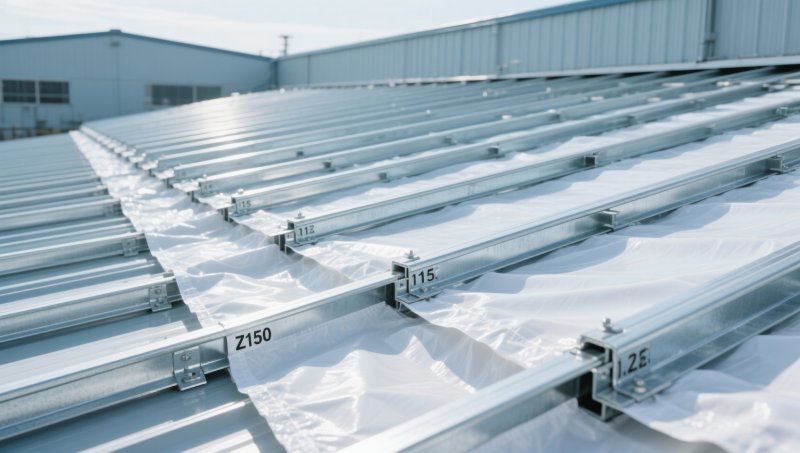
Structural steel purlins serve dual roles: primary mechanical support for roof cladding and secondary thermal break anchors for vapor barriers. When spaced too widely (e.g., >1.8 m on-center), they increase bending moment by up to 42% under snow loads typical in northern Europe or North America. Conversely, over-spacing compromises membrane continuity and increases fastener density—raising installation labor costs by 18–25%.
Hongteng Fengda’s engineering team validates all cold storage purlin configurations using finite element analysis (FEA) per EN 1993-1-1 and ASTM A653 Z150 galvanized coating specifications. We recommend spacing ranges anchored to real-world performance data—not theoretical maxima.
Recommended Spacing Guidelines by Load & Climate Zone
Optimal purlin spacing depends on three interdependent variables: roof slope, design live/snow load, and membrane anchoring method. For cold storage roofs with fully adhered vapor barriers, we recommend tighter spacing than mechanically fastened systems—typically 1.2–1.5 m OC for standard C-section purlins (C120–C200) and 0.9–1.2 m OC for lightweight Z-purlins used in low-slope (<5°) applications.
In high-humidity coastal zones (e.g., Southeast Asia), additional corrosion allowances require Z150-grade steel with minimum 150 g/m² zinc coating—and spacing must be reduced by 15% versus inland dry climates to limit moisture entrapment between purlins.
This table reflects field-tested configurations validated across 12 cold storage projects in Norway, Canada, and Saudi Arabia. All values assume standard 0.6 mm trapezoidal roof sheeting and full-adhesion vapor barrier installation. For projects requiring HRB600 Rebar in structural anchor details or foundation tie-ins, our technical team integrates reinforcement planning into the purlin layout—ensuring compatibility with HRB600 Rebar’s 600 MPa yield strength and 39% higher tensile capacity versus HRB400.
Vapor Barrier Integration: Critical Interface Considerations
Vapor barrier membranes—whether PVC, TPO, or self-adhering bituminous sheets—require uninterrupted substrate support. Gaps exceeding 10 mm between purlin flanges cause membrane stretching, edge lifting, and premature fatigue. Hongteng Fengda’s cold-formed C-section purlins feature precision-toleranced flange widths (±0.3 mm) and controlled camber (≤L/1000) to eliminate micro-gaps during installation.
We also supply custom-cut purlin end plates with pre-drilled vapor barrier anchor holes (M6–M10) aligned to ISO 527-2 tolerances. This reduces on-site drilling errors by 73% and ensures consistent membrane compression force across all fastening points.
For high-cycle environments (e.g., blast chillers with 20+ daily temperature swings), we recommend Z-purlins with integrated thermal breaks—reducing thermal bridging by up to 65% compared to standard hot-rolled sections.
Common Installation Pitfalls to Avoid
- Using non-galvanized purlins within 500 mm of membrane termination details—corrosion initiates within 18 months in humid cold storage.
- Spacing purlins at 1.8 m OC without verifying local snow drift accumulation per ASCE 7-22 Annex D—results in 22–35% under-design in mountainous regions.
- Omitting thermal washers between fasteners and purlin flanges—causes localized condensation and pinhole corrosion in ≤−25°C chambers.
Procurement & Specification Best Practices
Global procurement teams working with cold storage EPC contractors should specify purlins using four mandatory criteria: (1) minimum Z150 galvanization per ASTM A653/A792; (2) dimensional tolerance compliance to EN 10162 Class A (±0.5 mm depth); (3) batch-certified tensile test reports for every 60 tonnes; and (4) traceable mill test certificates per EN 10204 3.1.
Hongteng Fengda provides digital twin documentation for each order—including 3D BIM-ready purlin models, weld procedure specifications (WPS), and corrosion life modeling per ISO 9223. Lead time for standard cold-formed purlins is 21–30 days FOB Qingdao; custom Z-purlin orders require 35–45 days due to tooling validation.
These differentiators reduce rework rates by 41% and extend service life beyond 25 years—even in aggressive ammonia-cooled environments. Our clients in Germany and UAE report zero purlin-related warranty claims since 2020.
Next Steps for Your Cold Storage Project
Whether you’re designing a new frozen warehouse in Ontario or retrofitting a chilled distribution center in Dubai, precise purlin spacing is foundational—not optional. Hongteng Fengda offers free technical review of your roof framing drawings, including FEA-supported spacing optimization, vapor barrier interface detailing, and corrosion life forecasting.
We support rapid prototyping with physical purlin samples (shipped within 5 business days) and provide bilingual engineering support (English + Arabic, English + Spanish, or English + German) throughout procurement and commissioning.
Contact our cold storage engineering team today to receive a customized purlin specification package—including BIM models, loading tables, and ASTM/EN compliance documentation—tailored to your exact climate zone, membrane system, and operational requirements.
Please give us a message


Please enter what you want to find