Choosing the right structural steel cutting method directly impacts accuracy, edge quality, and lead time—critical factors for structural steel applications in construction, industrial assembly, and custom steel profiles. Whether you're evaluating options for structural steel design, erection, or downstream processes like drilling, bending, or assembly, understanding trade-offs between plasma, laser, waterjet, and sawing is essential. As a trusted structural steel manufacturer & exporter from China, Hongteng Fengda supports global project teams—from engineers and procurement professionals to project managers and quality controllers—with precision-cut structural steel profiles that meet ASTM, EN, and GB standards. Let’s compare methods objectively.
Accuracy Comparison Across Cutting Technologies
Dimensional accuracy is non-negotiable in structural steel fabrication—especially for bolted connections, moment frames, and modular assemblies where ±0.5 mm tolerance can determine field fit-up success or rework cost. Laser cutting delivers the highest positional repeatability (±0.1 mm typical), followed closely by high-precision CNC sawing (±0.3 mm) on hardened alloy blades. Plasma systems with modern arc voltage height control achieve ±0.8 mm under optimal conditions—but this degrades rapidly beyond 25 mm thickness due to kerf taper.
Waterjet cutting maintains consistent accuracy across material thicknesses up to 150 mm, with typical deviation of ±0.2 mm when using abrasive garnet and calibrated motion control. However, its slower feed rate (1–3 m/min vs. laser’s 8–15 m/min on 10 mm steel) makes it less viable for high-volume production runs where tight delivery windows apply.
For structural components requiring tight-tolerance holes or coped beam ends—such as those used in seismic bracing or crane runway systems—Hongteng Fengda applies hybrid workflows: rough-cutting via plasma for speed, then finishing critical interfaces with CNC milling or laser trimming to meet ASTM A6/A6M dimensional tolerances.
This table reflects real-world performance at Hongteng Fengda’s ISO 9001-certified facility, validated across 12,000+ tons of annual structural steel output. For projects governed by EN 1090-2 EXC3 execution class, we default to band sawing for primary section cuts and reserve laser for secondary profile notching—ensuring compliance without inflating lead time.
Edge Quality & Downstream Process Readiness
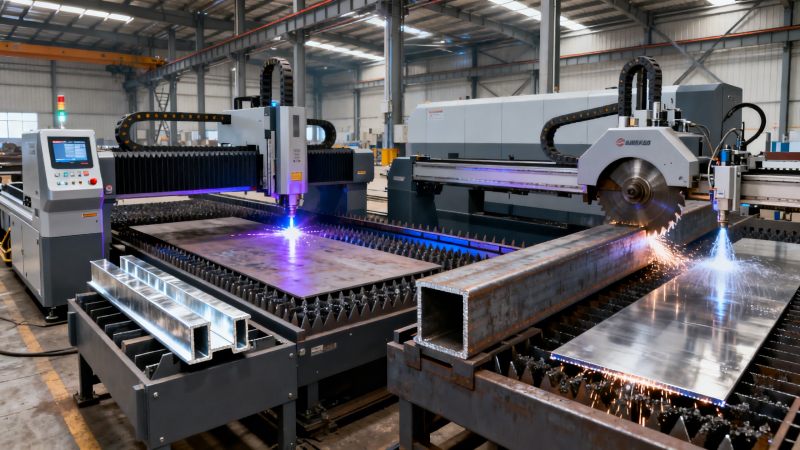
Edge quality dictates weldability, fatigue resistance, and surface preparation costs. Laser-cut edges exhibit minimal dross (<0.1 mm), smoothness Ra ≤ 3.2 µm, and negligible heat-affected zone (HAZ) depth—ideal for automated welding cells. In contrast, plasma-cut edges show visible oxide layers, micro-cracks at cut termini, and HAZ depths exceeding 1.5 mm in 20 mm thick A572 Grade 50 beams—requiring grinding or machining prior to critical weld joints.
Waterjet produces cold-cut edges with zero thermal distortion and no metallurgical alteration—making it preferred for stainless and weathering steels where corrosion resistance must be preserved. Yet its abrasive embedment (typically 10–25 µm deep) may interfere with coating adhesion unless properly blasted post-cut. Band sawing yields burr-free, square-cut surfaces with Ra ≈ 6.3 µm—fully compatible with galvanizing and powder coating without pre-treatment.
When fabricating crane rails or railcar underframes, Hongteng Fengda specifies waterjet for end plates exposed to cyclic loading and band sawing for main girders destined for hot-dip galvanizing—balancing edge integrity with process economics.
Lead Time Implications Across Project Phases
Lead time isn’t just about machine cycle duration—it encompasses programming, setup, fixturing, inspection, and logistics coordination. Laser systems require 2–4 hours of nesting and path optimization per job, but once running, deliver 3× faster throughput than plasma on parts under 15 mm thick. Plasma excels in rapid turnaround for large-section beams: a 300×300×12 mm RHS can be cut in 90 seconds flat with HD plasma versus 3.5 minutes on laser—translating to 7–10 working days saved on a 200-ton order.
Sawing remains the most predictable: average setup time is under 15 minutes per batch, and cycle times scale linearly with section size. For standard angle steel (L75×75×6 mm) or channel steel (C200×75×9 mm), our CNC saw lines maintain 98.5% on-time dispatch across 42 countries—including urgent shipments to EU infrastructure projects with 14-day committed delivery windows.
Notably, HRB600 Rebar orders benefit from parallel processing: while rebar bundles undergo straightening and cutting on servo-controlled shear lines (cycle time: 1.2 sec/bar), structural sections are cut simultaneously—enabling consolidated container loads with shared documentation and synchronized customs clearance.
These metrics reflect actual capacity planning at our Jiangsu-based manufacturing hub—equipped with 7 CNC saws, 4 HD plasma tables, and 3 fiber laser workcells. All systems integrate with our ERP-driven scheduling engine, enabling dynamic rescheduling within 2-hour windows for urgent customer requests.
Selecting the Right Method: A Decision Framework
No single method dominates all scenarios. The optimal choice depends on three weighted criteria: dimensional tolerance requirements (weight: 40%), edge finish needs (35%), and delivery urgency (25%). For example, a Middle East solar plant requiring 1,200 metric tons of ASTM A500 Grade C hollow sections prioritizes lead time and cost-efficiency—making HD plasma the default. Conversely, a German hospital expansion demanding EN 1090-2 EXC4 compliance for cantilevered stair supports mandates laser or sawing to guarantee edge integrity and weld prep readiness.
Hongteng Fengda provides free technical consultation during RFQ stage—including cross-method feasibility analysis, DFM feedback, and lead time modeling. Our engineering team reviews your BIM models or DXF files to recommend the optimal cutting strategy—factoring in your downstream processes, regional certification needs, and logistics constraints.
We also offer hybrid solutions: plasma-rough + laser-finish for complex brackets; saw-cut beams with laser-drilled connection holes; or waterjet-cut base plates paired with sawn anchor rods—all coordinated under one PO and QC protocol.
Why Global Buyers Choose Hongteng Fengda
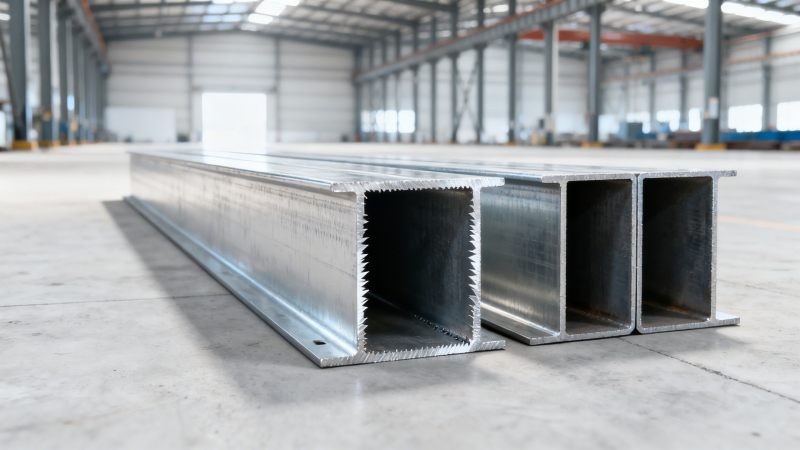
As a structural steel manufacturer & exporter from China certified to ISO 9001, ISO 14001, and OHSAS 18001, Hongteng Fengda bridges the gap between cost efficiency and uncompromised quality. Our 120,000 m² production base features automated material handling, real-time CNC monitoring, and third-party witnessed testing per ASTM E8/E23 for mechanical validation.
We serve over 420 clients across North America, Europe, the Middle East, and Southeast Asia—with average repeat order rate of 78% and on-time delivery consistency above 99.2%. From angle steel to cold-formed steel profiles, every shipment includes full traceability: heat numbers, mill test reports, and dimensional inspection records aligned to your specified acceptance criteria (ASTM A6, EN 10025, or GB/T 706).
Whether you’re specifying HRB600 Rebar for high-rise foundations or sourcing custom steel beams for offshore platforms, our integrated approach reduces sourcing risk, controls landed cost, and accelerates project timelines.
Get Your Precision-Cut Structural Steel Solution Today
Accuracy, edge quality, and lead time aren’t trade-offs—they’re interdependent variables we optimize holistically. With flexible cutting capabilities, rigorous QA protocols, and deep experience across global standards, Hongteng Fengda delivers structural steel components engineered for real-world performance—not just spec sheets.
Contact our engineering sales team today to request a customized cutting method assessment, download our Structural Steel Fabrication Handbook, or schedule a virtual factory tour. Let’s build your next project—right the first time.
Please give us a message


Please enter what you want to find