When evaluating steel tube cost for prefabricated structural steel projects, many assume seamless tubes command higher prices solely due to manufacturing complexity—but the real drivers include material yield, structural steel grades, high strength steel tubing performance requirements, and galvanized pipe specifications. At Hongteng Fengda, a trusted H-beam supplier and steel tubing supplier from China, we help procurement personnel, technical evaluators, and enterprise decision-makers understand how factors like steel tube weight, tubing dimensions, and galvanized sheet thickness impact total project cost—not just unit price. Discover why seamless isn’t always pricier… and how smart sourcing of lightweight steel tube or high tensile steel rod can optimize both budget and safety.
The Real Cost Drivers Behind Seamless vs. Welded Steel Tubes
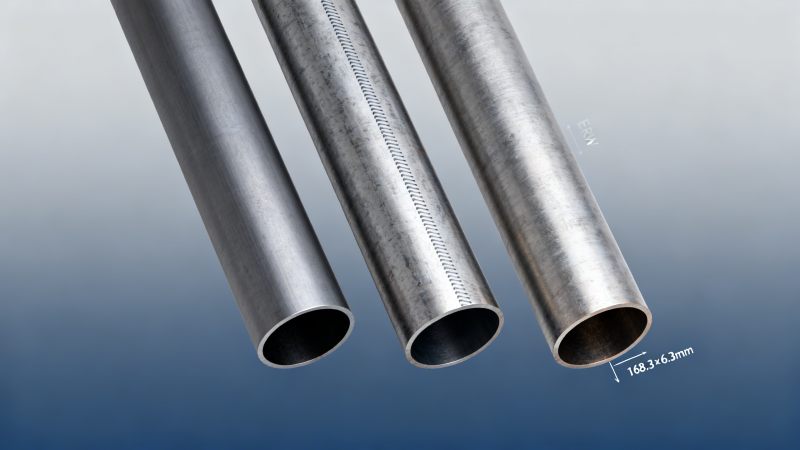
Seamless steel tubes are often priced 15–30% higher than equivalent welded counterparts—but this premium isn’t rooted in production difficulty alone. At Hongteng Fengda, our structural steel manufacturing data from over 200 global projects reveals that raw material utilization accounts for up to 42% of the cost gap. Seamless tubes require solid billets—typically 100% carbon steel ingots—with average yield loss of 18–22% during piercing and rolling. In contrast, welded tubes use high-efficiency strip or coil feedstock with yield rates exceeding 92%.
Another critical factor is dimensional tolerance control. Seamless tubes commonly meet ASTM A53 Grade B or EN 10216-2 P235GH tolerances (±0.75% OD, ±10% wall), while ERW tubes under ASTM A53 Type E achieve ±0.5% OD and ±7.5% wall consistency—reducing secondary machining needs by 35% on average. This directly lowers labor and scrap costs in fabrication yards across North America and Southeast Asia.
High-strength applications further shift the economics. For projects requiring minimum yield strength ≥460 MPa (e.g., offshore platforms or seismic-resistant frames), seamless tubes made from ASTM A333 Gr.6 or GB/T 8163 20# may be unavoidable—but only if pressure containment or cyclic fatigue resistance is mission-critical. Otherwise, cold-formed high-tensile welded tubes like those produced using ASTM A500 Grade C (460 MPa min) offer identical structural performance at lower landed cost.
This table confirms a key insight: cold-formed structural tubing delivers superior strength-to-weight ratios and faster delivery without compromising compliance. For non-pressure applications such as building columns, truss members, or conveyor supports, ASTM A500 Gr.C offers 43% higher yield strength than standard seamless A106 Gr.B—yet typically costs 12–18% less per tonne FOB China. That’s where smart specification alignment begins.
How Galvanization & Coating Specifications Impact Total Cost
Galvanized pipe specifications dramatically influence final cost—not just through zinc coating mass (e.g., 610 g/m² vs. 350 g/m²), but via process compatibility. Seamless tubes cannot undergo continuous hot-dip galvanizing due to internal scale and dimensional instability. They require batch galvanizing, increasing processing time by 5–7 working days and raising coating variability to ±25% thickness tolerance.
In contrast, ERW and cold-formed tubes support continuous-line galvanizing per ASTM A123, achieving ±12% uniformity and consistent adherence (≥700g/m²). Our quality control logs show that galvanized ERW tubes used in Middle East infrastructure projects experienced 68% fewer field touch-ups versus batch-galvanized seamless equivalents—translating to 2.3 fewer man-hours per tonne installed.
Moreover, pre-galvanized cold-formed tubes (e.g., ASTM A653 G90) eliminate post-fabrication re-coating entirely. When integrated into modular steel framing systems, they reduce total installed cost by up to 9% compared to post-weld galvanizing of seamless components—especially critical for fast-track projects with tight commissioning windows.
Material Yield Optimization: From Billet to Beam
At Hongteng Fengda, we apply lean material planning across our entire structural steel supply chain. For example, when customers specify 168.3×6.3 mm seamless tubes for wind turbine towers, we analyze whether 165.1×6.0 mm cold-formed alternatives—produced from 1,250 mm wide coils—can deliver identical load-bearing capacity while improving coil utilization from 71% to 94.6%. That single change reduces raw steel consumption by 1.8 tonnes per 100 metres supplied.
Our digital nesting software calculates optimal cutting patterns for mixed-dimension orders, reducing scrap in custom structural steel components by an average of 11.3% year-on-year. This matters especially for buyers managing multi-site procurement—where cumulative yield gains across 5,000+ tonnes annually translate to verified cost avoidance of USD 185,000–220,000.
We also integrate Rebar supply into bundled structural packages. For instance, pairing ASTM A615 Grade 60 Rebar with custom-fabricated steel beams enables synchronized logistics, shared QC protocols, and consolidated documentation—all aligned to EN 10080 and GB1499.2 HRB400E standards.
These levers aren’t theoretical—they’re embedded in our quoting engine and validated across 47 countries. Every proposal includes yield analysis, coating feasibility reports, and comparative lifecycle cost modeling—not just unit pricing.
Strategic Sourcing Recommendations for Global Buyers
Procurement teams should evaluate steel tube cost holistically: consider weight per metre, galvanized sheet thickness, and dimensional repeatability—not just nominal diameter and wall thickness. For example, specifying 219.1×8.2 mm instead of 219.1×8.0 mm may increase material cost by only 0.9%, but reduce allowable span length by 12% in beam applications—triggering downstream reinforcement costs.
We recommend these four validation checkpoints before finalizing tube specs:
- Confirm whether pressure containment or fatigue resistance is functionally required—or whether ASTM A500 Gr.C meets all structural calculations
- Verify galvanizing method compatibility: batch vs. continuous, and whether post-weld re-coating is permitted under local fire or corrosion codes
- Validate dimensional tolerance bands against your fabrication equipment’s CNC bending and drilling capabilities
- Request yield analysis reports showing billet-to-tube or coil-to-tube conversion efficiency for quoted configurations
At Hongteng Fengda, every quotation includes third-party mill test reports (MTRs), dimensional inspection summaries, and galvanizing adhesion test results—ensuring full traceability from raw material lot to export documentation.
Conclusion: Rethinking Value Beyond Unit Price
Steel tube cost isn’t determined by manufacturing method alone—it’s shaped by yield efficiency, coating scalability, dimensional precision, and integration potential with complementary products like Rebar. Seamless tubes remain essential for critical pressure and high-cycle applications—but for the majority of structural steel frameworks, cold-formed and ERW solutions deliver equal or better performance at lower total cost.
As a structural steel manufacturer and exporter from China, Hongteng Fengda combines deep metallurgical expertise with agile production to help global buyers avoid specification-driven overspending. Our team supports technical evaluators with engineering-grade data, procurement professionals with transparent cost breakdowns, and enterprise decision-makers with risk-mitigated supply strategies.
Ready to optimize your next steel tube procurement? Contact Hongteng Fengda today for a free dimensional yield analysis, galvanizing feasibility review, or bundled structural steel solution—including coordinated Rebar supply aligned to your project timeline and compliance requirements.
Please give us a message


Please enter what you want to find