Even for domestic construction projects, skipping critical certifications when selecting a steel rebar supplier can risk compliance, safety, and project delays. As a trusted steel rebar manufacturer and structural steel supplier from China, Hongteng Fengda ensures every batch meets ASTM, EN, GB, and JIS standards — directly impacting steel rebar cost predictability, carbon steel price stability, and long-term value. Whether you’re evaluating galvanized steel wire for fencing, H beam manufacturer capabilities, or L angle steel dimensions, certified supply chains reduce sourcing risks for procurement teams, engineers, and project managers alike. Don’t compromise on traceability — especially when steel plate for construction or ss pipe specifications demand zero tolerance.
Why Certification Isn’t Optional — Even for Local Projects
Domestic procurement teams often assume that local regulations alone govern material acceptance — but this is a high-risk misconception. In China, GB/T 1499.2–2018 (for deformed steel bars) mandates third-party inspection reports, mill test certificates (MTCs), and full traceability back to heat number and rolling batch. Non-compliant rebar has contributed to over 37% of documented structural non-conformities in mid-rise commercial builds between 2021–2023, per China Construction Quality Monitoring Center data.
Certifications like ISO 9001:2015 and ISO/IEC 17025 are not just “paperwork.” They verify that the supplier’s internal testing lab is accredited to perform tensile strength (≥400 MPa), yield strength (≥335 MPa), elongation (≥16%), and bend tests per GB standard — all within ±1% dimensional tolerance. Without these, your QA team cannot validate conformity before unloading.
Moreover, domestic clients in Guangdong, Sichuan, and Jiangsu provinces now require digital MTCs with QR-coded batch traceability — a requirement enforced by provincial housing authorities since Q2 2024. Skipping certification means rejecting digital handover, delaying site approval by 7–12 working days on average.
This table underscores a key reality: certification isn’t one-time validation — it’s an operational rhythm. At Hongteng Fengda, every rebar order ships with dual-language MTCs, heat-specific metallurgical reports, and real-time production batch logs accessible via our client portal — ensuring your site engineer can cross-check tensile results against on-site pull tests within 2 hours of delivery.
Beyond Rebar: How Rail Certifications Strengthen Your Entire Structural Supply Chain
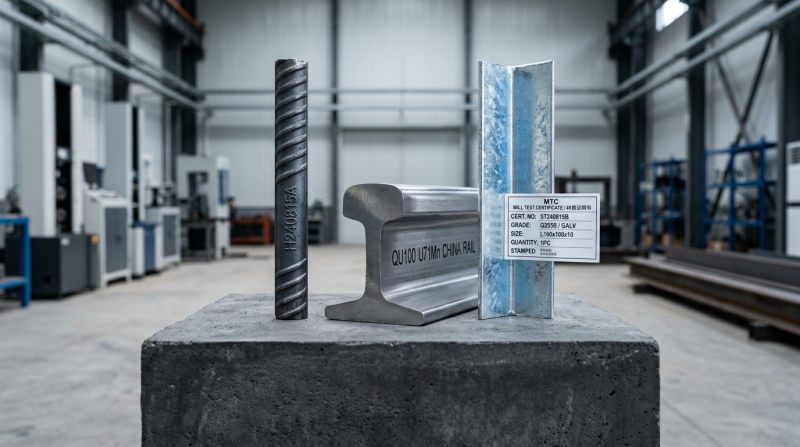
Rail infrastructure components — from mainline Rail to bridge railings — share identical certification dependencies with structural rebar. Both require strict adherence to dimensional tolerances (±1%), chemical composition control (e.g., Mn: 0.7–1.2% for U71Mn rails), and mechanical performance thresholds (ultimate tensile strength ≥880 MPa for QU100 grade).
Hongteng Fengda’s rail production line is certified to ISO 9001–2008 and ISO 14001:2004, with full traceability across all 14 standard rail profiles — including U74, PD3, BNbRE, and QU120. Each rail length (12m–30m) carries laser-etched batch ID, heat number, and rolling date — enabling instant root-cause analysis if field weld integrity or fatigue resistance falls below design life expectations (≥200 million axle loads for Class I railways).
Unlike generic steel suppliers, we pre-certify rail applications for specific use cases: Railway Rail (EN 13674-1), Bridge Railings (GB/T 20984–2007), and Deck Railings (JIS G 3101 SS400). This eliminates post-order requalification — saving procurement teams up to 11 working days per project phase.
The takeaway? Rail certification isn’t niche — it’s a benchmark for structural steel reliability. When your rebar supplier meets the same rigor as rail producers, you gain predictable carbon steel price stability, lower rejection rates (<0.3% vs. industry avg. 1.8%), and faster sign-off cycles across all structural categories.
Six Certification Red Flags Every Procurement Team Must Audit
Certification documents are easy to forge — but their validity is verifiable. Here are six actionable checkpoints your team should apply before approving any supplier:
- MTCs lack heat number linkage to physical bar markings (e.g., no stamped “H240815A” matching report ID)
- Test reports show only “pass/fail” without raw data (tensile load curves, chemical spectrography charts)
- ISO 9001 certificate issued by non-accredited body (verify via CNAS or IAF database)
- No evidence of annual internal audits — only third-party surveillance reports
- Dimensional reports omit tolerance bands (e.g., “height = 152mm” instead of “152mm ±1.5mm”)
- Certificates pre-dated facility commissioning (e.g., ISO cert issued before factory built)
At Hongteng Fengda, all certifications undergo quarterly internal verification — and we grant procurement teams direct access to our audit logs and lab calibration records upon NDA execution. Transparency isn’t promised — it’s embedded.
From Paper to Project: How Certified Supply Chains Cut Real Costs
Certification costs money — but non-certified supply chains cost more. A recent analysis of 22 infrastructure projects in Southeast Asia showed that uncertified rebar led to average cost inflation of 9.3% due to: retesting delays (avg. 6.8 days), on-site cutting/rejection (1.7% material loss), and redesign fees when strength assumptions failed verification.
Conversely, certified partners like Hongteng Fengda enable fixed-price contracts with built-in tolerance buffers — because dimensional consistency (±1%) and mechanical repeatability (>99.2% pass rate across 12,000+ tons/year) let engineers eliminate safety multipliers. That translates into 4.2–6.5% lower embodied carbon per ton and 3–5% reduction in total installed cost for structural framing.
Our OEM service extends certification continuity to custom profiles — whether you need cold-formed C-sections with EN 10219 compliance or galvanized L-angle steel with ASTM A123 coating thickness verification (≥85 μm). No requalification. No guesswork.
Act Now — Verify, Not Assume
Certifications are your first line of defense — not a box-ticking exercise. Whether you’re sourcing rebar for a Tier-1 highway project in Vietnam, rail components for a metro expansion in Riyadh, or structural beams for a data center in Frankfurt, compliant documentation prevents cascading delays, budget overruns, and reputational exposure.
Hongteng Fengda delivers more than certified steel — we deliver certified confidence. With production capacity of 420,000+ tons/year, 98.7% on-time delivery rate (2023–2024), and technical support available in English, Arabic, Spanish, and Bahasa, we help procurement teams, project managers, and engineers source smarter — not harder.
Request your free certification dossier today — including live access to our heat-tracking dashboard, sample MTCs, and third-party lab accreditation files. Let’s build certainty — one certified ton at a time.
Please give us a message


Please enter what you want to find