Before placing a bulk order with a steel rebar manufacturer, procurement professionals, project managers, and quality controllers must conduct a rigorous audit—especially when evaluating suppliers like Hongteng Fengda, a certified structural steel manufacturer and exporter from China. This checklist helps verify compliance with ASTM/EN/GB standards, assess real-time carbon steel price transparency, confirm steel rebar cost competitiveness, and validate capabilities across related product lines—including H beam manufacturer expertise, galvanized steel wire for fencing, steel plate for construction, L angle steel dimensions, SS pipe specifications, and galvanized steel price stability. Avoid supply chain risk: audit the right way.
1. Certification & Compliance Verification
International construction projects demand traceable conformity. A credible steel rebar supplier must hold valid third-party certifications—not just ISO 9001, but also product-specific approvals such as ASTM A615/A706 (US), EN 10080/BS 4449 (EU), and GB/T 1499.2–2018 (China). Hongteng Fengda maintains dual-certified production lines audited annually by SGS, Bureau Veritas, and China Classification Society (CCS), with test reports available per heat number and batch lot.
Non-compliance carries tangible cost: up to 12% rework rate on site if rebar fails tensile or bend tests. Auditors should request certified mill test reports (MTRs) covering chemical composition (C ≤ 0.25%, Mn 1.2–1.6%), mechanical properties (yield strength ≥ 400 MPa, elongation ≥ 14%), and surface finish (no scale flaking or cracks visible at 3× magnification).
Verify that the supplier’s lab is accredited to ISO/IEC 17025 and performs 100% dimensional inspection on every coil—measuring diameter tolerance within ±0.3 mm for Ø12–25 mm rebars, and weight deviation ≤ ±4% per meter.
This table highlights minimum performance thresholds required across major markets. Suppliers failing any column require immediate corrective action—or disqualification.
2. Production Capacity & Lead Time Reliability
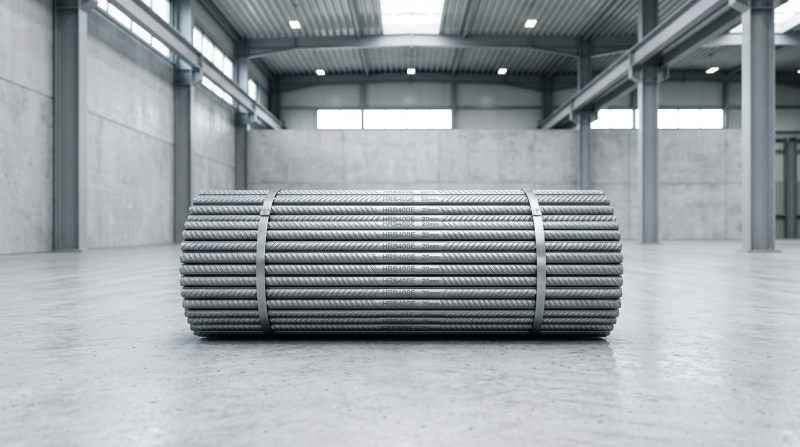
Bulk orders for infrastructure projects often exceed 5,000 metric tons per shipment. A robust rebar manufacturer must demonstrate stable output capacity of ≥ 80,000 MT/year across multiple rolling mills—and maintain ≥ 30 days of raw material inventory (billets, scrap, alloying agents) to buffer against iron ore price volatility.
Hongteng Fengda operates two integrated facilities in Hebei Province, with annual billet casting capacity of 1.2 million MT and rebar rolling capacity of 950,000 MT. Their ERP system tracks real-time furnace throughput, enabling accurate lead time commitments: standard orders (≤ 2,000 MT) ship within 18–25 days; custom grades (e.g., seismic HRB500E with controlled Ceq ≤ 0.52%) require 32–40 days.
Audit tip: Request quarterly production logs for the past 12 months. Consistent monthly output variance > ±7% signals instability. Also confirm cold storage capability for finished goods—temperature-controlled warehouses prevent moisture-induced rust during monsoon-season port delays.
3. Cross-Product Technical Alignment
Modern structural projects rarely source rebar alone. Integrated suppliers reduce coordination overhead and ensure dimensional compatibility across systems. For example, L angle steel dimensions must align precisely with rebar anchorage spacing; H-beam flange widths affect rebar lap length calculations; and galvanized steel wire for fencing shares zinc bath chemistry with rebar coating processes.
Hongteng Fengda’s R&D team co-develops cross-product technical packages—for instance, matching ASTM A615 Grade 60 rebar with EN 10346 DX51D+Z275 galvanized steel wire (zinc coating ≥ 275 g/m²) for perimeter security integration. Their QA lab validates inter-material weldability, thermal expansion coefficients, and chloride resistance using salt-spray testing per ASTM B117 (1,000-hour exposure).
For corrosion-critical applications, consider pairing rebar with Stainless Steel Welded Mesh—available in SS 304 and 316 grades with absolute micron retention from 4–360 μm, ideal for filtration layers in marine-grade foundations or chemical plant containment zones.
4. Traceability & Documentation Integrity
Each ton of rebar must carry full digital traceability: heat number, melt analysis, rolling date, inspector ID, and non-destructive testing (NDT) results. Hongteng Fengda embeds QR-coded labels on every bundle—scannable to access PDF MTRs, ultrasonic testing waveforms, and third-party certification scans.
Missing documentation triggers contractual penalties: under FOB Shanghai terms, late MTR submission beyond 48 hours post-shipment incurs 0.8% per day delay fee—capped at 5%. Verify that their document management system complies with ISO 27001 for data integrity and GDPR-compliant export controls.
Also audit packaging standards: seaworthy wooden crates for exports (ISPM-15 compliant), plastic-wrapped coils for inland delivery, and RFID-tagged pallets for warehouse automation compatibility.
This verification matrix ensures audit readiness for customs clearance, insurance claims, and downstream engineering sign-offs.
5. Risk Mitigation & Commercial Safeguards
Procurement teams must embed contractual safeguards. Key clauses include: (1) Price adjustment mechanism tied to CRU Index (±1.5% threshold before renegotiation); (2) Penalty for yield loss > 3.5% per coil; (3) Replacement guarantee for bent/damaged bundles within 72 hours; (4) Force majeure coverage limited to verified natural disasters—not labor strikes or policy shifts.
Hongteng Fengda offers optional credit insurance via Euler Hermes for orders ≥ $500,000, covering buyer insolvency risk up to 90% of invoice value. Their finance team provides quarterly carbon steel price trend reports—updated biweekly with LME, SHFE, and domestic GB index correlations.
Final recommendation: Conduct a pre-audit site visit to witness live rolling operations, sample cutting, and tensile testing. Observe operator PPE compliance, maintenance logs for rolling stands (scheduled every 72 operational hours), and calibration records for load cells (verified weekly per ISO 7500-1).
Conclusion: Build Confidence Through Structured Due Diligence
A rigorous steel rebar manufacturer audit isn’t about ticking boxes—it’s about validating engineering continuity, commercial resilience, and technical interoperability. From ASTM/EN/GB compliance to real-time price transparency and cross-product alignment, each checkpoint reduces hidden costs and accelerates project timelines.
Hongteng Fengda delivers this assurance through vertically integrated manufacturing, certified quality systems, and documented responsiveness across 12 global markets. Their structural steel portfolio—including angle steel, channel steel, steel beams, cold-formed profiles, and OEM solutions—ensures single-source consistency without compromising specification rigor.
Ready to initiate your supplier audit? Contact Hongteng Fengda’s technical sales team for a customized audit package—including factory tour scheduling, sample testing protocol, and multi-standard compliance gap analysis.
Please give us a message


Please enter what you want to find