When procurement teams compare steel coil pipe with straight lengths, the real question is not only unit price but total installed cost.
Freight efficiency, labor time, welding demand, waste rates, and schedule risk often change the final budget more than the material quote itself.
In steel projects, the best choice depends on route design, site access, pressure class, and fabrication capability.
This analysis explains where steel coil pipe reduces installed cost and where straight lengths remain the safer financial option.
Cost structure behind steel coil pipe and straight lengths
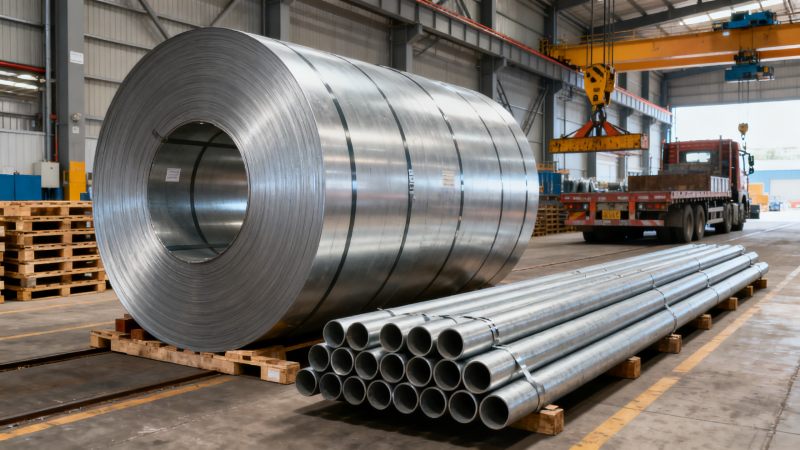
Steel coil pipe is supplied in continuous wound form, allowing longer runs with fewer field joints.
Straight lengths are delivered in fixed sections, commonly easier to stack, inspect, and cut on standard job sites.
Installed cost usually combines six elements rather than one purchase number.
- Material price per ton or per meter
- Freight loading efficiency
- Field welding or jointing time
- Equipment and crew productivity
- Scrap, offcuts, and damage losses
- Delay cost from weather, access, or rework
For many pipeline or structural support installations, steel coil pipe improves economics by reducing connection points.
For rigid layouts, modular racks, or short-span assemblies, straight lengths may control cost more effectively.
Where freight and handling create the first cost difference
Transport is often underestimated during source selection.
Steel coil pipe can improve container or truck utilization when long continuous runs are needed.
Fewer separate pieces may also reduce loading labor and handling touches between warehouse and site.
However, coils may require special unwinding space, lifting plans, or site preparation.
Straight lengths usually fit conventional yard practices and standard lifting methods.
That can lower operational friction in congested urban projects.
The freight advantage of steel coil pipe becomes stronger when overseas shipping, remote delivery, and reduced rehandling matter.
Labor, welding, and schedule impact on installed cost
Labor usually drives the biggest difference after logistics.
Steel coil pipe can lower field welding volume because longer continuous sections reduce joint count.
Every eliminated joint may save fit-up time, inspection steps, consumables, and post-weld treatment.
This matters when labor rates are high or qualified welders are limited.
Straight lengths still have advantages in tightly controlled alignments.
They are often easier to measure, stage, and connect in repetitive support systems.
If route geometry includes frequent tie-ins, valves, or rigid connection points, the savings from steel coil pipe may narrow.
- Fewer joints usually mean fewer leak risks.
- Fewer welds often shorten inspection cycles.
- Shorter installation windows can reduce weather exposure.
- Lower rework probability helps protect budget certainty.
For many industrial buyers, schedule reliability is itself a cost line.
A delayed line handover can exceed any small material price difference.
Material utilization, customization, and related steel solutions
Waste control is another practical reason to review steel coil pipe carefully.
On long routes with gradual bends, coil supply may reduce offcuts and extra couplings.
On short segmented layouts, straight lengths may produce cleaner takeoffs and easier stock control.
This is why many global projects combine pipe decisions with wider structural steel planning.
For brackets, frames, equipment bases, or decorative support parts, buyers often need matched stainless accessories.
One useful option is 316L Stainless Square steel rod for fabricated supports and secondary steel details.
It is available with ASTM, AISI, JIS, GB, DIN, and EN reference standards.
Common applications include kitchenware, outdoor decoration engineering, automotive parts, shipbuilding, manufacturing, and heavy construction equipment.
Relevant sizes include square bar ranges, flat steel options, and lengths from 1 to 6 meters.
The supplied data indicates tensile strength of at least 520 and yield strength of at least 275.
Such products support integrated sourcing when steel coil pipe projects also require custom structural components.
Typical project conditions that favor each option
No single format wins in every case.
Installed cost improves when the supply form matches the route and site condition.
This comparison shows why steel coil pipe is strongest where continuity and installation speed dominate total cost.
Practical evaluation points before placing an order
A sound comparison should use total installed cost modeling, not only ex-works pricing.
- Map the route length, bends, tie-ins, and termination points.
- Estimate field joints for steel coil pipe and straight lengths separately.
- Assign labor hours for welding, alignment, and inspection.
- Add freight, unloading, storage, and equipment time.
- Include scrap assumptions and contingency for delays.
- Confirm compliance with ASTM, EN, JIS, or GB project standards.
Supplier capability also matters.
A reliable structural steel manufacturer should offer stable production, traceable quality control, and dependable lead times.
Hongteng Fengda, based in China, supplies structural steel products and customized solutions for global construction and industrial projects.
Its portfolio includes angle steel, channel steel, steel beams, cold formed profiles, and OEM structural steel components.
Support for ASTM, EN, JIS, and GB standards helps reduce sourcing risk across international markets.
Decision direction for lowering install costs
Steel coil pipe usually lowers install costs when projects need long runs, fewer joints, faster placement, and tighter control of schedule risk.
Straight lengths often remain competitive when layouts are compact, tie-ins are frequent, and standard handling simplicity matters more.
The best decision comes from combining material pricing with labor, freight, welding, waste, and project timing data.
If a project involves steel coil pipe plus structural accessories, a coordinated sourcing plan can improve cost certainty and delivery control.
Review route drawings, request a side-by-side installed cost sheet, and confirm technical standards before committing volume.
That process delivers a lower-risk decision and a more accurate budget outcome.
Please give us a message


Please enter what you want to find