When selecting steel wire for construction, tensile strength is not just a technical number—it directly affects safety, performance, and cost. Buyers comparing corrosion resistant wire, high-temperature steel applications, or sourcing from a China steel supplier usually do not need the “highest possible” tensile value. What they need is a practical tensile range that fits the job, meets code requirements, and avoids unnecessary processing or procurement cost. In most construction use cases, the practical range is the one that balances strength, ductility, handling, fastening performance, and durability under real site conditions.
What tensile range is actually practical for construction steel wire?
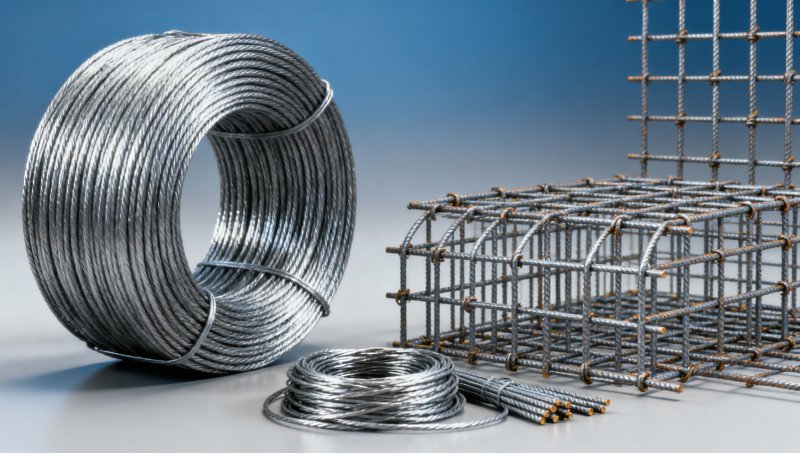
The short answer: for most construction applications, a practical tensile range is usually 400-1,200 MPa, but the right choice depends heavily on how the wire will be used.
That range sounds broad because “construction steel wire” covers several very different jobs, including:
- binding and tying rebar,
- welded wire mesh production,
- prestressing applications,
- fencing and reinforcement,
- suspension, fastening, or anchoring tasks,
- corrosion exposed outdoor use.
For practical buying and technical evaluation, it helps to divide tensile strength into working bands:
- Low to moderate tensile: 350-600 MPa — often suitable for tying wire, general-purpose binding, and applications where flexibility matters more than maximum load.
- Medium tensile: 600-900 MPa — common for mesh, reinforcement-related processing, and structural support tasks that need a balance of formability and strength.
- High tensile: 900-1,200 MPa — used where reduced deformation, better load capacity, or specialized reinforcement performance is needed.
- Very high tensile: above 1,200 MPa — usually for prestressing or engineered applications, not for routine site use.
For many buyers, the mistake is assuming that stronger automatically means better. In reality, construction teams often reject overly high-tensile wire because it can be harder to bend, tie, weld, cut, or process consistently on site.
What different buyers care about before choosing wire strength
Different decision-makers read the same tensile number differently, so practical selection should align with their concerns:
- Engineers and technical evaluators care about load performance, elongation, fatigue behavior, and code compliance.
- Procurement teams focus on total landed cost, supplier consistency, lead time, and risk of claims.
- Project managers want smooth installation, low breakage rate, and reduced site delays.
- Quality and safety teams need traceability, stable mechanical properties, coating consistency, and standard compliance.
- Business and finance approvers care about whether a higher-grade wire truly creates value or simply raises cost.
That is why the “best” tensile range is rarely the highest available. It is the one that delivers enough strength without creating downstream problems in fabrication, handling, safety, or budget.
How to choose the right tensile range by application
A practical way to decide is to start from the application, not from the material certificate alone.
1. Rebar tying and general binding
For rebar tying wire and light fixing tasks, lower to moderate tensile levels are usually more practical. The wire needs to bend easily, twist without snapping, and allow fast manual or tool-assisted tying. If tensile strength is too high, workers may experience more breakage and slower installation.
Practical focus: ductility, ease of twisting, manageable coil handling, and stable wire diameter tolerance.
2. Welded wire mesh and fabricated products
For mesh manufacturing, a medium tensile range is often preferred. The wire must keep shape, support weldability, and perform consistently in automated production. If tensile is too low, dimensional stability can suffer. If too high, weld performance and forming efficiency may become less reliable.
Practical focus: weldability, tensile consistency from coil to coil, surface condition, and process compatibility.
3. Structural reinforcement and heavier-duty support uses
For applications requiring stronger load resistance or reduced deformation, medium to high tensile wire is often more suitable. This can include reinforcement systems, industrial fastening, or special support functions in demanding environments.
Practical focus: load-bearing reliability, fatigue resistance, and service-life stability.
4. Prestressed or engineered systems
If the wire is intended for prestressing concrete or highly engineered structural systems, very high tensile grades may be required. But these are specialized products that must be matched with strict standards, controlled production, and verified application design. They are not general-purpose construction wire.
Practical focus: code-specific qualification, stress-relaxation properties, and certified mechanical performance.
Why “practical” tensile strength is a balance, not a maximum
In real construction procurement, tensile strength must be evaluated together with several other properties:
- Ductility: High tensile wire with poor elongation can crack or fail during bending or tying.
- Weldability: Some stronger wires are less suitable for welded assemblies.
- Corrosion resistance: Outdoor and humid environments may require coated or alloy-protected options.
- Fatigue behavior: Repeated loading can matter more than static tensile value.
- Surface quality: Cracks, scale, or inconsistent coating can reduce actual performance.
- Dimensional consistency: Diameter tolerance influences installation and fabrication accuracy.
This is especially important when buyers compare corrosion resistant wire options. In many projects, a slightly lower tensile level with better corrosion protection and processing performance is more practical than a higher tensile product that is harder to use and degrades faster in service.
How corrosion, temperature, and environment affect the useful tensile range
The “practical” tensile range changes once environment is considered.
For example:
- Outdoor construction: corrosion resistance may matter more than pushing tensile to the top end.
- Marine or humid areas: protective coating quality can determine service life more than raw base strength.
- High-temperature steel applications: room-temperature tensile values alone are not enough; strength retention, oxidation resistance, and thermal stability become critical.
- Cold-forming or site-bending work: moderate tensile with better elongation is often safer and more efficient.
That is why technical assessment should not stop at the mill test certificate headline value. Practical performance is always application plus environment plus processability.
What to ask a supplier before approving steel wire for a project
If you are sourcing from a China steel supplier or any international manufacturer, these questions help reduce procurement risk:
- What is the guaranteed tensile range, not just the nominal value?
- What are the yield strength, elongation, and diameter tolerances?
- Which standards apply—ASTM, EN, JIS, or GB?
- Is the product intended for tying, mesh welding, reinforcement, or prestressing?
- What coating or corrosion protection is available?
- Can the supplier provide batch traceability and quality inspection records?
- How stable is production between lots and shipments?
- What packaging, coil weight, and lead time options are available?
These questions matter because many project failures or site complaints come not from insufficient headline strength, but from inconsistency, poor coating, difficult handling, or mismatch between the wire and the actual use case.
Material selection should consider the full steel system, not wire alone
Construction buyers often assess wire together with other steel components used in the same project. For example, if a project demands both reinforcement accessories and corrosion resistant sheet or profile materials, the selection logic should be consistent across the steel package: required strength, fabrication method, expected exposure, and lifecycle cost.
In corrosion-sensitive building envelopes or industrial applications, coated steel products may provide better long-term value than relying on bare high-strength materials alone. One example is AZ50 Galvalume Steel Coil, which combines aluminum, zinc, and silicon coating technology for strong corrosion resistance, good weldability, and reliable mechanical performance. With tensile strength typically in the ≥270-500 MPa range and yield strength of ≥240-380 MPa, it is suited to exterior, structural, and industrial applications where durability and processability both matter. For many buyers, this kind of balanced coated steel solution better reflects what “practical performance” means in construction procurement.
Common buying mistakes when comparing tensile strength
- Choosing the highest tensile grade without considering workability
- Ignoring elongation and bending performance
- Comparing prices without checking applicable standards
- Assuming all corrosion resistant wire performs the same
- Using general-purpose wire for engineered structural functions
- Approving samples without verifying mass-production consistency
These mistakes can increase scrap, slow installation, raise labor cost, and create quality disputes after delivery.
Final answer: what tensile range should you choose?
For most construction use, the practical tensile range is not a single number but a selection window based on application:
- 350-600 MPa: practical for tying, binding, and flexible on-site use
- 600-900 MPa: practical for many mesh, fabrication, and general reinforcement-related uses
- 900-1,200 MPa: practical for heavier-duty and specialized structural support needs
- Above 1,200 MPa: mainly for prestressing and engineered systems, not routine construction tasks
The best choice depends on load demand, forming method, weldability, corrosion exposure, compliance requirements, and total project cost. In short, practical tensile strength is the level that safely performs the job while remaining workable, durable, and commercially efficient.
For buyers, evaluators, and project teams, the smartest decision is to select steel wire by real application conditions rather than by maximum strength alone. That approach reduces sourcing risk, improves site efficiency, and supports better long-term project value.
Please give us a message


Please enter what you want to find