Steel Sheet Price: How Thickness, Grade, and Finish Affect Your Total Cost
Understanding steel sheet price is essential for procurement professionals who need to balance quality, performance, and budget. Thickness, grade, and surface finish can significantly change the total cost, affecting not only material pricing but also processing, transportation, and long-term project value. This guide explains the key cost drivers behind steel sheet purchasing, helping buyers make more informed sourcing decisions and reduce overall procurement risks.
If you buy steel sheet often, you already know the quoted ton price is only the visible part of the number. What usually causes trouble is everything around it: tolerance, yield strength, coating choice, cutting loss, shipping method, and whether the material actually matches the fabrication plan. Buyers who compare only base price often end up paying more after processing delays, rework, or specification disputes.
For procurement teams sourcing from China or other export markets, the practical question is not “What is today’s steel sheet price?” but “What specification gives me the lowest real cost for this job?” That is the checklist worth using.
Start with the actual use case, not the cheapest thickness
Thickness is one of the fastest ways to change material cost, but it is also where buyers create expensive mistakes. A thinner sheet may reduce the purchase price per piece, yet increase deformation risk during forming, welding, transport, or site installation. A thicker sheet raises material weight immediately and can also raise freight, handling, and machining cost.
A useful check is simple: confirm whether the thickness was selected by design load, fabrication method, or just historical habit. Those are not the same thing. In some projects, old drawings keep a thicker gauge than necessary. In others, the design is already tight and any attempt to save cost by reducing thickness will move the problem downstream.
- Check nominal thickness against minimum acceptable thickness after tolerance.
- Ask whether the sheet will be cut, bent, stamped, welded, or used as-is.
- Review whether higher thickness creates unnecessary dead weight in transport-heavy projects.
- Confirm if local code, client specification, or engineer approval limits substitution.
This is especially important when comparing suppliers. Two quotations can look similar while one is based on a wider negative tolerance window. If your downstream process is sensitive, that lower quote may not be comparable at all.
Do not treat grade as a paperwork item
Grade changes steel sheet price for good reasons. It affects mechanical performance, chemistry, weldability, forming behavior, and sometimes inspection requirements. Buyers sometimes over-specify grade because the cost difference looks manageable at quote stage. Then the project absorbs that premium across the full volume, even when the application did not require it.
The reverse problem is more dangerous: replacing one standard with a “close enough” material name. ASTM, EN, JIS, and GB grades can be comparable in some cases, but they are not automatically interchangeable. If the project document names A36, S235, SS400, or another grade, the mill test certificate and approval path need to match the real requirement. Anything else should be treated as substitution and verified before ordering.
When grade premiums are under review, ask three direct questions: does the design need that strength level, does fabrication need that chemistry, and does the client require that exact standard? If the answer is vague, pause before signing the PO.
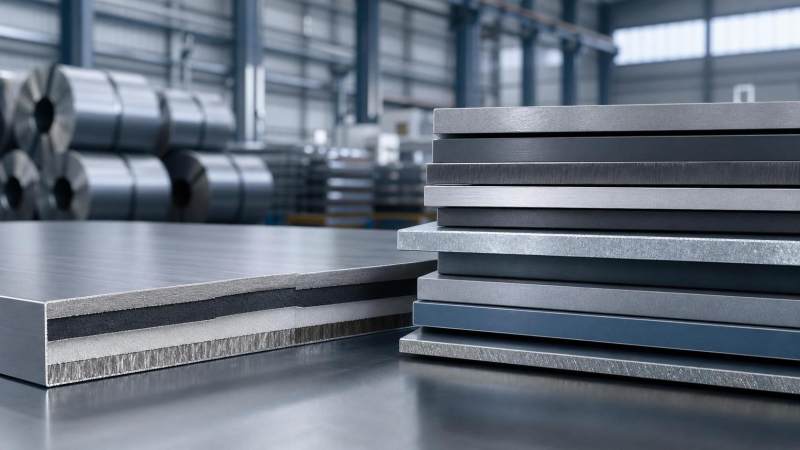
Surface finish can quietly change the whole budget
Finish is where many buyers underestimate total cost. A plain hot rolled sheet, pickled sheet, galvanized sheet, polished finish, and patterned plate may all serve “steel sheet” demand, but the pricing logic behind them is very different. Finish affects corrosion resistance, visual quality, slip resistance, secondary painting, storage conditions, and scrap rate.
For example, if the sheet will be used for floors around equipment, ramps, or industrial walkways, a patterned surface may reduce secondary processing and improve service performance. In that kind of application, buyers often compare plain plate plus added treatment against ready-to-use material such as S335JR Patterned steel plate. The right choice depends on fabrication flow, not just the ex-works price.
Based on available product data, this type of patterned plate is commonly offered in 2-8mm thickness, widths from 600mm to 1800mm, and lengths from 2m to 12m or custom requirements, with applications in transportation, construction, decoration, machinery, shipbuilding, and equipment-floor areas. Stated standards may include ASTM, DIN, JIS, BS, GB/T, ISO, SGS, and BV, but buyers should still verify which certificates are available for the exact batch and destination market.
The practical lesson: choose finish by end use and downstream cost. Decorative or anti-skid performance can justify a higher unit price if it removes later work, reduces slip risk, or helps the product pass inspection with fewer corrections.
Watch the conversion loss, not just the sheet price per ton
A common purchasing gap is ignoring nesting efficiency. The cheaper steel sheet price may belong to a stock width or length that creates more scrap after cutting. That is not a bargain. For buyers supporting manufacturing lines, size optimization often saves more than aggressive price negotiation.
Before placing an order, ask the fabricator or production team for the preferred mother sheet size. Even a small change in width can improve yield meaningfully on repeated parts. If the supplier offers OEM cutting or customized sheet dimensions, compare that option against in-house cutting cost, scrap disposal, and production speed.
Freight and packaging can erase a good quote
Heavy steel products punish procurement teams that leave logistics to the end. Thickness increases weight quickly. Longer sheets may reduce weld seams or joints, but they can also trigger transport constraints, special loading issues, and port handling complications. Export buyers should confirm packing method, bundle weight, container loading plan, and port suitability before approving production.
For ocean shipments, the real landed cost should include corrosion protection during transit, especially if the finish is sensitive or the destination has long inland transport after discharge. Cheap packaging is one of those savings that comes back later as a claim dispute.
Suppliers with export experience tend to manage this better because they understand documents, marking, packing sequence, and realistic lead times. For global buyers working across North America, Europe, the Middle East, and Southeast Asia, that reliability often matters as much as a small price difference.
Check standards, certificates, and what “available” actually means
This part is less exciting, but it is where procurement risk becomes expensive. If the project requires ASTM, EN, JIS, or GB compliance, ask for the exact standard reference, not a general statement that the material is “up to export standard.” Those are not the same thing.
Also separate three things clearly: material can be produced to a standard, a mill can issue a certificate, and a third party can inspect the goods. Buyers sometimes assume all three are included because the supplier website lists multiple standards or inspection bodies. That needs document-level confirmation for the ordered item.
If you are sourcing structural or industrial steel from a Chinese manufacturer, it is reasonable to ask for mill test certificate format, inspection scope, dimensional tolerance confirmation, and production lead time before deposit. A reliable supplier should be able to answer these points without ambiguity.
A short buyer checklist before you request quotes
- Define end use: structural, decorative, anti-skid, fabrication, or resale.
- Lock the required thickness range and acceptable tolerance.
- State the exact grade and standard, and mark substitutions as subject to approval.
- Specify finish condition and whether further coating or painting will follow.
- Confirm sheet dimensions that reduce cutting loss.
- Request certificate requirements before order confirmation.
- Include packaging, shipping terms, and delivery destination in the RFQ.
- Compare total landed cost, not only FOB or EXW material price.
That last point is usually where the best procurement decisions come from. Steel sheet price matters, but buying the right thickness, right grade, and right finish matters more. If the specification fits the application, the production plan, and the logistics route, your total cost becomes predictable. That is what most procurement teams actually need: fewer surprises after the quote is accepted.
For buyers looking for a structural steel manufacturing and export partner in China, experience in international standards, customized production, and stable lead times can reduce a lot of hidden sourcing risk. Price is important, but consistency is what keeps a project on schedule.
Please give us a message


Please enter what you want to find