Buying the wrong steel round plate can quietly drive up material waste, machining costs, and project delays. For end users, common mistakes often start with unclear specifications, overlooked tolerances, or choosing suppliers without proven quality control. This guide explains the most frequent buying errors and shows how to source the right steel round plate more efficiently for reliable performance and better value.
Why do buyers waste money on steel round plate even before machining starts?
Many buyers assume waste happens only on the shop floor, but a large share of loss is built into the purchase decision. A steel round plate may look simple, yet its grade, thickness, flatness, diameter tolerance, surface condition, and cutting method all affect how much usable material remains after fabrication. When these details are not confirmed early, the result is often excess trimming, rejected parts, slower processing, or unexpected rework.
For end users, the most common problem is buying based on price per ton alone. Lower unit cost can be misleading if the plate arrives with poor dimensional consistency, unsuitable chemistry, or a finish that requires extra grinding. In real purchasing situations, a cheaper steel round plate can become more expensive once scrap rates, labor, tool wear, and delivery delays are counted.
Another hidden issue is ordering from a generic description instead of a use-based specification. If the plate will be welded, formed, exposed to moisture, or used in corrosive conditions, the material choice must match that environment. Buyers who skip this step often receive a product that is technically available but operationally wrong.
What specification mistakes cause the most waste when ordering steel round plate?
The biggest waste usually comes from incomplete specifications. When a purchase order says only “steel round plate” with a thickness and diameter, too much is left open to interpretation. Suppliers may follow different standards, and small differences can create major downstream problems.
Key details that should always be confirmed include material grade, standard, thickness tolerance, diameter tolerance, flatness, edge condition, heat treatment status, surface finish, and whether the plate is cut from sheet, flame cut from thicker plate, or machined from forged stock. These factors influence both performance and yield.
A frequent mistake is over-specifying dimensions without considering standard production sizes. Buyers may request a nonstandard diameter that forces extra cutting from a larger plate, increasing scrap. The opposite mistake also happens: choosing a “close enough” size that later requires heavy machining. Both decisions raise waste. Good sourcing balances design need with available mill or processing sizes.
Tolerance confusion is another costly problem. Some buyers request very tight tolerances without needing them, paying more for precision they never use. Others fail to define tolerances at all and receive material outside the practical range for their process. In both cases, poor specification control increases waste.
How can end users choose the right grade instead of just a common grade?
The right grade depends on how the steel round plate will actually be used. Buyers often default to a familiar carbon steel or stainless option because it is easy to source. However, the correct selection should be based on corrosion exposure, load requirements, fabrication method, operating temperature, hygiene needs, and expected service life.
For example, if the application involves humidity, chemicals, food contact, or marine conditions, corrosion resistance becomes a major decision factor. In such cases, a stainless solution may reduce long-term waste by preventing premature failure, replacement, or surface degradation. This is why some buyers shift from a general steel round plate request to a more application-specific material review.
A useful reference in corrosive or high-temperature environments is 316 Stainless Steel Plate. This material contains 2–3% molybdenum, which improves resistance to pitting and corrosion, especially in acidic environments. Typical performance data includes tensile strength of at least 520, yield strength of at least 275, elongation around 55–60, hardness up to 183HB or 100HRB, and density of 7.98. It is widely used in chemical processing, food industry equipment, medical equipment construction, agriculture and ship parts, kitchen supplies, vehicles, conveyor belts, and components such as bolts, nuts, springs, and screens.
This kind of product is also available in multiple thicknesses from 0.3mm to 200mm, with common lengths such as 2000mm, 2438mm, 3000mm, 5800mm, 6000mm, and 12000mm, plus several width options and finishes including BA, 2B, NO.1, NO.4, 4K, HL, and 8K. For buyers, the lesson is clear: choosing the right material is not about selecting the most popular option, but about matching mechanical properties, corrosion performance, and processing needs to the final application.
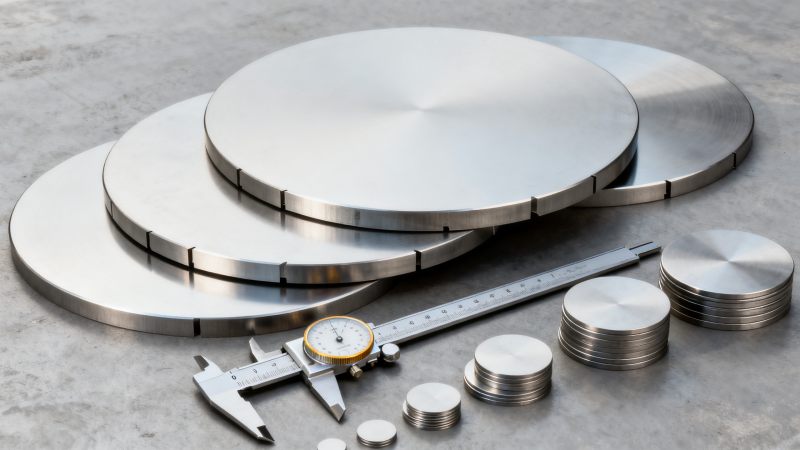
How do tolerance, flatness, and surface finish affect waste in a steel round plate order?
These details matter more than many buyers expect. A steel round plate with inconsistent thickness may cause uneven machining depth, poor balance in rotating applications, or assembly mismatch. Flatness problems can increase setup time, especially in CNC, laser, or fixture-based operations. Surface defects may not affect all applications, but for visible, coated, sanitary, or precision parts, they can lead to rejection.
Flatness should be discussed whenever the plate must sit flush, seal properly, or enter automated fabrication. Surface finish should also align with the end use. If a part will be polished, painted, or used in a clean environment, a rough or damaged surface can add labor and lower yield. Buyers who ignore finish often end up paying twice: once for the material, and again for corrective processing.
Tolerance control should be practical, not excessive. Tight tolerances improve fit and reduce secondary operations, but they also increase cost. The best approach is to define the minimum tolerance level the project truly needs. This reduces waste without overpaying for unnecessary precision on every steel round plate ordered.
Why is supplier capability just as important as the steel round plate itself?
Even with a good specification, poor supplier execution can still create waste. Reliable sourcing depends on process control, not just inventory availability. Buyers should evaluate whether the supplier can consistently meet standards, provide traceable material documentation, manage dimensional accuracy, and deliver stable quality across batches.
For steel products used in construction, manufacturing, and industrial projects, a capable supplier should understand international requirements such as ASTM, EN, JIS, and GB where relevant. Strong quality systems, modern manufacturing equipment, and repeatable inspection methods reduce the risk of receiving off-spec material. Certifications such as ISO, SGS, or BV can support confidence, but they should not replace actual communication about inspection scope and acceptance criteria.
This is especially important in export supply. A structural steel manufacturer and exporter with stable production capacity, clear documentation, and dependable lead times can help global buyers reduce sourcing risk. End users benefit when suppliers can not only ship material, but also support customized solutions, OEM requirements, and practical specification guidance before production starts.
What questions should buyers ask before placing a steel round plate order?
A good purchasing process starts with the right questions. These questions help prevent waste far more effectively than solving problems after delivery. Before confirming a steel round plate order, buyers should clarify:
- What is the exact application: structural, decorative, chemical, food-related, high-temperature, or general fabrication?
- Which material grade and standard are required?
- What are the critical dimensions, and which tolerances actually matter?
- Does the part require a specific flatness level or surface finish?
- Will the plate be welded, machined, formed, coated, or exposed to corrosion?
- Is there a standard stock size that can improve yield and reduce scrap?
- What inspection documents, test certificates, or third-party verification are needed?
- Can the supplier support repeat orders with consistent quality and lead time?
These questions turn a simple purchase into a more accurate sourcing decision. They also make supplier quotations easier to compare because each offer is based on the same technical requirements.
What are the most common misconceptions about saving money on steel round plate?
One misconception is that buying oversized material is always safer. In reality, too much extra stock can raise scrap volume and machining time. Another is that all steel round plate suppliers offer equivalent quality if they quote the same grade. Grade alone does not guarantee similar flatness, chemistry consistency, finish, or cutting accuracy.
Some buyers also believe stainless is always too expensive. That may be true on initial price, but not necessarily on lifecycle value. In corrosive or hygienic environments, the right stainless plate can reduce maintenance, replacement, contamination risk, and production downtime. Material cost should therefore be viewed together with service life and processing efficiency.
A final misconception is that documentation is optional for routine purchases. When quality issues appear, missing mill test certificates, unclear standards, or poor traceability make claims difficult and root-cause analysis slower. Good documentation is not paperwork for its own sake; it protects quality and helps control waste over time.
How can buyers reduce waste and improve purchasing results over the long term?
The best long-term strategy is to standardize the buying process. Build a clear specification template for each recurring steel round plate application. Record accepted tolerances, preferred grades, target finish, approved standards, and any processing notes from production teams. This creates consistency and lowers the chance of repeat mistakes.
It also helps to work with suppliers that understand both material production and downstream use. For example, experienced structural steel manufacturers can advise on standard sizing, feasible tolerances, and whether a custom solution is justified. That kind of support is valuable for global buyers who need stable quality, controlled cost, and dependable delivery rather than one-off low pricing.
If you need to confirm a steel round plate order more confidently, start by discussing the end-use environment, required grade, dimensional tolerances, finish expectations, applicable standards, documentation needs, batch consistency, and delivery schedule. These are the questions that most directly influence waste, total cost, and whether the purchased material truly fits the job.
Please give us a message


Please enter what you want to find