Selecting the right steel plate for construction is critical to structural safety, fabrication efficiency, and long-term project performance.
Grade selection requires more than strength alone. It also depends on toughness, weldability, tolerance, corrosion exposure, and recognized standards.
For reliable steel plate for construction, every technical decision should connect design loads, fabrication methods, site conditions, and inspection requirements.
Basic Definition of Steel Plate for Construction
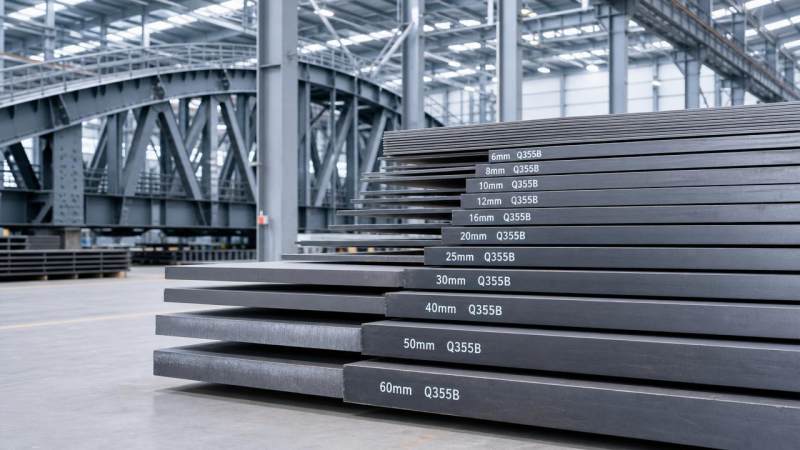
Steel plate for construction refers to flat-rolled steel used in buildings, bridges, industrial plants, foundations, equipment bases, and structural assemblies.
It is usually supplied in specified thickness, width, length, grade, surface condition, and delivery status.
Common construction steel plate grades include carbon structural steel, low-alloy high-strength steel, weathering steel, and normalized structural plate.
The main purpose is to transfer loads safely while supporting cutting, drilling, welding, forming, bolting, and coating operations.
A suitable steel plate for construction must match the structural design code and the actual fabrication route.
Industry Standards and Current Selection Priorities
Construction projects often reference ASTM, EN, JIS, GB, ISO, or project-specific technical specifications.
These standards define mechanical properties, chemical composition, testing methods, dimensional tolerances, and documentation requirements.
Steel plate for construction is increasingly reviewed through traceability, weldability, low-temperature performance, and consistency across production batches.
Modern structural steel supply also requires predictable lead times, mill test certificates, and alignment with international inspection practices.
Hongteng Fengda supports structural steel projects with products complying with ASTM, EN, JIS, and GB requirements.
Key Grade Properties for Construction Use
Strength and Load Performance
Strength is usually the first parameter reviewed for steel plate for construction, but it should not be isolated.
Higher yield strength can reduce weight, yet it may require stricter welding procedures and more careful forming control.
Typical grades must be checked against design stress, plate thickness, connection type, and safety factors.
Toughness and Service Temperature
Toughness becomes essential when steel plate for construction is used in bridges, cranes, offshore structures, or cold-region buildings.
Charpy impact testing helps confirm resistance to sudden fracture under low temperature or dynamic loading.
For critical structures, impact test temperature and absorbed energy should be clearly stated in the purchase specification.
Weldability and Carbon Equivalent
Weldability depends on carbon content, alloying elements, plate thickness, heat input, and cooling rate.
Low carbon equivalent usually improves welding behavior and reduces the risk of cold cracking.
A practical steel plate for construction specification should include preheating guidance when thick plate or high-strength grades are used.
Application Value in Structural Projects
Correct grade selection improves safety, fabrication speed, installation accuracy, and long-term maintenance planning.
It also reduces rework caused by unsuitable cutting performance, excessive distortion, weld defects, or inconsistent mechanical properties.
Steel plate for construction is often combined with beams, channels, angles, bars, and customized structural components.
In reinforced concrete systems, Rebar may complement plate-based structural solutions for foundations, slabs, and load-transfer zones.
Available models include GB1499.2 HRB400, HRB500, HRB400E, ASTM A615 Grade 60, BS4449 460B, and AS/NZS 4671 500N.
These carbon steel bars offer formability and weldability for building material applications and broader industrial uses.
A coordinated material package helps align steel plate for construction with reinforcement, connections, and fabricated steel members.
Typical Construction Scenarios and Grade Focus
Different construction scenarios place different demands on steel plate for construction.
The following classification supports practical grade comparison before final technical approval.
In corrosive environments, coating compatibility and surface preparation grade are as important as mechanical performance.
Weathering steel may be suitable when controlled atmospheric corrosion resistance is required by project design.
Practical Grade Selection Method
A structured selection process reduces uncertainty and prevents conflicts between design, fabrication, and inspection requirements.
- Confirm the applicable standard, design code, and project technical specification.
- Define yield strength, tensile strength, elongation, and toughness requirements.
- Check plate thickness, tolerance, flatness, edge condition, and delivery length.
- Review carbon equivalent, welding consumables, preheat requirements, and heat input limits.
- Clarify surface treatment, blasting grade, primer compatibility, and corrosion exposure.
- Request mill test certificates, heat numbers, inspection reports, and traceability records.
This method makes steel plate for construction easier to compare across mills, regions, and equivalent standards.
Equivalent grades should never be accepted only by name. Chemical and mechanical values must be verified.
Common Risks in Plate Specification
One common risk is selecting a grade with sufficient strength but unsuitable toughness for the service temperature.
Another risk is ignoring weldability when thick steel plate for construction is used in highly restrained joints.
Dimensional tolerance can also affect fit-up, bolt alignment, machining accuracy, and installation time.
- Avoid vague descriptions such as “standard plate” without grade and tolerance.
- Avoid replacing specified grades without written technical confirmation.
- Avoid incomplete documents for critical load-bearing structures.
- Avoid ignoring surface defects before coating or welding.
Clear documentation protects project quality and supports smooth third-party inspection.
Supply Capability and Quality Control Considerations
Reliable supply is part of grade selection because late or inconsistent materials can disrupt structural fabrication schedules.
Hongteng Fengda manufactures and exports structural steel from China for global construction, industrial, and manufacturing projects.
The company supplies angle steel, channel steel, steel beams, cold formed profiles, and customized structural steel components.
For steel plate for construction programs, coordinated sourcing can reduce material mismatch and simplify quality control.
Modern facilities, stable production capacity, and strict inspection help maintain consistency across export orders.
Compliance with ASTM, EN, JIS, and GB standards supports projects across North America, Europe, the Middle East, and Southeast Asia.
Actionable Next Steps for Grade Confirmation
Before ordering steel plate for construction, prepare a complete material requirement sheet.
It should include grade, standard, thickness, dimensions, quantity, delivery condition, testing requirements, and documentation needs.
For welded structures, add joint details, service temperature, inspection level, and coating system.
For complex projects, confirm equivalent grades through chemical composition, mechanical properties, and test certificates.
A dependable structural steel partner can review requirements, recommend suitable grades, and support customized steel solutions.
When safety, cost, and schedule all matter, well-specified steel plate for construction becomes a foundation for project reliability.
Please give us a message


Please enter what you want to find