Before ordering from any steel pipe supplier, assume that every important claim needs evidence. “We meet ASTM,” “our prices are competitive,” “delivery is stable,” or “quality is consistent” are not procurement facts until they are supported by mill test certificates, inspection records, production data, packing details, and shipment history. For buyers comparing ss pipe specifications, checking ASTM A106 Gr B mechanical properties, or evaluating a steel rebar supplier for a construction project, proof is what separates a low-risk purchase from a costly problem.
This article explains what claims should be verified, what documents to request, and how engineers, procurement teams, quality managers, and decision-makers can evaluate a supplier before placing an order.
Which steel pipe supplier claims matter most before you place an order?
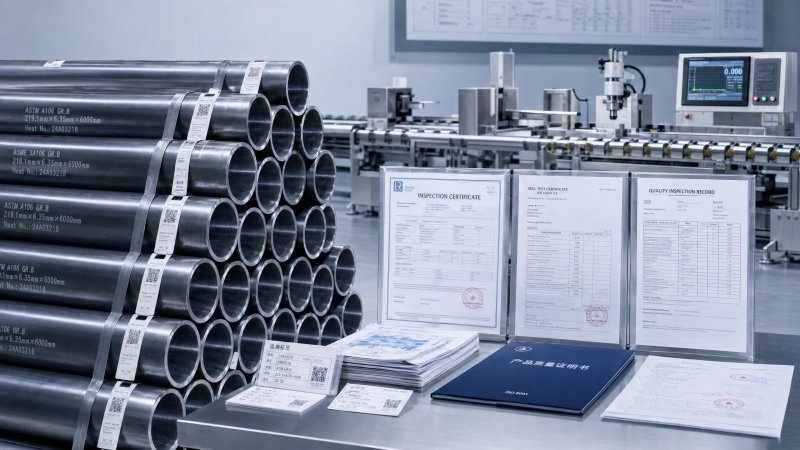
The most important supplier claims are the ones that directly affect project safety, total cost, schedule reliability, and downstream risk. In practice, buyers should focus on six areas first:
- Material grade and standard compliance
- Mechanical and chemical properties
- Dimensional tolerance and product consistency
- Surface condition, coating, and packaging quality
- Lead time, production capacity, and shipping reliability
- Price transparency and hidden cost exposure
If a supplier cannot provide clear and verifiable support in these areas, the risk is not theoretical. It can turn into failed inspections, fabrication delays, claim disputes, rework, or site safety issues.
A simple rule helps: the bigger the project impact of a claim, the stronger the proof you should demand.
How do you verify quality claims instead of trusting sales language?
Quality claims should always be checked against objective records. A reliable steel pipe supplier should be able to provide a document package that matches the exact product being quoted.
Ask for the following:
- Mill Test Certificate (MTC) with heat number traceability
- Chemical composition report
- Mechanical test results such as yield strength, tensile strength, and elongation
- Dimensional inspection report
- NDT or hydrostatic test records where applicable
- Third-party inspection reports if required by the project
- Photos or videos of actual production and marking
For example, if a supplier claims compliance with ASTM A106 Gr B mechanical properties, the report should show test values that align with the specification, not just a statement that the product is “ASTM standard.” If you are reviewing ss pipe specifications, check whether wall thickness, OD, length, straightness, and end finish are listed clearly. Vague specifications are a common source of dispute later.
Quality managers and technical evaluators should also verify whether the test reports are batch-specific or simply reused templates. The presence of heat numbers, dates, inspector signatures, and consistent values across documents can reveal a lot.
What proof should you ask for when a supplier claims compliance with ASTM, EN, JIS, or GB?
Standard compliance is one of the most commonly overstated claims in steel sourcing. A supplier may say a product is “made to ASTM” while only partially meeting dimensional, chemical, or testing requirements.
To verify compliance, request evidence at three levels:
- Manufacturing capability evidence
Factory certifications, process flow, equipment list, and quality control procedures. - Product-level evidence
MTCs, inspection reports, and sample markings that show the actual standard, grade, size, and heat number. - Delivery-level evidence
Packing list, labels, and shipment records proving the same compliant goods are what will actually be shipped.
This matters not only for pipes but also for related construction steel products. For instance, when evaluating reinforcement materials, buyers should apply the same discipline. If a supplier offers Wire rod for civil engineering construction, houses, bridges, roads, railways, foundations, beams, columns, walls, slabs, and rebars, they should still verify grade, size, surface treatment, tolerance, and certification support. Claimed compliance with standards such as BS4449-2005, JIS G3112-2004, ASTM A615-A615M-04a, ISO, SGS, or BV should be tied to actual reports, not catalog text.
Where the order is high-value or project-critical, third-party pre-shipment inspection is often worth the cost.
How can buyers check whether pricing is really competitive?
Low quoted price does not automatically mean low total procurement cost. Buyers should verify what the quote includes and what may be missing.
Ask these questions:
- Is the grade exactly the same as the comparison quote?
- Are wall thickness and tolerances equivalent?
- Does the price include coating, beveling, cutting, bundling, or marking?
- What inspection costs are included?
- What are the packing standards?
- Is the delivery term FOB, CFR, CIF, DDP, or EXW?
- Are there minimum order quantity or overproduction conditions?
- What is the payment structure and financial risk exposure?
A realistic quote comparison should include raw material grade, processing, testing, packaging, logistics, customs impact, and expected rejection risk. A cheap offer that leads to delayed delivery, failed testing, or inconsistent dimensions is rarely the lowest-cost option.
Finance approvers and business evaluators should especially review currency terms, payment terms, claim handling conditions, and penalties related to delay or nonconformance.
What delivery and capacity claims should be verified before placing a large order?
Lead time is often promised too easily. Buyers should not only ask when goods can ship, but why that schedule is credible.
Request proof such as:
- Monthly production capacity
- Current production loading
- Recent shipment records for similar products
- Typical production cycle by size and grade
- Port arrangement and logistics plan
- Contingency plans for raw material fluctuation or equipment downtime
For project managers, dependable delivery is often more valuable than a slightly lower unit price. If the steel arrives late, site work, fabrication, labor scheduling, and contractual milestones may all be affected.
A good supplier should be able to explain:
- Which production line will handle your order
- How long raw material preparation takes
- How inspection is scheduled
- When export packing is completed
- How shipment timing is controlled
If the answers remain generic, the schedule promise may not be reliable.
How do engineers and QC teams reduce technical risk during supplier evaluation?
Technical and quality teams should build a pre-order verification checklist instead of reviewing each quote informally. The checklist should cover:
- Standard and grade confirmation
- Mechanical property validation
- Chemical composition review
- Dimensional tolerance review
- Surface and coating requirements
- End-use suitability
- Marking and traceability requirements
- Testing scope and acceptance criteria
- Packing and corrosion protection
- Nonconformance and claim response process
This is particularly important for projects where multiple steel products are sourced together, such as pipes, structural sections, steel plate for construction, and reinforcement products. Consistency in documentation and traceability across categories reduces overall project risk and simplifies quality control during receiving inspection.
If possible, ask for a pre-production sample, a previous batch MTC, or photos of warehouse stock with visible markings. These simple checks often expose mismatches between marketed claims and actual execution.
What warning signs suggest a steel supplier may not be reliable?
Some warning signs appear long before any contract is signed. Be cautious if you see these patterns:
- Quotations with incomplete technical details
- Reluctance to provide MTCs or test reports
- Documents that look generic or inconsistent
- Unusually low prices without a clear explanation
- Lead times that seem disconnected from market reality
- Frequent changes in contact person or company details
- Weak response to traceability, inspection, or claims questions
- No clear explanation of manufacturing origin
For distributors, project buyers, and enterprise decision-makers, these signs usually indicate either capability gaps, trading opacity, or unstable supply control. None of those are ideal if your project depends on predictable quality and delivery.
What does a practical supplier verification process look like?
A workable process does not need to be complicated, but it should be disciplined. A typical evaluation sequence is:
- Clarify the exact technical requirement
Grade, size, standard, coating, tolerance, testing, end use, and packing. - Request a formal quotation with full specification
Make sure all assumptions are written. - Collect proof documents
MTC, certifications, inspection records, shipment references, and product photos. - Cross-check documents
Ensure consistency between quote, certificates, standards, and markings. - Assess commercial terms
Payment, Incoterms, lead time, claim terms, and liability handling. - Evaluate supply reliability
Capacity, previous exports, communication quality, and responsiveness. - Use third-party inspection if needed
Especially for large or specification-sensitive orders. - Approve a trial order or phased order
Reduce risk before full-volume commitment.
This approach helps procurement teams move from promise-based purchasing to evidence-based sourcing.
Why proof-based sourcing creates better business outcomes
Requiring proof is not about mistrust. It is about protecting project performance. Verified supplier claims help buyers:
- Reduce rejection and rework risk
- Improve budget predictability
- Prevent schedule disruption
- Strengthen compliance and audit readiness
- Make internal approvals easier
- Build long-term supplier confidence based on facts
For global buyers sourcing from China or other export markets, this matters even more. Distance increases the cost of error. The right supplier is not the one making the strongest claims, but the one that can prove them clearly and consistently.
Before ordering, treat every major steel pipe supplier claim as a checkpoint. Verify quality with test records, confirm standards with traceable documentation, examine price beyond the headline number, and test delivery promises against real capacity evidence. Whether you are reviewing ss pipe specifications, validating ASTM A106 Gr B mechanical properties, comparing steel plate for construction, or screening a steel rebar supplier, proof is the foundation of a safe purchasing decision.
The best sourcing decisions come from evidence, not assumptions. If a supplier can prove capability, compliance, consistency, and delivery reliability, you can move forward with far greater confidence.
Please give us a message


Please enter what you want to find