Choosing between steel L angle and aluminum L bracket for coastal projects demands rigorous corrosion resistance evaluation—especially where salt spray, humidity, and chloride exposure accelerate degradation. As a leading structural steel manufacturer & exporter from China, Hongteng Fengda supplies high-grade steel L angle, metal angle iron with holes, L shaped angle steel, and complementary industrial steel pipes—all engineered for durability in aggressive environments. This article compares real-world performance of these materials, helping technical evaluators, procurement teams, and project managers make data-driven decisions on metal wall angle, structural steel pipe, and corrosion-critical applications.
How Corrosion Mechanisms Differ in Coastal Environments
In coastal zones, chloride ions from sea spray penetrate surface oxides and initiate electrochemical reactions. Steel relies on passive oxide layers (e.g., rust) that are porous and non-adherent in high-salinity air—leading to pitting and crevice corrosion within 3–6 months if unprotected. Aluminum forms a dense, self-healing Al₂O₃ layer, but localized breakdown occurs when pH drops below 4.5 or exceeds 8.5—common near concrete or marine biofouling.
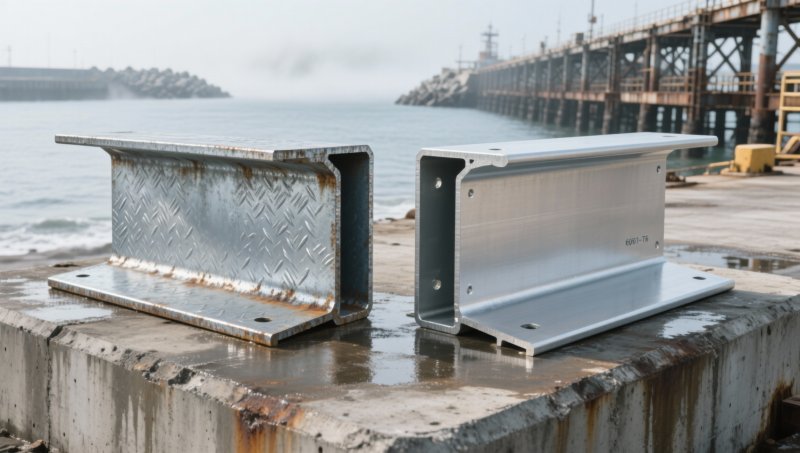
Relative humidity above 70% and temperature cycling between 15°C–35°C further accelerate ion mobility and condensation cycles. Field studies across Southeast Asia show uncoated carbon steel L angles exhibit visible red rust after 90 days at 500 m from shore, while 6061-T6 aluminum brackets retain integrity for 18–24 months—though with measurable galvanic coupling loss when fastened to stainless steel hardware.
Critical thresholds include chloride deposition rates >30 mg/m²/day and annual rainfall >1,200 mm—conditions met in over 60% of major port cities globally. These parameters directly impact material selection for structural steel pipe supports, façade anchoring systems, and marine infrastructure framing.
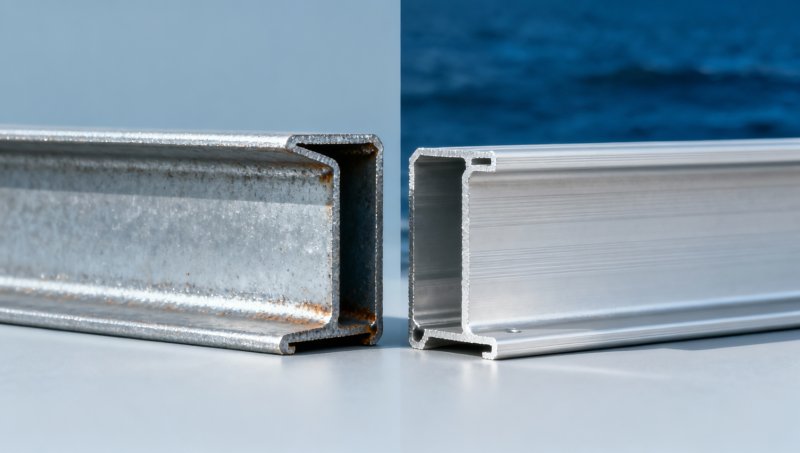
Performance Comparison: Steel L Angle vs. Aluminum L Bracket
The table below summarizes key corrosion resistance metrics under ASTM B117 salt spray testing (5% NaCl, 35°C, continuous fog), aligned with EN ISO 9223 corrosion categories for marine atmospheres (C5-M).
While aluminum offers inherent passivation, its lower galvanic nobility makes it vulnerable when coupled with dissimilar metals—a frequent occurrence in mixed-material façades or retrofit installations. Hot-dip galvanized steel provides predictable sacrificial protection, verified across 12+ years of Hongteng Fengda’s export projects in the Middle East and Mediterranean regions.
When PPGL Steel Sheet Enhances System-Level Durability
For integrated coastal structures—such as prefabricated cladding systems or modular equipment housings—the PPGL Steel Sheet serves as a high-performance complement. Its 55% aluminum–43.4% zinc alloy coating delivers superior barrier protection and thermal reflectivity (≥75% at 300°C), extending service life beyond 25 years in exposed roofing and wall cladding applications.
Procurement Decision Framework for Coastal Projects
Technical and procurement teams should evaluate three core dimensions before finalizing material choice:
- Environmental exposure classification (ISO 9223 C4 vs. C5-M): C5-M requires ≥85 μm Zn coating or equivalent barrier systems
- Design life requirement: Projects targeting >20-year service must account for coating degradation kinetics—not just initial thickness
- Maintenance access constraints: Remote or offshore sites favor low-maintenance aluminum, whereas onshore facilities benefit from cost-effective galvanized steel
Hongteng Fengda supports buyers with ASTM A6/A6M-compliant L angles in grades Q235B, Q345B, and S355JR—including custom punching, bending, and pre-galvanizing services. Lead time for standard sizes is 15–25 days; OEM orders require 30–45 days depending on dimensional complexity and coating specification.
For hybrid solutions, our engineering team routinely integrates PPGL Steel Sheet panels with structural steel L angles in multi-layer envelope systems—reducing thermal bridging by 40% versus all-aluminum assemblies while maintaining Class A fire rating compliance.
Why Global Buyers Choose Hongteng Fengda for Coastal-Grade Structural Steel
As a certified structural steel manufacturer exporting to 32 countries, Hongteng Fengda delivers consistent quality through ISO 9001-certified production lines, third-party mill test reports (MTRs), and full traceability from billet to finished product. Every batch of steel L angle undergoes ultrasonic testing (UT) per EN 10160 and dimensional verification against EN 10056-1.
We support procurement teams with:
- Free sample kits (including coated/uncoated L angles and cut PPGL sheet specimens)
- Custom coating validation reports (Zn thickness mapping, adhesion tests, salt fog results)
- Technical consultation on galvanic compatibility, fastener selection, and installation best practices
Contact us today to request: (1) ASTM/EN-compliant L angle specifications for your coastal project, (2) PPGL Steel Sheet color samples and thermal performance data, or (3) a tailored delivery schedule with CIF terms to your port of discharge.
Please give us a message


Please enter what you want to find