Steel Bar Price vs Grade and Size: What Affects Your Final Cost
When a buyer compares quotations for steel bars, the fastest mistake is to reduce everything to price per ton. On paper, that looks efficient. In practice, it often hides the real cost. Two offers can show a similar steel bar price, yet one includes tighter dimensional control, certified mechanical properties, cleaner chemistry, better packing, and more predictable delivery. The other may only be cheap at the invoice stage.
For project teams working on construction, industrial fabrication, or manufacturing supply, the final cost is shaped by a chain of decisions: grade selection, bar size, applicable standard, processing scope, order quantity, and logistics. If any one of these is misread during evaluation, the gap between quoted cost and landed usable cost can become larger than expected.
That is why procurement reviews need more than a spreadsheet comparison. They need a technical reading of what the supplier is really offering and what risk remains on the buyer side.
Grade changes more than strength — it changes sourcing risk
Steel grade is usually the first driver behind cost differences. A higher grade may require tighter control of chemical composition, stronger mechanical performance, or both. That affects melting practice, rolling control, testing frequency, and certification work. So even before fabrication starts, the cost base has already shifted.
Buyers sometimes assume that upgrading grade is a safe way to “future-proof” a purchase. Not always. If the design only requires a certain performance class, moving to a higher grade can raise cost without creating practical value. In some projects it may also complicate downstream welding procedures, inspection requirements, or approval documents. The right question is not “what is the best grade?” but “what grade meets the project requirement with the lowest total risk?”
This point becomes more important in international sourcing. A supplier working across ASTM, EN, JIS, and GB standards may understand equivalent or near-equivalent grades, but they are not automatically interchangeable. Yield strength, tensile strength, elongation, tolerances, and testing methods can differ by standard. If the quote lists only a familiar trade name without confirming the governing standard, the comparison is incomplete.
Experienced evaluators usually check three things early: the exact grade designation, the standard edition requested by the project, and whether third-party inspection or mill test certificates are part of the supply scope. A lower quotation can become expensive if compliance documents must be chased later.
Size has a direct effect on yield, processing, and availability
Bar size influences price in a more practical way than many non-technical buyers expect. Larger diameters or sections may look cheaper on a per-ton basis because they are more efficient to roll in certain mills. Small sizes, by contrast, can carry higher conversion cost due to production setup, slower rolling, tighter tolerance control, or lower mill productivity.
But size is not just a mill issue. It also affects how much material you actually use. If a design allows multiple size options, choosing a more common size can improve availability and reduce lead time. Choosing a less common one may increase both manufacturing cost and stock risk. This is especially relevant when the order is not large enough to justify a dedicated rolling schedule.
Cut length is another hidden variable. Buyers often focus on nominal bar diameter and forget that random length versus fixed length can materially change price. Fixed lengths create additional cutting, sorting, and packing work. Depending on the project, they can also increase scrap at the supplier end, which will be reflected in the offer.
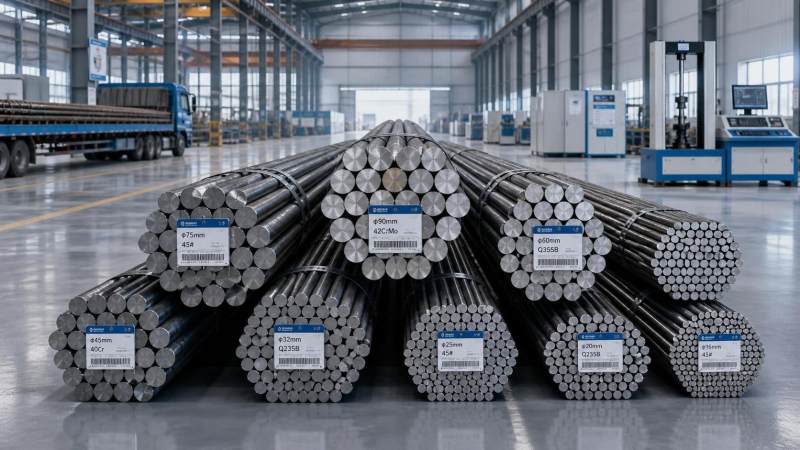
There is also the question of dimensional tolerance. Tight tolerances usually mean more process control and more inspection. If your project really needs that precision, the premium is justified. If it does not, over-specifying tolerance is one of the easiest ways to pay more without noticing it during tender review.
The quoted steel bar price often excludes what buyers actually need
In real purchasing situations, the headline number rarely tells the whole story. A steel bar may be quoted as black finish, ex-works, standard bundling, no machining, no coating, and standard testing only. Another supplier may quote a higher figure but include cutting, drilling, anti-rust treatment, export-worthy packing, and a fuller document package. The second quote may look expensive until the project team calculates internal handling and subcontracting costs.
That is one reason many global buyers prefer suppliers that can combine production discipline with broader structural steel support. A manufacturer serving construction and industrial projects, not just spot traders, is usually better positioned to discuss standard compliance, customized fabrication, and lead-time coordination in one conversation. For importers buying from China, this matters because the cost of a mistake is not local rework only; it can include port delay, replacement freight, and schedule impact on site.
Companies such as Hongteng Fengda, which work with angle steel, channels, steel beams, cold formed profiles, and customized structural components under ASTM, EN, JIS, and GB frameworks, are often evaluated not only on unit price but on whether they can keep product quality and documentation consistent across repeat shipments. For procurement teams, consistency usually matters more than winning one low bid.
A useful cross-check: compare steel bars with other steel forms
One practical way to test whether a quote is reasonable is to compare the cost logic with adjacent steel products. Mid-project buyers often source more than bars alone, and the pricing principles are surprisingly similar. For example, when reviewing Carbon Steel Plate for manufacturing use, the same cost drivers appear again: grade family, thickness range, surface requirement, compliance standard, and processing complexity.
In cold-rolled plate grades such as SPCC, SPCD, SPCE, SPCF, or SPCG, price is not determined only by weight. Chemistry limits become tighter as formability requirements rise. The supplied data may specify carbon as low as C≦0.02 for one grade, while harder tempers can be described through hardness ranges such as 1/8 hard, 1/4 hard, 1/2 hard, or full hard. Width can range from 100 mm to 3000 mm, length from 1 m to 12 m or customized, and thickness from 0.1 mm to 400 mm. Those differences affect rolling route, finishing, and application suitability, whether the plate is used for switchboards, automobile panels, roofs, or formed industrial parts.
The lesson for bar buyers is straightforward: once the material must meet a more demanding forming, strength, surface, or dimensional requirement, the supplier is no longer selling commodity tonnage. They are selling controlled production capability. That is why simple tonnage comparison often fails.
Standards, certification, and test scope can move cost quickly
International projects rarely accept an undefined material basis. Buyers may require compliance with ASTM, EN, JIS, GB, or other referenced standards, sometimes together with ISO-based quality systems or customer-specific inspection procedures. Every extra compliance layer has a cost implication, even when the material itself looks similar.
This does not mean certification is expensive by default. It means the buyer should know what is included. Mill test certificates, heat number traceability, dimensional inspection records, coating records, and third-party witness inspections are not administrative details. They affect release timing, shipment preparation, and supplier workload. If a quotation does not state them clearly, comparison remains uneven.
What experienced buyers usually ask before approving a supplier
A good procurement review is less about squeezing the last dollar from the quote and more about removing ambiguity. A few questions usually reveal whether the price is workable:
- Is the quoted grade tied to a clearly named standard and edition?
- Are size tolerances, fixed lengths, and unit weight assumptions stated?
- Does the offer include processing, coating, marking, and export packing if required?
- What test certificates will be delivered, and when?
- Is lead time based on stock, ongoing production, or a new rolling schedule?
- How will nonconformity be handled if material arrives outside agreed tolerance or documentation scope?
These are not legalistic details. They are cost-control questions. A supplier that answers them clearly is often easier to work with than one offering a slightly lower price with too many open assumptions.
Final cost is usually decided before the order is placed
The market will always move, and steel bar price will continue to fluctuate with raw material trends, production schedules, and freight conditions. But for most business evaluators, the bigger issue is not market volatility alone. It is whether the quote has been normalized well enough to compare like for like.
Grade affects metallurgical control and compliance burden. Size affects rolling efficiency, yield, and availability. Processing, testing, packing, and logistics can shift the real cost just as much as the base material itself. Once that is clear, the cheapest offer is often no longer the lowest-cost option.
If a sourcing decision will support a long-duration construction or industrial program, it is usually worth spending more time on specification alignment and supplier capability review than on negotiating a headline number that may not survive project execution.
Please give us a message


Please enter what you want to find