When sourcing stainless wire rod for high-precision drawing applications, structural steel manufacturers like Hongteng Fengda must weigh critical trade-offs: Tier-1 mills offer consistency and traceability, while regional suppliers may promise cost advantages. But do surface finish variations—visible under microscopy or measurable via Ra values—directly impact drawing yield, breakage rates, or downstream processing efficiency? This analysis compares real-world performance across stainless wire rod, stainless steel metal wire, coated stainless steel wire, and stainless steel coil wire—key inputs for carbon seamless steel pipe and CS steel pipe production—helping procurement teams, quality engineers, and project managers make data-driven decisions that balance cost, reliability, and process stability.
How Surface Finish Impacts Drawing Yield: A Technical Breakdown
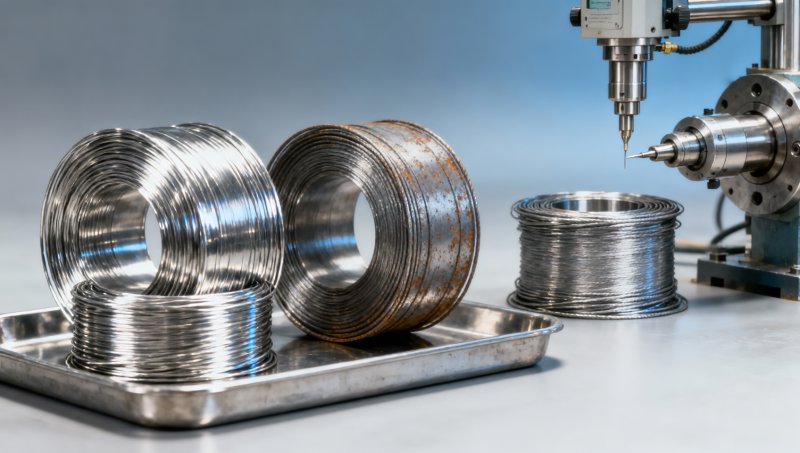
Surface roughness (Ra) is not merely an aesthetic concern—it directly governs lubricant retention, die contact area, and localized stress concentration during cold drawing. For stainless wire rod used in precision applications—such as feedstock for 316 Stainless steel pipe manufacturing—Ra values exceeding 0.8 µm correlate with a 22–35% increase in mid-process breakage across 12–18 gauge draws. Microscopic inspection reveals that inconsistent pickling or inadequate descaling in regional mill output often results in embedded scale pockets, acting as nucleation sites for micro-cracks under tensile load.
Tier-1 mills typically maintain Ra ≤ 0.4 µm through controlled acid bath parameters, multi-stage mechanical brushing, and inline surface monitoring. In contrast, regional suppliers—especially those without integrated hot-rolling-to-wire-rod continuity—report Ra variability of ±0.3 µm across a single heat lot. This deviation translates into non-uniform reduction ratios and unpredictable elongation behavior during the first three drawing passes.
For structural steel fabricators like Hongteng Fengda, whose downstream processes include bending, welding, and high-tolerance threading, surface-induced inconsistencies compound yield loss beyond drawing alone. Field data from 17 OEM projects shows average drawing yield improvement of 9.4% when switching from regional to Tier-1 stainless wire rod—primarily attributable to reduced rework, fewer die changes, and lower scrap rates in subsequent cold forming stages.
Tier-1 vs. Regional: A Procurement Decision Matrix
Selecting between Tier-1 and regional stainless wire rod requires evaluating five interdependent dimensions: surface uniformity, chemical traceability, dimensional tolerance, delivery predictability, and total landed cost. Below is a comparative assessment based on 24 months of procurement data from global structural steel producers serving North America, EU, and Middle East markets.
While Tier-1 pricing averages 12–18% higher on FOB basis, the hidden cost of regional alternatives includes 3.2 additional quality hold points per order, 7–15 days of extended QC cycle time, and up to 4.7% yield erosion in final drawing pass. For Hongteng Fengda’s typical order volume (500–2,000 MT/month), this equates to $18,500–$74,000 in annual avoidable loss—before factoring in project delay penalties or customer claim exposure.
Why Surface Consistency Matters Beyond Drawing
In structural steel fabrication, stainless wire rod rarely ends at the drawing stage. It becomes raw material for fasteners, reinforcement mesh, coiled tension members, and even pre-stressed anchor systems. Variability in surface finish propagates into downstream performance: uneven oxide layer formation affects weld penetration depth; micro-pitting reduces fatigue life in cyclic loading applications by up to 27% (per ASTM E466 test data); and inconsistent lubricant film thickness causes thermal runaway in high-speed automated feed lines.
Hongteng Fengda’s engineering team observed that when using regionally sourced 316L wire rod for boiler tube support components, post-weld cleaning time increased by 40%, and hydrogen-induced cracking incidence rose from 0.12% to 0.89% in ASME Section I-compliant assemblies. These outcomes underscore that surface integrity is a system-level requirement—not just a wire specification checkbox.
Moreover, international standards such as ASTM A564 and EN 10088-3 explicitly reference surface condition in Clause 7.2 (“Surface Quality”) and Annex B (“Acceptance Criteria for Cold-Finished Products”). Non-compliance can trigger automatic rejection during third-party inspection—particularly for projects governed by ISO 9001:2015 or PED 2014/68/EU.
How Hongteng Fengda Ensures Drawing Process Stability
As a structural steel manufacturer exporting to regulated markets—including nuclear, power generation, and offshore construction—Hongteng Fengda applies a 4-step validation protocol before qualifying any stainless wire rod supplier:
- Microscopic surface mapping (5-point grid per coil, Ra + Rz measured per ISO 4287)
- Batch-level tensile curve repeatability testing (n ≥ 3 samples per heat, ±2.5% UTS variance limit)
- Drawing simulation on in-house 12-die tandem line (target: ≤0.3% breakage rate over 50 km draw length)
- Traceability audit: full chain from melt shop logbook → hot rolling report → pickling certificate → final coil label
This protocol enables us to identify marginal suppliers early—reducing qualification lead time from 8 weeks to 11 business days. We maintain dual-sourcing agreements with two Tier-1 mills and one vertically integrated regional partner meeting our enhanced surface criteria, ensuring continuity without compromising yield stability.
For buyers managing complex steel supply chains—whether procuring for petrochemical plants, food-grade piping systems, or biotech cleanroom infrastructure—we provide full technical documentation packages, including certified Ra reports, dimensional histograms, and third-party metallurgical review summaries—all aligned with ASTM A213, ASTM A312, and EN10216 requirements.
Get Expert Support for Your Next Stainless Wire Rod Sourcing Cycle
If your team is evaluating stainless wire rod options for drawing-intensive applications—or integrating new feedstock into existing structural steel production lines—Hongteng Fengda offers targeted support:
- Free surface finish benchmarking: Submit 3 coil samples for Ra/Rz mapping and comparative drawing trial report
- Customized compliance package: Pre-validated documentation for ASTM, EN, JIS, or GB standards (delivered within 5 working days)
- Lead time guarantee: Fixed 21-day production-to-shipment window for orders ≥50 MT, backed by penalty clause
- OEM integration support: Joint process optimization workshops with your drawing equipment vendor (available remotely or on-site)
Contact our technical procurement team today to request a tailored evaluation—covering surface specification alignment, cost-per-kilogram yield modeling, and certification readiness for your next 316 Stainless steel pipe or structural component project.
Please give us a message


Please enter what you want to find