Stainless steel sheet supplier MOQs hide real cost per usable square meter
When evaluating a stainless steel sheet supplier, minimum order quantities (MOQs) often mask the true cost per usable square meter—especially for buyers sourcing structural steel from China. As a certified stainless steel sheet manufacturer and steel beam manufacturer, Hongteng Fengda helps procurement professionals, project managers, and technical evaluators cut through pricing illusions by offering transparent, volume-flexible quoting—covering stainless seamless pipe, seamless stainless steel tube, galvanized steel plate, angle steel price benchmarks, and more. Our ASTM/EN-compliant solutions support global construction and industrial projects without hidden yield losses or markup traps.
Why MOQs Distort Your Real Cost Per Usable Square Meter
Many stainless steel sheet suppliers quote low per-kg or per-sheet prices—but impose rigid MOQs (e.g., 5+ tons or 200+ m²) that force buyers to accept excess material, extended lead times, or costly storage. Worse: those MOQs rarely account for real-world usability. In structural applications—like cofferdams, marine foundations, or load-bearing cladding—cutting, welding, edge trimming, and interlock compatibility reduce net usable area by 8–15%. A “100 m²” order may deliver only 86–92 m² of fully installable surface. That’s not inefficiency—it’s an unpriced yield loss baked into the MOQ.
For project managers and procurement teams, this means budget overruns on site, delayed schedules due to rework, and inflated landed costs per functional unit—not just per ton. And when your supplier doesn’t disclose standard mill tolerances, flatness deviations, or interlock alignment variances upfront, those hidden variables compound the cost-per-usable-square-meter gap.
How Structural Steel Buyers Can Calculate True Usable Yield
Start with three non-negotiable inputs:
- Mill tolerance allowance: EN 10029 Class B (±0.15 mm for ≤3 mm thickness) directly impacts flatness—and therefore how much sheet can be used without pre-straightening or rejection.
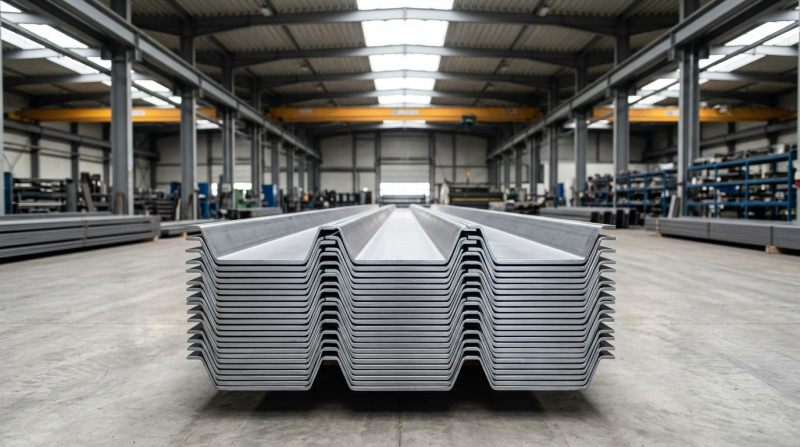
- Cutting & fabrication loss: For Steel Sheet Piles, cold-rolled interlocks require precise width control; even ±1.5 mm deviation across a 600 mm flange wastes ~0.25% of total surface area per pile—and multiplies across hundreds of units.
- Interlock compatibility margin: S355-grade piles with Larssen locks must maintain consistent web thickness (±0.2 mm) to avoid gapping or binding during driving. Suppliers who batch-mix heats without traceability increase field rejection risk—and effective cost per installed meter.
We recommend calculating “usable yield” as: (Ordered area − [trim waste + tolerance-related scrap + interlock mismatch loss]) ÷ Ordered area. At Hongteng Fengda, we provide yield-loss projections per order—based on your exact grade (S275, S355, ASTM A690), interlock type, and dimensional specs—before quotation. No assumptions. No surprises.
What Transparent, Project-Ready Quoting Actually Looks Like
Transparent quoting isn’t about lowering headline prices—it’s about aligning pricing with your project’s physical and logistical reality. At Hongteng Fengda, every stainless steel sheet and structural steel quote includes:
- A clear breakdown of base material cost per usable m²—not just per ton—calculated using your required thickness, width, and finish;
- Yield-loss adjustment based on your application (e.g., deep-water cofferdam vs. dry-land retaining wall);
- No forced MOQs: We support orders from 10 m² to full-container loads—with no penalty for smaller volumes, because we optimize cutting plans across shared production runs;
- Pre-shipment dimensional verification reports (including interlock gap testing for Steel Sheet Piles)—so you know exactly what arrives, before it ships.
This approach reduces total cost of ownership—not just purchase price—for decision-makers managing multi-phase infrastructure builds, OEM equipment integrators needing repeatable tolerances, and distributors balancing inventory turnover with project demand spikes.
Conclusion: Stop Paying for Square Meters You Can’t Use
MOQs are not neutral logistics thresholds—they’re pricing levers that obscure true value. When sourcing stainless steel sheets or structural components like Steel Sheet Piles for demanding applications (deep-water construction, high-strength cofferdams, reusable systems), what matters isn’t how much you order—but how much you can reliably install, weld, drive, or reuse without rework. Hongteng Fengda eliminates the guesswork: we quote per usable square meter, validate yield assumptions with mill data and real-world test reports, and scale flexibility to your project—not our production schedule. Because in structural steel, efficiency isn’t measured in tons ordered. It’s measured in meters installed, on time, on budget, and on spec.
Please give us a message


Please enter what you want to find