Stainless Steel Sheet Manufacturer Certifications You Can’t Verify by Email Alone
When evaluating a stainless steel sheet manufacturer—or any structural steel supplier like Hongteng Fengda—you can’t rely solely on email-verified certifications. True due diligence requires cross-checking ISO, ASTM, EN, and GB compliance against third-party audit reports, mill test certificates (MTCs), and physical product traceability. Whether you’re sourcing stainless seamless pipe, steel plate galvanized for corrosion resistance, or structural steel welding components, unverified claims risk project delays, safety nonconformance, or costly rework. As a trusted stainless steel sheet supplier and Steel Beam manufacturer serving global buyers, we ensure every certification—from seamless stainless steel tube standards to angle steel price transparency—is physically auditable, not just email-attested.
Why “Email-Verified” Certifications Are Meaningless—And What Actually Matters
Email confirmation of a certification is functionally equivalent to receiving a signed letter claiming your car meets crash-test standards—without seeing the actual IIHS report or crash video. For procurement teams, project managers, and quality assurance leads, this isn’t due diligence—it’s delegation of risk. What matters is *evidence*, not attestation: third-party audit reports dated within the last 12 months, MTCs with batch-specific chemistry and mechanical test results, and traceable heat numbers linking your order directly to certified production runs.
This is especially critical when sourcing Steel Plate Galvanized, where zinc layer uniformity, base steel grade integrity, and coating adhesion directly impact service life in aggressive environments—from coastal infrastructure to chemical processing plants. A DX53D sheet stamped “EN 10346 compliant” means nothing unless the MTC shows Zn coating mass at 185 g/m² ±10% *and* tensile strength measured at 320 MPa—not just “within spec range.”
The 4 Certifications You Must Physically Cross-Check (Not Just Accept)
1. ISO 9001:2015 — Look Beyond the Certificate Number
The certificate number proves registration—not capability. Demand the latest surveillance audit report from the certifying body (e.g., SGS, TÜV, BV). Check for: (a) scope explicitly listing “hot-dip galvanized steel sheets,” (b) non-conformities closed with evidence, and (c) auditor observations on traceability systems. At Hongteng Fengda, our ISO 9001 scope covers the full galvanizing line—including bath chemistry monitoring logs and post-coating thickness mapping per EN ISO 1461.
2. ASTM A653 / A792 — MTCs Must Match Your Order’s Exact Grade & Coating
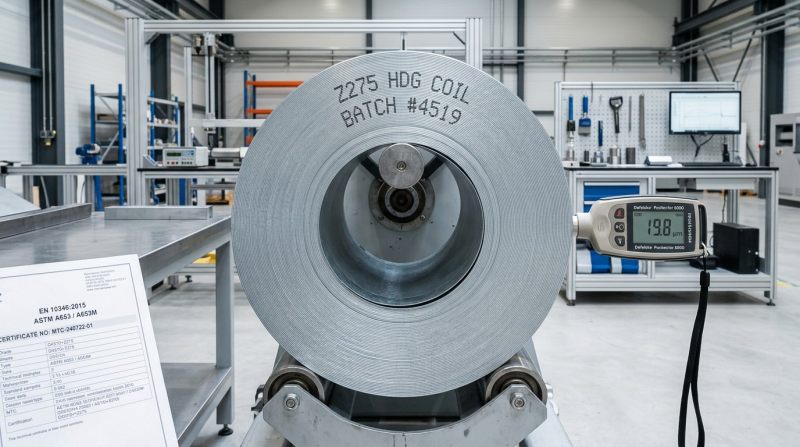
Receiving an MTC labeled “ASTM A653 SS Grade” is insufficient. For Steel Plate Galvanized, verify the MTC lists: (i) your exact grade (e.g., DX54D, S350GD), (ii) coating type (Z = pure zinc, AZ = 55% Al-Zn), (iii) coating mass (e.g., Z275 = 275 g/m² total), and (iv) mechanical properties tested on *your batch*. We issue MTCs with QR-coded heat numbers—scannable to view raw lab data from our in-house testing lab (accredited to ISO/IEC 17025).
3. EN 10346:2015 — Confirm Batch-Specific Corrosion Test Records
EN compliance requires salt-spray test validation (ISO 9227) for each coating type. Ask for the test report referencing your order’s coating mass and substrate grade. Generic “EN compliant” statements are red flags. Our DX53D and S320GD sheets undergo mandatory 96-hour neutral salt spray testing; reports show zero red rust at 72 hours for Z275-coated batches—data you’ll receive with shipment.
4. GB/T 2518–2019 — Traceability to Chinese Mill Production Logs
For buyers requiring dual compliance (e.g., EU projects using Chinese-sourced material), GB/T 2518 certification must be tied to physical mill logs—not just translation. Verify the GB certificate includes the same heat numbers as your MTC and references furnace temperature profiles and cooling rates logged during production. This ensures mechanical property consistency—critical for S550GD high-strength galvanized sheets used in load-bearing structures.
What You Should Do Next—A Practical 3-Step Verification Checklist
Don’t wait until PO approval. Before finalizing any stainless steel sheet or galvanized steel supplier:
- Request the last 3 months’ third-party audit reports—not just the ISO certificate—and confirm scope matches your product category (e.g., “cold-rolled, hot-dip galvanized steel sheets up to 6.0 mm thick”).
- Require pre-shipment MTCs with heat numbers before production starts—and validate those numbers against your order. Reject any MTC missing yield/tensile/elongation values *or* coating mass verification.
- Verify physical traceability: Can you scan a QR code on the coil tag and see real-time galvanizing bath temperature, immersion time, and post-coating thickness map? If not, you’re relying on paper—not process control.
At Hongteng Fengda, every Steel Plate Galvanized order ships with a digital dossier: MTC + mill log excerpt + salt-spray report + traceability QR code. No email attestations. No generic certificates. Just auditable, batch-specific proof—because your project’s timeline, safety, and budget depend on it.
Bottom Line: Certification Is Evidence—Not a Checkbox
“Certified” means nothing without verifiable, batch-linked, third-party-validated evidence. For technical evaluators, procurement managers, and EPC project leads, the real signal isn’t whether a supplier *has* ISO or ASTM certs—it’s whether they let you *see* how those standards are enforced in real time, on your specific material. When sourcing stainless steel sheets or galvanized structural components, prioritize suppliers who treat certification as operational transparency—not marketing collateral. That’s how you eliminate rework, avoid compliance surprises, and build trust that lasts beyond a single order.
Please give us a message


Please enter what you want to find