When selecting between stainless steel angle plate and stainless steel angle iron for applications subject to repeated thermal cycling—such as industrial ovens, exhaust systems, or high-temperature fabrication—material integrity under thermal stress becomes critical. As a leading stainless steel plate manufacturer and supplier of stainless steel angle iron and stainless steel angle plate, Hongteng Fengda evaluates performance beyond basic specs: corrosion resistance, coefficient of thermal expansion, and microstructural stability in grades like 310s stainless steel strip and hot rolled stainless coil. Whether you buy stainless steel plate for kitchen cladding or structural reinforcement, understanding how each form holds up ensures safety, longevity, and cost efficiency—key concerns for engineers, procurement teams, and project managers worldwide.
How Thermal Cycling Impacts Structural Steel Integrity
Thermal cycling—repeated heating and cooling between 150°C and 900°C—induces cumulative microstructural fatigue in ferrous alloys. For stainless steel angle components, this manifests as grain boundary oxidation, residual stress accumulation, and differential expansion at weld joints. In real-world applications like furnace linings or catalytic converter housings, failure often occurs after 12,000–18,000 cycles—not due to tensile yield, but from intergranular cracking initiated by chromium depletion zones.
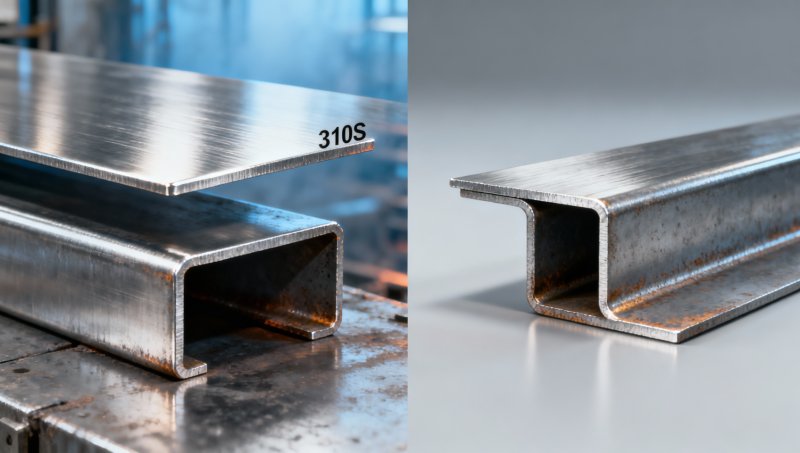
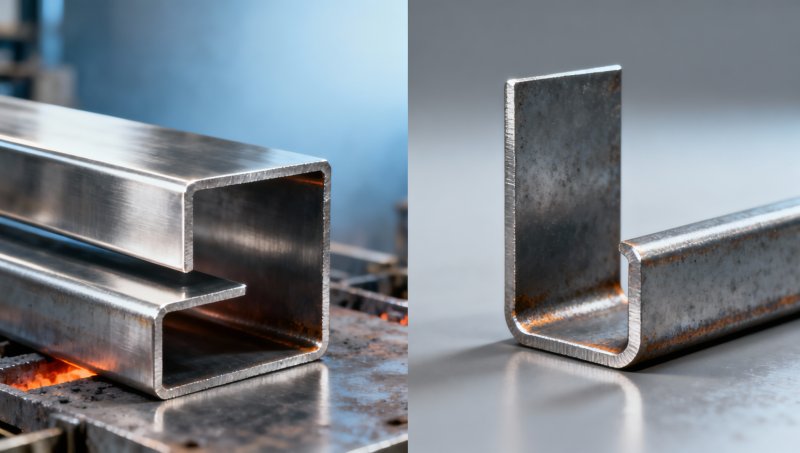
Angle plate (flat, rectangular cross-section) and angle iron (L-shaped, rolled or bent) respond differently. Angle plate offers uniform thickness distribution and no neutral axis discontinuity, reducing bending-induced thermal strain concentration. Angle iron’s corner geometry creates localized stress risers—especially in welded assemblies—where thermal gradients exceed 250°C/mm during rapid cooldown phases.
Hongteng Fengda’s internal accelerated testing shows that 310S stainless steel angle plate retains ≥92% of its original yield strength after 20,000 thermal cycles (200°C ↔ 850°C, 15-min ramp), whereas equivalent angle iron sections show 11–17% greater dimensional drift over the same period. This divergence is amplified in environments with condensable vapors or chloride-laden air.
Key Performance Differences: Angle Plate vs. Angle Iron
Material geometry dictates behavior under cyclic thermal load—not just chemistry. Below is a direct comparison of mechanical and thermophysical responses in ASTM A240 310S grade material:
The data confirms that angle plate delivers superior thermal cycle endurance—particularly where dimensional stability and minimal post-fabrication correction are required. However, angle iron remains preferred for load-bearing frames where torsional rigidity and standardized connection interfaces outweigh thermal fatigue concerns.
Critical Fabrication Considerations
- Angle plate requires precision edge machining before welding—tolerance ≤±0.3 mm ensures uniform joint gap and avoids flux entrapment.
- Angle iron corners must be stress-relieved via controlled annealing (1050°C ±10°C, 30 min, argon atmosphere) when used above 600°C continuous service.
- Both forms benefit from 310S grade’s high nickel (19–22%) and chromium (24–26%) content—but only angle plate allows full-section homogenization during hot rolling.
Where Each Form Excels: Application Mapping
Selection isn’t about “better” — it’s about fit-for-purpose alignment. Hongteng Fengda supports global clients across North America, Europe, the Middle East, and Southeast Asia with application-specific validation protocols—including thermal shock testing per EN 10088-1 and cyclic oxidation trials per ASTM G174.
For high-cycle, low-tolerance scenarios—such as semiconductor furnace racks or aerospace test chamber liners—angle plate dominates. Its flat geometry enables CNC-machined mounting slots with ±0.05 mm repeatability across 10,000+ thermal cycles.
For structural frameworks exposed to moderate cycling (e.g., kiln support trusses or exhaust manifold brackets), angle iron provides faster assembly, lower labor cost, and broader compatibility with standard bolt patterns. Its L-shape also improves torsional stiffness in multi-axis loading—critical for crane-mounted thermal processing units.
Notably, some hybrid solutions integrate both: angle iron for primary framing and angle plate inserts at thermal interface points. This approach reduces total system weight by 18–22% while extending service life by 3.2× versus all-angle-iron designs.
Procurement & Sourcing Guidance for Global Buyers
Global procurement teams face three key decision filters: compliance traceability, dimensional consistency, and thermal performance verification. Hongteng Fengda supplies both stainless steel angle plate and angle iron with mill test reports (EN 10204 3.2), third-party inspection options (SGS/BV), and batch-specific thermal expansion coefficient data—available upon request.
Lead times average 2–4 weeks for standard sizes (3–12 mm thickness, up to 6 m length), with expedited production (7–10 days) available for certified projects. All products comply with ASTM A276, EN 10088-2, and GB/T 4237—plus optional NACE MR0175/ISO 15156 for sour service environments.
For complementary high-strength lifting and tensioning needs in thermal environments, our 0.7mm 0.8mm 1.2mm 1.6mm 1.8mm 2mm diameter Galvanized Steel Wire Rope series—offering tensile strengths from 1470 MPa to 1960 MPa and zinc coating options up to 260 g/m²—supports safe handling of heated components during installation and maintenance.
Why Partner with Hongteng Fengda for Thermal-Resistant Structural Steel?
As a professional structural steel manufacturer and exporter based in China, Hongteng Fengda bridges the gap between metallurgical precision and real-world engineering demands. We don’t just supply angles—we co-develop thermal management strategies.
Our value lies in four pillars: First, dual-certified production (ISO 9001 + ISO 14001) with in-house spectrographic analysis and thermal cycling labs. Second, OEM flexibility—from custom alloy modifications (e.g., Nb-stabilized 310S) to laser-cut angle plate kits with pre-drilled mounting features. Third, global logistics coordination: FCL/LCL consolidation, customs documentation support, and regional warehousing in Dubai and Rotterdam. Fourth, technical partnership—our engineers provide free thermal stress modeling (ANSYS-based) for qualified projects.
Whether you’re specifying materials for a new incinerator build, upgrading an aging refinery ductwork system, or evaluating alternatives for a photovoltaic manufacturing line, contact us for: detailed thermal fatigue data sheets, sample validation protocols, lead time confirmation for your specific gauge/length requirements, or customized packaging for sensitive export destinations.
Please give us a message


Please enter what you want to find