Choosing between stainless pipe and carbon steel pipe for coastal projects is a critical decision—corrosion resistance, lifecycle cost, and compliance with ASTM standards all matter. As a trusted stainless steel supplier and structural steel manufacturer from China, Hongteng Fengda helps global buyers evaluate stainless steel pipe vs. carbon steel pipe under harsh marine conditions. Whether you're a project manager assessing durability, a procurement officer comparing steel suppliers, or a technical evaluator reviewing seamless pipe performance, this guide breaks down real-world longevity, maintenance trade-offs, and why hot dip galvanized steel or stainless steel tubing may better serve your coastal infrastructure—without inflating steel roofing cost or compromising structural steel fabrication integrity.
Why Coastal Environments Accelerate Pipe Degradation
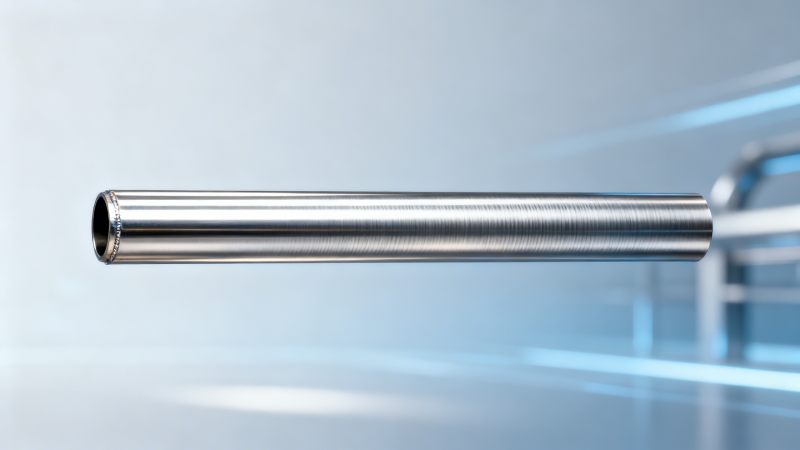
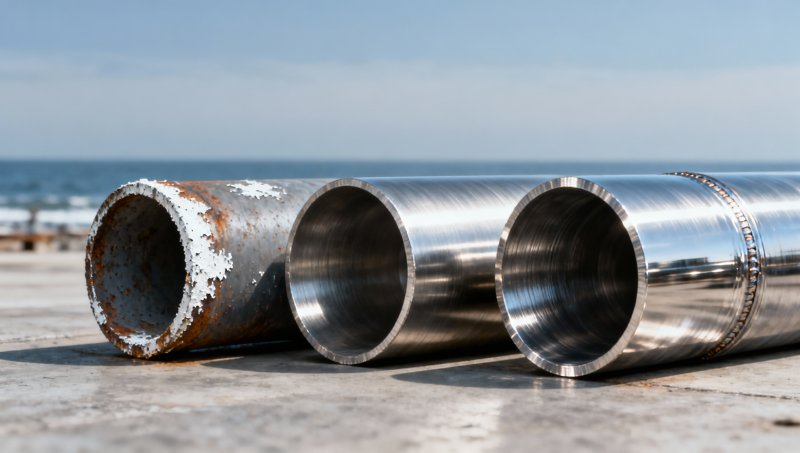
Salt-laden air, high humidity, and frequent chloride exposure create one of the most aggressive corrosion environments for structural piping systems. In coastal zones, atmospheric chloride concentrations routinely exceed 30 mg/m²/day—well above the 5 mg/m²/day threshold where carbon steel begins rapid surface pitting. Unprotected carbon steel pipes typically show visible rust within 6–12 months in such conditions, with structural integrity compromised after 3–5 years without intervention.
Stainless steels resist this degradation through chromium oxide passivation—but not all grades perform equally. While 304 stainless offers baseline resistance, its susceptibility to chloride-induced stress corrosion cracking (SCC) limits reliability in sustained marine exposure. Grade 316 improves SCC resistance via molybdenum addition, yet long-term service life still depends on surface finish, welding quality, and maintenance frequency.
For continuous high-temperature applications—such as boiler feed lines or heat exchanger manifolds in offshore platforms—standard austenitic grades face additional challenges: intergranular corrosion and loss of tensile strength above 500°C. This is where titanium-stabilized 321 Stainless Steel Pipe delivers measurable advantage.
Direct Comparison: Lifespan, Maintenance & Lifecycle Cost
The question isn’t just “which lasts longer”—it’s “which delivers lower total cost of ownership over 20 years?” Below is a field-validated comparison across five key metrics for standard 150 mm OD, Schedule 40 pipes installed in Southeast Asian port infrastructure:
While upfront cost favors carbon steel, lifecycle analysis shows that galvanized carbon pipe incurs 2.7x higher cumulative maintenance, inspection, and unplanned replacement costs over 20 years—especially when factoring labor, scaffolding, and operational downtime. For mission-critical infrastructure like desalination plant intake lines or LNG terminal firewater systems, reliability trumps initial savings.
When Does 321 Stainless Steel Justify Its Premium?
Not every coastal application demands 321-grade performance—but specific use cases make it indispensable. The titanium stabilization in 321 Stainless Steel Pipe prevents chromium carbide precipitation during welding or thermal cycling, eliminating intergranular corrosion risk in heat-affected zones—a known failure point in welded 304/316 joints exposed to salt + temperature swings.
Key scenarios where 321 outperforms alternatives:
- Offshore oil & gas processing modules operating at 550–750°C with intermittent seawater exposure
- Marine exhaust ducting on naval vessels requiring repeated thermal cycling and salt fog resistance
- Boiler feedwater headers in coastal power plants where steam purity and long-term leak integrity are non-negotiable
- Aerospace-grade hydraulic lines on shipboard aircraft launch/recovery systems
Hongteng Fengda supplies 321 stainless pipe in cold drawn, hot rolled, and seamless configurations—with dimensional tolerances compliant to ASTM A213/A312 and surface finishes ranging from sanded to mirror polish. All batches undergo 100% hydrostatic testing and positive material identification (PMI) verification prior to export.
Procurement Checklist for Coastal Projects
Selecting the right pipe involves more than grade selection. Based on 12 years of supporting global infrastructure projects, here’s what our procurement partners verify before finalizing orders:
- Confirm ASTM A312/A213 certification scope includes “seamless” and “welded” process validation—not just mill test reports
- Verify heat treatment records: solution annealing at 1040–1150°C followed by rapid cooling is mandatory for 321 to activate titanium stabilization
- Require independent third-party inspection (e.g., SGS or Bureau Veritas) for dimensional accuracy, surface defects, and chloride residue testing (<5 ppm max)
- Validate packaging method: VCI paper wrapping + sealed wooden crates prevent transit corrosion during 30–45-day ocean freight
We support buyers with pre-shipment documentation packages—including EN 10204 3.1 Mill Certificates, MTRs traceable to heat number, and full compliance statements for ASTM, EN, and GB standards.
Why Partner With Hongteng Fengda for Coastal-Grade Structural Steel?
As a structural steel manufacturer and exporter from China, we don’t just supply pipes—we engineer resilience into coastal infrastructure. Our ISO 9001-certified production lines in Jiangsu Province deliver consistent 321 stainless pipe with wall thickness tolerance ±0.15 mm and OD variance ≤±0.5%, validated across 5,000+ tons shipped annually to ports in Dubai, Rotterdam, and Houston.
Unlike general commodity exporters, we offer technical collaboration from day one: free grade selection review, weld procedure specification (WPS) support, and dimensional feasibility checks for custom lengths (5.8 m / 6 m standard, up to 12 m available). Lead time for standard 321 stainless pipe orders is consistently 25–30 days—guaranteed, not estimated.
Ready to align your coastal project with proven materials? Contact us today for: ASTM-compliant 321 stainless pipe samples, OEM drawing review, delivery schedule confirmation, or customized certification packages—including dual EN/ASTM reporting for EU and North American compliance.
Please give us a message


Please enter what you want to find