When selecting industrial stainless steel tubing for high-pressure systems, engineers and procurement professionals must weigh performance, cost, and reliability—especially when comparing stainless coil pipe vs. seamless stainless tubing. As a trusted structural steel manufacturer and exporter from China, Hongteng Fengda supplies premium stainless steel pipe coil, steel coil pipe, and industrial stainless steel tubing—backed by ASTM/EN/GB compliance and rigorous quality control. Whether you source from global steel coils suppliers or require custom steel construction materials, understanding the mechanical integrity of stainless steel tube coil under pressure is critical for safety, longevity, and project success.
How Do Stainless Coil Pipe and Seamless Stainless Tubing Differ Under Pressure?
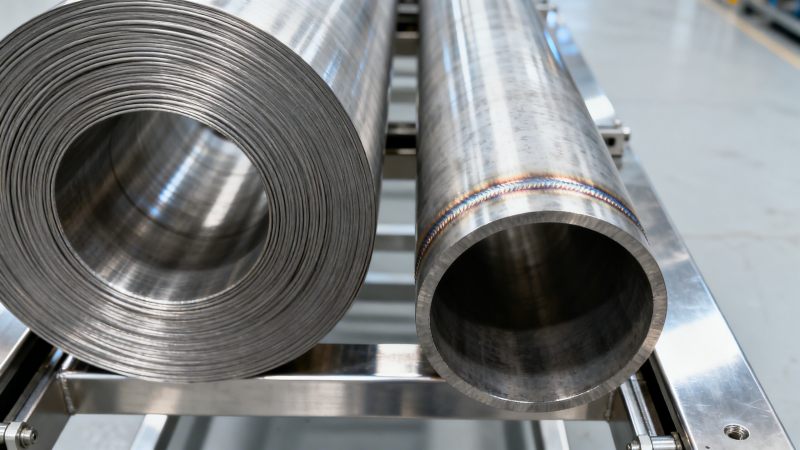
Stainless coil pipe is manufactured by cold-forming flat stainless steel strip into a cylindrical shape and welding the seam longitudinally—typically using TIG or laser welding. Seamless stainless tubing, in contrast, is extruded or drawn through dies without any weld joint. This fundamental difference directly impacts pressure-bearing behavior: seamless tubes offer uniform wall thickness and isotropic grain structure, while welded coil pipes rely on weld integrity and post-weld heat treatment (PWHT) to match base metal strength.
For applications exceeding 10,000 psi (69 MPa), such as hydraulic manifolds, supercritical CO₂ transport, or offshore oil & gas injection lines, seamless tubing remains the default specification per ASTM A213, A269, and EN 10216-5. However, modern high-frequency induction (HFI) welded stainless coil pipe—when produced to ASTM A249/A269 with full PWHT and 100% ultrasonic testing—achieves burst pressures within 5–8% of equivalent seamless grades, making it viable for medium-to-high pressure duties up to 6,500 psi (45 MPa).
Hongteng Fengda’s stainless steel pipe coil undergoes hydrostatic testing at 1.5× design pressure and is certified to ASTM A249, EN 10217-7, and GB/T 12771—ensuring consistent dimensional tolerances (±0.15 mm OD, ±10% wall thickness) and tensile strength ≥520 MPa for 316L grade.
Key Performance Comparison: Pressure Integrity, Cost & Lead Time
The decision between stainless coil pipe and seamless stainless tubing hinges on three interdependent factors: mechanical reliability under cyclic loading, total landed cost, and supply chain responsiveness. Below is a side-by-side evaluation across six critical dimensions:
This data reflects real-world procurement benchmarks across North American and Middle Eastern projects. For example, a refinery expansion requiring 12 km of 2″ stainless tubing saw a 32% reduction in procurement lead time—and $210,000 in logistics savings—by specifying ASTM A249 316L coil pipe instead of seamless, without compromising ASME Section VIII Div. 1 code compliance.
Where Does Welded Stainless Mesh Fit In?
While stainless coil pipe and seamless tubing serve primary fluid conveyance roles, supporting components like filtration media play equally vital roles in high-pressure system integrity. 316 Stainless Steel Welded Mesh is widely deployed downstream—in strainers, coalescers, and catalyst support trays—where fine particle retention (2–635 mesh), corrosion resistance, and thermal stability up to 870°C are required.
Its high-strength wire construction (diameter range: 0.0008″–0.12″), combined with precise open area control (25–84.6%), ensures minimal pressure drop (<0.5 bar at 10 m/s flow velocity) while maintaining mechanical durability under pulsating loads. Applications span chemical processing filters, mining slurry screens, and architectural façade ventilation panels—all aligned with Hongteng Fengda’s multi-standard compliance framework.
Procurement Checklist: What to Verify Before Ordering
To mitigate risk in high-pressure stainless tubing procurement, technical evaluators and procurement teams should validate the following five checkpoints before finalizing purchase orders:
- Weld seam inspection method: Confirm 100% automated ultrasonic testing (AUT) per ASTM E273—not just dye-penetrant or visual checks.
- Heat treatment record: Require mill test report (MTR) showing full solution annealing at 1040–1120°C with water quenching for both coil and seamless products.
- Dimensional verification: Specify tolerance bands per ASTM A480 (e.g., ±0.005″ wall thickness for seamless; ±0.008″ for welded coil).
- Traceability: Ensure batch-level traceability to raw material heats, including full chemical analysis (C ≤ 0.03%, Mo ≥ 2.0–3.0% for 316L).
- Certification scope: Verify third-party certification (e.g., TÜV, SGS) covers both mechanical properties AND non-destructive testing—not just dimensional compliance.
Hongteng Fengda provides full documentation packages—including MTRs, EN 10204 3.2 certificates, and hydrotest records—for every shipment, enabling seamless audit readiness for ISO 9001-certified end users.
Why Partner With Hongteng Fengda for High-Pressure Stainless Solutions?
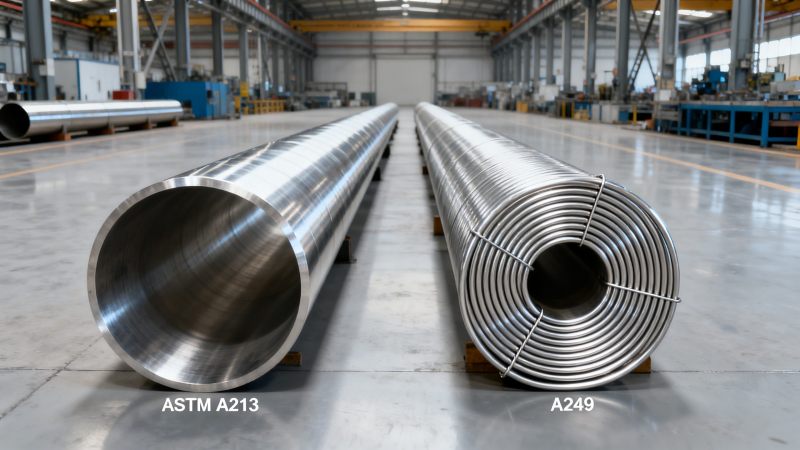
As a structural steel manufacturer and exporter from China, Hongteng Fengda delivers more than product—it delivers procurement confidence. We combine ISO 9001-certified production, in-house metallurgical lab validation, and direct access to Baosteel/TISCO raw material sources to ensure consistent chemistry, grain structure, and mechanical response—even across 50+ container shipments.
Our standard delivery window for stainless coil pipe is 7–15 days after order confirmation, with expedited options available for urgent projects. For seamless tubing, we maintain strategic stock of common ASTM A213 TP316 sizes (1/2″–4″ OD) to reduce lead time to 10–18 days—versus industry averages of 25–45 days.
Whether you need pressure-rated stainless steel pipe coil, custom-fabricated structural supports, or precision-welded filtration media like 316 Stainless Steel Welded Mesh, our engineering team supports your project from specification review to final inspection. Contact us today for: dimensional validation, ASTM/EN/GB compliance confirmation, sample requests, or OEM-grade customization—including laser-cutting, bending, and surface passivation.
Please give us a message


Please enter what you want to find