Stainless Steel Tube Coil vs. Straight Tube: What Really Moves the TCO Needle in HVAC Retrofits
When retrofitting aging HVAC systems—especially in high-value commercial buildings, industrial plants, or constrained urban facilities—the choice between stainless steel tube coil and straight tube isn’t a materials footnote. It’s a project-level cost lever. And yet, procurement teams often default to familiar specs, comparing only nominal wall thickness or grade (e.g., 304 vs. 316), while overlooking how form factor reshapes labor, reliability, and spatial efficiency across the entire lifecycle.
That’s where the real TCO divergence begins—not at the mill certificate, but at the mechanical room door.
Installation Labor: Fewer Joints, Fewer Decisions, Fewer Days
Straight tube requires field cutting, threading, welding, or brazing at every directional change, branch, or termination point. In a typical retrofit of a rooftop unit serving six zones, that can mean 18–25 joints per circuit—each demanding skilled labor, pressure testing, documentation, and rework contingency. Field welds on thin-wall stainless are especially sensitive to heat input, distortion, and post-weld cleaning—adding time and inspection overhead.
Stainless steel tube coil, by contrast, enables continuous runs with minimal interruptions. A single 300-meter coil can service an entire floor without splices—reducing joint count by 60–70% compared to straight tube equivalents. That doesn’t just cut labor hours; it compresses scheduling risk. One North American data center retrofit reported a 3.2-day reduction in piping installation per HVAC zone—translating directly into earlier commissioning and faster occupancy revenue.
But coil isn’t plug-and-play. Its value hinges on consistent dimensional control: uniform OD, precise wall thickness, and tight coiling geometry that feeds smoothly through bending tools and supports clean, repeatable forming. That’s why specifiers increasingly ask for traceable coil—batch-certified to ASTM A269 or EN 10216-5, with full heat lot documentation—not just grade compliance.
Leak Points: Where Reliability Meets Real-World Wear
Every joint is a potential failure vector—not just during hydrotesting, but over decades of thermal cycling, vibration, and maintenance access. In retrofits, many joints sit behind access panels or above suspended ceilings, making leak detection slow and repair disruptive. Industry data (from ASHRAE TC 7.9 field surveys) suggests 68% of HVAC refrigerant leaks in retrofitted systems originate at field-fabricated joints—not at the tube itself.
Coil-based systems shift the failure profile. With fewer joints—and those joints concentrated at major equipment interfaces where inspection and service access are designed in—the long-term probability of unplanned downtime drops measurably. It’s not theoretical: a Middle Eastern hospital retrofit using pre-coiled 316L tubing reported zero joint-related refrigerant loss in its first 27 months of operation, versus three documented incidents in the previous straight-tube system within 14 months.
That reliability advantage compounds when paired with material performance under real conditions—like resistance to chloride-induced pitting in coastal or chemically treated environments. Here, stainless grade matters, yes—but so does consistency. A coil with variable wall thickness or micro-scale surface defects (from inconsistent pickling or annealing) undermines even the best alloy choice.
Space Savings: Not Just Physical Footprint—But Project Flexibility
Retrofit mechanical rooms rarely expand. They shrink—under pressure from tenant demands, code updates, or building repurposing. Straight tube layouts demand generous bend radii, offset allowances, and clearance for wrench rotation. That eats up usable volume fast.
Coil allows tighter, more organic routing—especially with modern mandrel-bent tooling. You can snake around existing ductwork, conduit, or structural beams without adding elbows or expansion loops. One Southeast Asian hotel retrofit reclaimed 1.4 m² of floor space per AHU room by switching to coil—enough to install additional vibration isolation mounts and improve acoustic separation.
That reclaimed space isn’t just square meters—it’s reduced coordination headaches, fewer clashes in BIM models, and lower risk of last-minute design revisions mid-installation.
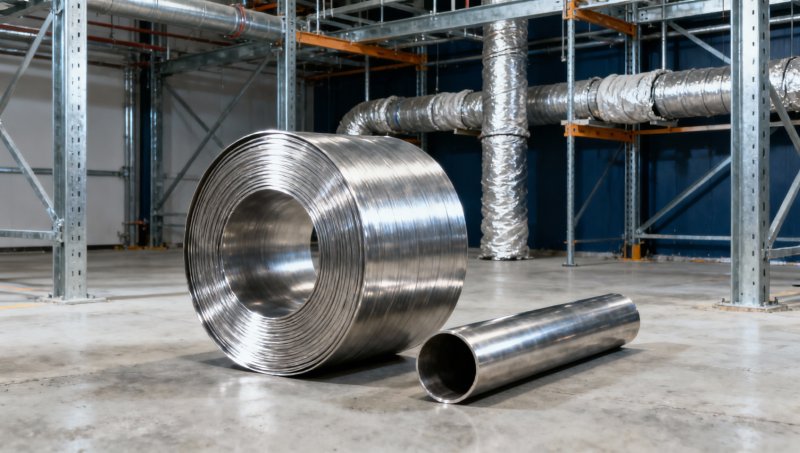
Where Material Consistency Meets Application Reality
None of this works if the coil arrives with inconsistent mechanical properties—or if the supporting structural components don’t match the system’s integrity requirements. For example, mounting brackets, support rails, and seismic bracing must align with the same corrosion resistance, strength class, and fabrication tolerance as the tubing itself.
That’s why integrated sourcing matters. At Hongteng Fengda, our stainless steel production line handles both precision tube coil and structural elements like 310 Stainless Square steel rod—all under unified quality control and certified to ASTM, EN, and GB standards. The square rod’s cold-worked formability and yield strength (≥275 MPa) make it suitable for custom bracketry and load-bearing supports in HVAC enclosures, especially where welding compatibility and surface finish consistency matter across assemblies.
We see this alignment play out repeatedly: projects specifying both coil and structural supports from one source avoid mismatched heat treatments, inconsistent passivation, or delayed handoffs between suppliers. That cohesion reduces QA bottlenecks and accelerates final sign-off.
What to Verify Before Committing—Beyond the Catalog Sheet
If you’re evaluating coil for your next retrofit, look past the grade stamp:
- Ask for actual OD and wall thickness measurements—not just tolerances—from recent production lots.
- Confirm coil packaging includes protective wrapping and end caps rated for marine or humid storage conditions.
- Require batch-specific certs showing tensile, yield, and elongation—not just “meets ASTM A269.”
- Verify minimum bend radius capability for your intended tooling—and whether the supplier validates it with destructive testing.
And remember: coil isn’t universally optimal. Very short runs (<15 meters), applications requiring frequent disassembly, or sites lacking trained coil-handling crews may still favor straight tube—even with higher TCO. Context drives the right call, not dogma.
Final Thought: TCO Starts with Traceability
Total cost of ownership in HVAC retrofits isn’t calculated at the PO stage. It’s revealed in the third-year service log, the fifth-year energy audit, and the unplanned shutdown during peak occupancy. Choosing stainless steel tube coil isn’t about trading upfront cost for convenience—it’s about shifting spend from reactive labor and warranty claims toward predictable, verifiable performance.
For global project managers and procurement leaders, that means partnering with manufacturers who treat coil not as a commodity roll, but as a system-critical component—with controlled metallurgy, documented processing, and engineering continuity across product families. That’s the kind of consistency Hongteng Fengda builds into every coil shipment, every structural profile, and every custom solution we deliver from our facilities in China to construction sites across North America, Europe, and beyond.
If your next retrofit involves tight timelines, limited access, or elevated reliability expectations—start the conversation with parameters, not just part numbers.
Please give us a message


Please enter what you want to find