Choosing between a stainless steel pipe coil and straight pipe depends on pressure, routing, installation speed, and maintenance strategy.
In steel-related projects, the right format affects labor hours, leakage risk, material yield, and lifecycle cost.
A stainless steel pipe coil often performs better where long continuous runs, compact layouts, and reduced fittings matter most.
Straight pipe remains valuable for rigid structures, visible routing, and applications requiring exact linear alignment.
This article explains when stainless steel pipe coil is the better choice and how to specify it with confidence.
Basic Understanding of Stainless Steel Pipe Coil
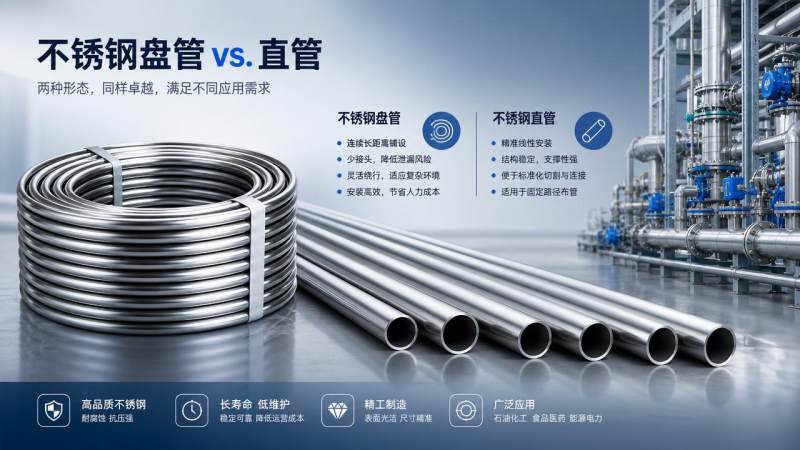
A stainless steel pipe coil is stainless tubing or pipe supplied in wound lengths rather than straight cut sections.
It is commonly used in instrumentation, heat exchange, hydraulic systems, fluid transfer, and compact industrial assemblies.
The main distinction is continuity.
A stainless steel pipe coil can reduce the number of joints across long runs, which directly lowers potential leak points.
Common grades include corrosion-resistant stainless steels selected for temperature, media compatibility, and mechanical demands.
Compared with straight pipe, coiled material also supports easier transport, storage, and field handling in restricted spaces.
Key Format Differences
- Coil favors flexibility and continuous installation.
- Straight pipe favors rigidity and dimensional control.
- Coil often reduces fittings, welding, and connection time.
- Straight lengths simplify supports and visual alignment.
Industry Context and Current Selection Priorities
Across construction, processing, and equipment manufacturing, material format is now evaluated alongside metal grade and wall thickness.
This shift is practical.
Installation labor, shutdown risk, and supply efficiency can outweigh a small difference in unit material price.
As projects seek fewer site welds and faster commissioning, stainless steel pipe coil receives more attention.
In broader steel sourcing, buyers often compare format decisions across multiple materials, not only stainless tubing.
For example, formability and surface quality also matter when selecting sheet products such as Carbon Steel Plate.
Typical grades include SPCC, SPCD, SPCE, SPCF, and SPCG, with widths from 100mm to 3000mm and thickness from 0.1mm to 400mm.
That same specification discipline should guide stainless steel pipe coil decisions as well.
When Stainless Steel Pipe Coil Has a Clear Advantage
A stainless steel pipe coil is not automatically better.
Its advantage becomes clear when geometry, operating conditions, and installation methods reward continuity and flexibility.
1. Long Runs with Minimal Connections
Where fluid lines extend over significant distances, coiled pipe can cover more length without intermediate couplings.
This is useful in chemical dosing, instrumentation lines, refrigeration loops, and hydraulic circuits.
2. Congested Equipment Layouts
Skids, panels, machinery frames, and modular units often require routing around obstacles.
A stainless steel pipe coil allows smoother bends and simpler path adjustment than multiple straight segments.
3. Corrosion-Sensitive Services
When service media can attack weak points, reducing welded or threaded joints improves system integrity.
The fewer the transitions, the lower the risk concentration.
4. Faster Field Installation
Projects with tight schedules benefit from reduced cutting, fitting, and joining work.
A stainless steel pipe coil can shorten assembly time, especially in repetitive layouts.
5. Transport and Storage Efficiency
Long straight sections need more space and careful handling.
Coiled supply can simplify shipping logistics and reduce storage footprint at busy project sites.
Situations Where Straight Pipe Remains the Better Option
Straight pipe still holds clear advantages in many steel system designs.
It should not be replaced by coiled material without checking structural and installation requirements.
- Long exposed pipe racks requiring neat, linear runs
- Large diameters with limited bend practicality
- Systems needing frequent branch connections at fixed intervals
- Applications with strict support spacing and rigid alignment
- Projects where on-site bending control is limited
In these cases, straight pipe can deliver cleaner geometry, easier support design, and more predictable installation results.
Typical Application Categories for Stainless Steel Pipe Coil
The value of stainless steel pipe coil becomes easier to judge when linked to actual operating scenarios.
These examples show that the best use of stainless steel pipe coil is usually functional, not merely aesthetic.
Specification Factors That Should Guide the Decision
A reliable choice between stainless steel pipe coil and straight pipe should be based on measurable project conditions.
Material Grade
Check corrosion exposure, fluid chemistry, temperature range, and cleaning regime before confirming the stainless grade.
Outer Diameter and Wall Thickness
These dimensions influence bendability, pressure capacity, and the practical minimum bend radius.
Coil Length
Longer coils reduce joints, but should still match handling equipment, transport limits, and site installation methods.
Surface and Cleanliness Requirements
Critical systems may need specific surface finish, passivation, or tighter cleanliness controls.
Applicable Standards
Verify product compliance with required ASTM, EN, JIS, or other project specifications before release.
Practical Use and Installation Considerations
Even when stainless steel pipe coil is the right product, poor handling can reduce its benefits.
- Confirm minimum bend radius before field forming.
- Use proper uncoiling methods to avoid twist and flattening.
- Match fittings and joining methods to pressure and media.
- Protect surfaces from contamination during storage and installation.
- Inspect continuous lengths carefully after bending and final routing.
Reliable steel supply also matters.
Hongteng Fengda supports global projects with stable production, strict quality control, and products aligned with major international standards.
This reduces sourcing uncertainty when specification accuracy and delivery consistency are important.
Decision Path for the Next Specification Step
Use stainless steel pipe coil when the system benefits from longer continuous runs, fewer joints, compact routing, and faster installation.
Choose straight pipe when rigid alignment, large size, or structured branching takes priority.
The strongest decisions compare operating media, geometry, labor input, standards, and lifecycle maintenance together.
If a project is evaluating stainless steel pipe coil, prepare a technical list covering grade, dimensions, pressure, bend radius, and installation environment.
That approach leads to a safer and more cost-effective steel system specification.
Please give us a message


Please enter what you want to find