Stainless steel coil price quotes often seem simple at first glance. The number per ton looks clear. The real sourcing picture is usually more complex.
In today’s steel market, volatility, specification shifts, and logistics pressure can quickly change the final payable amount. A low stainless steel coil price may hide meaningful downstream costs.
That is why quote evaluation now matters as much as price negotiation. Clear cost visibility helps reduce disputes, improve budgeting accuracy, and support more stable project execution.
Why stainless steel coil price quotes are becoming less transparent
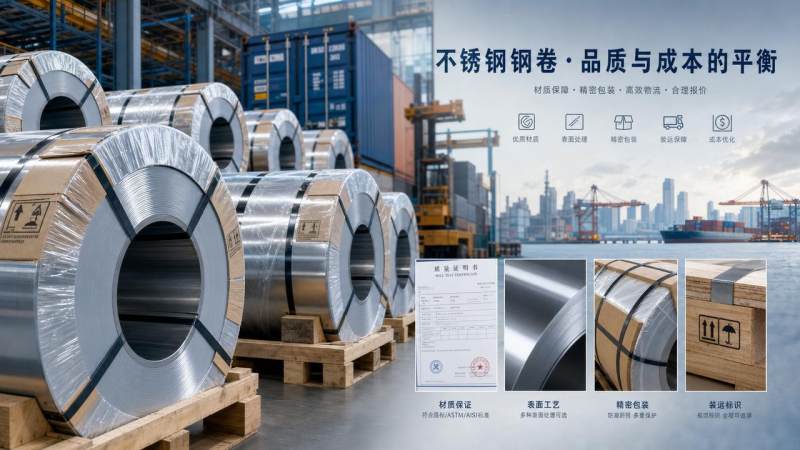
Recent market behavior shows a wider gap between headline offer prices and actual landed costs. This trend is visible across construction, fabrication, equipment, and export-driven steel purchasing.
A quoted stainless steel coil price may cover only base material. It may exclude edge condition, protective film, testing, loading, port charges, or documentation support.
Another change is the growing use of customized requirements. Buyers increasingly request exact width, finish consistency, stricter tolerances, and project-specific packaging.
These details are commercially important. Yet they are not always shown in the first stainless steel coil price sheet, especially when offers are designed to appear highly competitive.
The main signals behind hidden cost growth
Several market forces are driving this pattern. The following factors explain why stainless steel coil price comparisons now require deeper review.
This means sourcing teams should read quotes as dynamic commercial documents, not just product prices. The true decision basis is total delivered value.
Which hidden costs most often change the stainless steel coil price
The most common hidden costs are predictable. They usually appear in six areas, and each can materially alter the stainless steel coil price.
1. Grade and chemistry premiums
304, 316, 310, and duplex-related offers do not move equally. Molybdenum, nickel, and chromium content can create significant price separation.
Some quotes show a reference grade first. Premiums for alternative grades are added later. This can distort early comparison work.
2. Thickness tolerance and width accuracy
Tighter tolerances require more controlled rolling and slitting. Narrow tolerance ranges usually cost more, even when the listed stainless steel coil price looks unchanged.
3. Surface finish and protective treatment
2B, BA, No.4, HL, and customized finishes carry different processing levels. PVC film, interleaving paper, and anti-rust handling may be billed separately.
4. Packaging and loading method
Export-worthy packaging is not always standard. Wooden pallets, steel strapping, waterproof wrapping, and eye-to-sky loading all affect total cost.
5. Testing, certification, and traceability
Mill test certificates may be included. Third-party inspection, PMI testing, or EN and ASTM compliance verification may not be.
6. Freight, destination, and customs-related fees
FOB, CFR, and CIF offers create very different risk profiles. Port congestion, inland delivery, insurance, and destination charges can erase apparent savings.
How these cost shifts affect steel projects and sourcing decisions
When the stainless steel coil price is underestimated, budgets become unreliable. Fabrication schedules may then suffer because approvals, payments, or material substitutions take longer.
Cost surprises also affect internal comparison between stainless steel and structural steel solutions. In some applications, alternate steel sections may offer stronger value alignment.
For example, project planners sometimes compare coil-based fabrication with ready structural sections such as H Shape Beam for load-bearing frames.
Where bending resistance, efficient cross-section design, and simple construction matter, standardized beam options can reduce processing uncertainty and support cost control.
Typical grades include Q235, Q345B, S275JR, S355JR, A572, and A992. Common applications cover steel structures, bridging, shipbuilding, and automobile chassis work.
This does not replace coil sourcing. It highlights a broader trend: buyers increasingly evaluate total fabrication economics, not only the initial stainless steel coil price.
What deserves closer attention before accepting a quote
A disciplined review process reduces hidden-cost exposure. The following checkpoints make stainless steel coil price offers easier to compare on equal terms.
- Confirm grade, standard, and chemistry basis clearly.
- Check thickness tolerance, width tolerance, and coil weight range.
- Verify finish type, film requirement, and edge condition.
- Ask whether packaging is domestic or export standard.
- Clarify included documents and extra inspection fees.
- Review Incoterms, freight validity, and destination exclusions.
- Confirm production lead time and dispatch window.
- Ask how quantity changes affect the stainless steel coil price.
These points are especially relevant when multiple suppliers offer similar headline rates. Small commercial differences often create large final cost differences.
A practical way to compare stainless steel coil price offers
The best comparisons use a normalized quote matrix. This approach reveals which supplier is truly competitive after all variables are aligned.
This framework turns a vague offer into a measurable decision. It also improves internal approval because the stainless steel coil price is presented with full cost logic.
How reliable steel partners help control total cost risk
A strong supplier relationship reduces uncertainty before material reaches the jobsite. Transparency, stable production, and standards compliance matter more than a low opening number.
Hongteng Fengda supports global construction and industrial demand with structural steel manufacturing, export experience, and strict quality control aligned with ASTM, EN, JIS, and GB standards.
Stable capacity and dependable lead times help reduce sourcing risk. This becomes especially valuable when market volatility makes every stainless steel coil price quote time-sensitive.
The same principle applies across steel categories. Whether evaluating coils, sections, or customized components, complete commercial clarity usually outperforms headline price attraction.
What to do next when reviewing stainless steel coil price quotes
Start with a line-by-line cost checklist. Compare all offers on the same grade, finish, tolerance, packaging, inspection, and delivery basis.
Then request written confirmation for every excluded item. This step prevents later disputes and reveals whether the stainless steel coil price is genuinely competitive.
If the project includes mixed steel demand, evaluate material alternatives together. Standardized structural products may reduce fabrication cost and schedule complexity in selected applications.
A smart quote review is not only about buying cheaper. It is about buying with fewer surprises, better compliance, and stronger total project control.
Please give us a message


Please enter what you want to find