Stainless Sheet Metal for Construction: Buying Checks
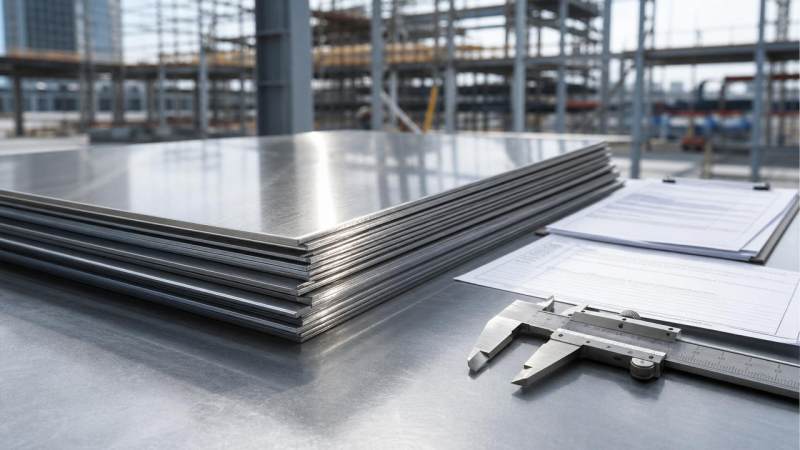
Buying stainless sheet metal for construction requires more than comparing prices or available stock.
Material grade, surface finish, tolerance, certificates, and supplier stability now influence project risk more directly.
The right stainless sheet metal for construction improves durability, lowers maintenance demand, and supports structural and architectural goals.
This buying check guide helps confirm compliance with ASTM, EN, JIS, or GB standards before ordering.
Construction Demand Is Moving Toward Verified Metal Performance
Construction projects increasingly require traceable steel, predictable fabrication quality, and materials suitable for longer service cycles.
This shift affects stainless sheet metal for construction in facades, roofing details, wall panels, drainage systems, and interior finishes.
Price remains important, but low-cost sheets can create welding defects, corrosion issues, or installation waste.
Modern sourcing decisions therefore focus on verified performance, stable supply, and documentation accuracy.
Key Trend Signals In Stainless Sheet Metal Selection
- More projects specify stainless sheet metal for construction by grade, finish, and forming requirement.
- International tenders increasingly request mill test certificates and third-party inspection options.
- Architectural applications demand consistent surface appearance across multiple production batches.
- Coastal and industrial projects pay closer attention to chloride resistance and maintenance cost.
Why Buying Checks Are Becoming More Detailed
The buying process for stainless sheet metal for construction has become more technical.
Supply chains are wider, standards differ by region, and project delivery schedules are tighter.
A small specification error can affect cutting, bending, welding, packaging, or final installation.
Grade Verification Shapes Long-Term Construction Reliability
Grade is the first technical checkpoint when ordering stainless sheet metal for construction.
Common options include 304, 304L, 316, and 316L, each serving different exposure conditions.
304 stainless suits many indoor and general outdoor construction uses.
316 stainless offers stronger resistance in marine, chemical, or high-chloride environments.
For welded parts, low-carbon grades help reduce sensitization risk near weld zones.
Practical Grade Buying Checks
- Confirm chemical composition against the requested stainless grade.
- Check whether equivalent standards are acceptable for the project.
- Review mechanical properties, including tensile strength and elongation.
- Match corrosion resistance to real exposure conditions.
These checks make stainless sheet metal for construction easier to qualify before fabrication begins.
Surface Finish Is Now A Performance And Design Issue
Surface finish affects both visual appearance and practical performance.
For stainless sheet metal for construction, finish selection should consider cleaning, reflection, forming, and installation handling.
Popular finishes include 2B, BA, No.4, hairline, mirror, and patterned surfaces.
Architectural panels often need uniform grain direction and consistent brightness across sheets.
Protective film quality also matters because scratches can appear during transport or site cutting.
Thickness Tolerance Influences Fabrication Cost
Thickness is not only a number on a quotation.
Incorrect tolerance can affect bending radius, welding heat input, fastener design, and panel flatness.
Stainless sheet metal for construction should be ordered with clear thickness, width, length, and tolerance requirements.
Cut-to-size supply can reduce waste when installation dimensions are stable.
However, custom cutting needs reliable dimensional control and careful edge protection.
Dimensional Checks Before Order Confirmation
- Specify nominal thickness and acceptable tolerance range.
- Confirm sheet width, length, and diagonal tolerance.
- Review flatness requirements for visible panels.
- Clarify edge condition for laser cutting or bending.
Material Choice Is Expanding Beyond One Sheet Type
Many construction systems now combine stainless, galvanized, and coated steel according to function.
Stainless sheet metal for construction is preferred where corrosion resistance or appearance is critical.
Galvanized sheet steel may support enclosures, agricultural buildings, transportation parts, appliances, and general construction uses.
For related sourcing, Galvanised Sheet Steel Suppliers can support DX51D, SGCC, S350GD, and S550GD requirements.
Available thickness ranges can include 0.12mm to 6.00mm, with widths from 600mm to 1500mm.
Lengths from 1m to 12m and customized dimensions help align supply with project drawings.
This mixed-material approach helps balance durability, cost, forming performance, and application exposure.
Certification Review Reduces Compliance Risk
Documentation is a core buying check for stainless sheet metal for construction.
A quotation should not be separated from the standard, grade, origin, and inspection records.
Mill test certificates should show heat number, chemical composition, mechanical properties, and applicable standard.
If the project requires ASTM, EN, JIS, or GB, certificates must match that requirement.
Third-party inspection can add confidence for large orders or high-risk environments.
Documents Worth Checking
- Mill test certificate and heat traceability.
- Dimensional inspection report for custom sheets.
- Surface finish confirmation or sample approval.
- Packing list, shipping marks, and export documents.
Supplier Stability Is Becoming A Strategic Buying Factor
A dependable supplier affects more than one shipment.
For stainless sheet metal for construction, stable production capacity supports phased construction schedules and repeat orders.
Hongteng Fengda is a structural steel manufacturer and exporter based in China.
The company supplies angle steel, channel steel, steel beams, cold formed profiles, and customized components.
Its manufacturing and quality control systems support ASTM, EN, JIS, and GB standard requirements.
Export experience across North America, Europe, the Middle East, and Southeast Asia improves delivery coordination.
Supplier Checks That Matter
- Confirm production scope and relevant steel categories.
- Review experience with international construction standards.
- Check lead time reliability and export document accuracy.
- Ask how nonconforming material is handled.
Different Construction Links Feel The Impact Differently
The quality of stainless sheet metal for construction affects design, fabrication, installation, and building maintenance.
Design work depends on predictable strength, finish, and corrosion behavior.
Fabrication depends on stable thickness, forming performance, and weldability.
Installation depends on sheet flatness, packaging protection, and dimensional accuracy.
Maintenance depends on grade suitability and surface cleanability over years of exposure.
Buying Priorities Should Follow Exposure And Function
Not every application needs the same stainless sheet metal for construction.
Indoor decorative panels may prioritize finish consistency and scratch protection.
Outdoor cladding may prioritize corrosion resistance, flatness, and wind-load compatibility.
Drainage or roofing accessories may require formability, weldability, and reliable edge quality.
Core Points To Confirm Before Purchase
- Application environment, including humidity, pollution, chemicals, and salt exposure.
- Required stainless grade and acceptable equivalents.
- Surface finish, grain direction, and protective film type.
- Thickness, sheet size, tolerance, and flatness.
- Certificates, inspection requirements, and packing standards.
A Practical Response Plan For Future Orders
Future orders of stainless sheet metal for construction should be planned with clearer technical communication.
Early confirmation reduces rework, delays, and disputes after shipment.
Conclusion: Better Checks Create Safer Steel Sourcing
Stainless sheet metal for construction is becoming more specification-driven and performance-focused.
Grade, finish, tolerance, certificates, and supplier capability should be reviewed together.
This approach helps control sourcing risk, reduce maintenance uncertainty, and support stable project delivery.
For structural steel and customized project supply, Hongteng Fengda provides reliable manufacturing and export support from China.
Share drawings, standards, quantities, and delivery expectations to receive a practical steel solution for upcoming construction needs.
Please give us a message


Please enter what you want to find